Bob Schwartz

December 10, 1968: The Death of Thomas Merton

Thomas Merton died on this date in 1968. It was an untimely and unusual death, and happened on the anniversary of his entering the monastery in 1941.

He was traveling in Asia at the time. We are fortunate to have not only his many books, but also seven volumes of his journals. At that moment, he was intensifying his long-time interest in Asian religions, particularly Buddhism.

Merton readers and students—and there are millions—see in his later writings and testimony of others suggestions that at the time of his death he was planning to leave the monastery and pursue (return to) a more worldly life. If I ever participated in that speculation, maybe a more mature spiritual life has made me realize the question is pointless. Not just because we will never know, but because for someone as spiritually rich and talented as Merton, and so generous with his spiritual wealth, doubts and all, it is beside the point.

Here is the last journal entry before he died:


December 8, 1968. Bangkok

A Dutch abbot who is staying with an attaché of the Dutch Legation came around to the hotel yesterday and we went to Silom Road again, to find Dom Leclercq and others who had arrived. Most of the delegates were arriving today and I will go to the Red Cross place where we are supposed to stay and where the meeting is to be held. It is 30 kilometers out of Bangkok. The Dutch abbot was trying to talk me into participating in a TV interview but I am not sure it is such a good idea, for various reasons. And first of all I find the idea very distasteful. The suggestion that it would be “good for the Church” strikes me as fatuous as far as my own participation is concerned. It would be much “better for the Church” if I refrained.

It is good to have a second time round with these cities. Calcutta, Delhi, and now Bangkok. It now seems quite a different city. I did not recognize the road in from the airport, and the city which had seemed, before, somewhat squalid, now appears to be, as it is, in many ways affluent and splendid. What has happened, of course, is that the experience of places like Calcutta and Pathankot has changed everything and given a better perspective in which to view Bangkok. The shops are full of good things. There is a lot to eat. Lots of fruits, rice, bottles, medicines, shirts, shoes, machinery, and meat (for non-Buddhists). And the stores near the Oriental Hotel are really splendid. So too is the Oriental itself. I have a fine split-level dwelling high over the river, and you enter it through an open veranda on the other side, looking out over the city.

I went to Silom Road, walked into the French Foreign Missions place and found it deserted. I wandered around in the rooms looking at the titles of books on the shelves: [Sir Walter) Scott’s Marmion, André Maurois, along with Edward Schillebeeckx, a set of Huysmans, I forget what else-lots of magazines from Études to Paris-Match. Finally Fr. Leduc appeared, and presently-he told me to wait-the superior, P. Verdier, came in with Abbot de Floris, who is running the meeting, and Fr. Gordan. They said there was mail for me; it turned out to be a letter from Winifred Karp, the young girl who stayed with the nuns at the Redwoods, forwarded from Calcutta. I have a hunch some of my mail will be getting lost in this shift.

The flight over Malaysia: dark-blue land, islands fringed with fine sand, aquamarine sea. Lots of clouds. It was a Japan Air Lines plane. They made me weigh my hand luggage, which put me overweight for the economy class allowance, so instead of just paying more for nothing I paid the difference for a first-class ticket, thus covering it with the bigger baggage allowance. And had a very comfortable ride, overeating, drinking two free, and strong, Bloody Marys, and talking to a diplomatic courier for the State Department, who by now is getting ready to fly on to Karachi in Pakistan on the night Pan Am plane.

This evening I took a walk through Bangkok, down past the Post Office and into Chinatown. A Chinese Buddhist temple was all lit up and having some kind of fair, preparing a stage for a show, food for a banquet, and booths were selling all kinds of trinkets, lights, and incense. I went in and wandered around. There were hundreds of kids playing. Older people happy and fairly busy preparing whatever it was. Perhaps something to do with the king, whose birthday was yesterday. The city is full of flags, signs saying “Long live our noble King” and huge pictures of Phumiphol Aduldet himself, now as a Thai general and now as a bhikkhu in the lotus posture.

Last night I had a good Hungarian dinner at Nikas No. 1 (where, however, I seem to have been grossly shortchanged) and went on to see an Italian movie about some criminals in Milan, a quasi-documentary. It was not bad, very well filmed, and worth seeing.

Today is the Feast of the Immaculate Conception. In a little while I leave the hotel. I’m going to say Mass at St. Louis Church, have lunch at the Apostolic Delegation, and then on to the Red Cross place this afternoon.

The Other Side of the Mountain: The End of the Journey (The Journals of Thomas Merton v. 7)
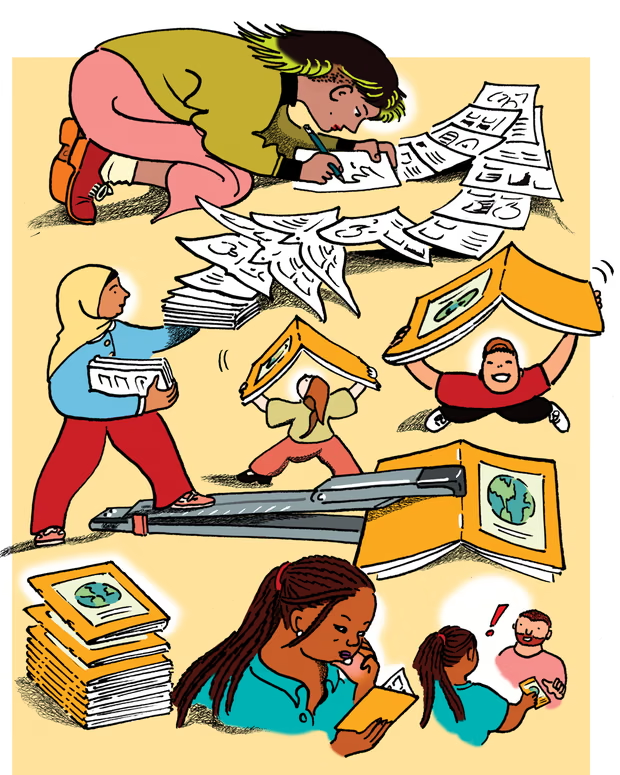
Best news of the day: Zines are making a comeback

Illustration: Jillian Tamaki/The Guardian

“Zines have always been inherently social and political, since they began as “fanzines” centered on science fiction in the 1930s, with the first known being The Comet. Fanzines shared opinions and views that were often expressed in letters to the editor that publications rejected… In the 1980s, during the punk rock movement, zines had their “second birth” and it gave rise to the “perzine,” or personal zine of relayed experiences and opinions.”

I love paper and ink/toner, the kind found on my desktop and in my files, in the pages rolled out by my printers, in the books on my shelf. I am also digitally experienced and capable, and use those tools often and effectively (e.g. this blog). But I love paper media.

If you are of a certain age and cultural leaning, you know what zines are. If not, the Guardian piece below will fill you in.

If you want to go with an imperfect analogy, try this one. It can be powerful to listen to great music at home, even to see concerts on a big screen with big sound. But it is never going to be same as sitting or standing next to dozens, hundreds, thousands of others in front of live artists performing.

If you come across a zine, read a zine. Or create and print a zine, which couldn’t be easier.


Gen-Zine: DIY publications find new life as form of resistance against Trump
People of all ages, from all regions, are making, printing and distributing zines on the streets, in libraries and at local gathering spots.

Mallory Carra
Guardian
Wed 10 Dec 2025 07.00 EST

On a cloudy Saturday afternoon, the Los Angeles central public library bustled with nearly 100 people making zines, small, DIY magazines made out of a single piece of paper. There was folding, laughing and helping with cuts. Titles like “Narcan 101,” “Free Palestine,” and “An American Zine,” filled with illustrations and tips, lined a table down the hall.

While this may sound like a scene from the 1980s or 1990s – when zines were popular as a countercultural form of expression – this was a workshop in modern-day Los Angeles, where immigration raids and federal threats have left residents restless and scared.

Zines have made a resurgence in recent months as communities seek to share information, such as how to protect one another from Immigration and Customs Enforcement (ICE) or how to resist the Trump administration outside “No Kings” protests. Just this week, 404 Media announced it is printing a 16-page zine that includes their reporting on ICE. People of all ages, from all regions, are making, printing and distributing zines on the streets, in libraries and at local gathering spots.

We asked critics from authoritarian regimes what they wish they’d known sooner. Here’s what they said

Zine-makers and enthusiasts say that people are likely embracing the pen-and-paper medium again due to social media censorship, surveillance, doxing and the alleged suppression of certain topics on algorithms.

“There’s a freedom people are craving because they’re feeling so constrained, surveilled and, frankly, threatened in so many other spheres that exist,” said Mariame Kaba, the co-founder of the Black Zine Fair in Brooklyn, who has been making zines since the 1980s. “You can print it cheaply, copy it, and make it into something, then you can give them out by the thousands to people in your community. There’s no barrier to entry, and that makes a difference.”

In particular, Kaba pointed to Brooklyn illustrator Megan Piontkowski’s series of “How to Report ICE” zines, a simple black-and-white one-page pdf document that requires four folds and a cut in the middle to aid folding. This zine has gone viral on Bluesky and Google Drive, where Piontkowski houses over 70 versions of her pamphlet in English and Spanish with localized rapid response hotlines and resources for cities and states across the US. She makes these zines in her spare time – fielding dozens of requests for other locations – to use her art to lend support.

“I really hate feeling powerless when horrible things are happening around me,” said Piontkowski, who drew inspiration from Kaba to make the zine. “It’s something I can do, and it’s also something other people can do. If they’re very vulnerable, ill, on a visa, or have a small child and they can’t protest, they can still fold some zines. You could do it at home, and hand them out to your friends or people you know at the grocery store or cafe.”

Zine-folding parties have also become popular in recent months. After ICE launched “Operation Midway Blitz” in Chicago in September, resident Emily Hilleren saw local social media posts where people packaged whistles with the Pilsen Arts and Community House’s zine about warding off ICE, called “Form a Crowd, Stay Loud.” Hilleren started gathering friends at a local bar called Nighthawk to fold the zines and pair them with whistles. Soon, the bar promoted the events via social media, and other Chicago bars began asking Hilleren to host folding parties for them. She’s hosted seven events around the city – most to capacity – and has helped people organize two others.

“People have seen the whistle kits and zines in person, recognize it’s a good, helpful thing and they see the opportunity to contribute to it,” she said. “The social aspect of it has been really attractive as well. Everyone I’ve talked to says: ‘I have to do something. I can’t just sit home, looking at my phone and reading all the bad news. I have to get out there, be with people, and do something tangible.’”

Zines have always been inherently social and political, since they began as “fanzines” centered on science fiction in the 1930s, with the first known being The Comet. Fanzines shared opinions and views that were often expressed in letters to the editor that publications rejected.

“Science fiction is a very political fiction, because it’s imagining different worlds and new worlds, and so the crossover to politics happens pretty early,” said New York University media and culture professor Stephen Duncombe, author of the book Notes From Underground: Zines and the Politics of Alternative Culture. “Zines started out as talking back to mass culture, and part of what people want to talk back to mass culture is about politics.”

In the 1980s, during the punk rock movement, zines had their “second birth”, according to Duncombe, and it gave rise to the “perzine,” or personal zine of relayed experiences and opinions. Around this time, zines became more social – before social media – with review publications, like Fact Sheet Five by Mike Gunderloy, which catalogued hundreds of zines, becoming a place where people could learn about and request zines, discovering new ones in the communities with which they identified, such as queer, riot grrrl and Afro-Punk.
people sitting at tables and making zines
A zine-folding event at the Nighthawk bar in Chicago, organized by Emily Hilleren. Photograph: Courtesy Jessica Wolfe

For example, Duncombe recalled an old letter published in the queer zine Homocore from a gay teen boy who lived in Montana and loved hardcore music. “For that kid, this is pre-internet, and he lived in the world of country and western machismo straight guys,” Duncombe said. “This [zine] was like a world just opened up for him, and zines have always had that role for people.”

According to the zine community, the medium has always sought to inform the public. Back in the 1990s, Kaba recalled reading zines that spread then little-known information about the abortion medication mifepristone and herbal abortions.

“All of a sudden, through zines, you learned how to self-manage your own abortion,” she said. “Every generation has the information that is relevant to their cultural space that they’re in, and zines are always going to speak to that, because those folks who are on the margins are looking for ways to connect.”
And zines have long been a safe space for marginalized communities to express themselves. Nova Community Arts in Los Angeles hosts a weekly “Queer Art Hang” workshop, where LGBTQ+ folks can make, fold, and trade zines together, in person, without surveillance or bullying on social media.

“Being able to sit down in front of a piece of paper in a safe space, amongst friends and community members, is something that is honestly so healing for queer people, who have experienced, all of our lives, people telling us what we’re supposed to do, what things we’re supposed to put out there, and what we’re supposed to look like,” said Nova co-director Rosie Mayer.

Though people often associate zines with Gen X, younger generations – who have grown up with social media and cellphones – are turning to zines to inform and for solace amid the current political landscape. After ICE raids and protests erupted in Los Angeles earlier this year, 16-year-old Victoria Echerikuahperi hosted a healing zine workshop for raid victims and has continued to lead youth zine events around the city under her stage name, DJ Mariposa.

“There’s no right or wrong way to do it, and people could get their creativity out,” she said. “A lot of people were thanking me and were happy, because, yes, writing about political things is heavy, but it’s also like a release, knowing that this zine could be helpful to someone, or this could open someone’s eyes.”

A thought in flight leaves no trace

“We experience the afflictions of desire and hatred, but their appearance is like the flight of a bird through the sky, leaving no tracks.”
Khenchen Thrangu

Lust and hate arise but leave no trace,
Like birds in flight; don’t cling to passing moods, people of Dingri.
Advice from a Yogi, Padampa Sangye

Commentary:

Even though the mind is the root of everything, our afflicted thoughts of greed, lust, and hatred appear, strong and powerful, and we engage in the greed and hatred. We think of something, and we think of it again and again, and it gets stronger and stronger. How do we get rid of these thoughts?

We experience the afflictions of desire and hatred, but their appearance is like the flight of a bird through the sky, leaving no tracks. They just dissolve into emptiness without leaving any trace. There is no reason to be attached or to fixate on them. They arise, and then they’re the past, and they can’t do anything to us.

Since everything comes down to the mind, we can attain the ultimate result. We are able to give up all of samsara because samsara is just the mind. We are able to achieve nirvana because nirvana is just the mind. The afflictions of desire and hatred sometimes seem like solid things that we can’t get rid of. But if we look at their ultimate nature, how they actually are, we see that we can get rid of them. Since we have the instructions, we should have confidence that we can eliminate the afflictions of desire and hatred.

Khenchen Thrangu


Padampa Sangye was an eleventh-century Indian yogi and spiritual master (also known as Kamalashila) who traveled widely throughout his life and brought Indian Buddhist teachings to China and Tibet. Best known as Machig Labdron’s teacher, he is counted as a lineage guru by all schools of Tibetan Buddhism.

Khenchen Thrangu is an eminent teacher of the Kagyu tradition of Tibetan Buddhism. He was appointed by the Dalai Lama to be the personal tutor for His Holiness the Seventeenth Karmapa and has authored many books, including Pointing Out the Dharmakaya, Everyday Consciousness and Primordial Awareness, and Vivid Awareness.