Bob Schwartz

Trump Jr. is a flawed copy of Trump. Bobby Kennedy and RFK Jr. are not in the same universe.

The post below was published on June 6, 2018, the 50th anniversary of the assassination of Bobby Kennedy. I’ve published six posts about Bobby Kennedy over the years.

The feeling many of us had toward Bobby Kennedy is based on a complicated and tragic part of our history. His brother, the President, had been assassinated five years earlier. Martin Luther King Jr. had been assassinated months before. Just as importantly, it increasingly looked like Bobby Kennedy would be the next Democratic candidate for president, and would win, starting the process of getting out of Vietnam. Above all that, separate from the Kennedy legacy and from the politics, he was beloved.

Then he was gone. The Democratic Convention was a disaster. Hubert Humphrey was the candidate, who lost and gave us Richard Nixon. So it goes.

The feeling many of us–most Americans–have toward RFK Jr., our health czar, is indescribably negative and scared. He has Bobby Kennedy’s name and DNA, and nothing else.

My advice: Every time you see RFK Jr. or hear about another of his outrages, take a moment to learn a little more about Bobby Kennedy. The post below can be a start.


Come, my friends,
‘T is not too late to seek a newer world.
Ulysses by Alfred, Lord Tennyson.

Bobby Kennedy was killed 50 years ago today, in the midst of what might have been a successful campaign for the Democratic nomination and for the presidency in 1968. We don’t know unwritten stories. He was 42 years old.

You will find plenty of perspectives on Bobby Kennedy published today, and in the dozens of books and hundreds of essays written about him and his place in history. I’ve written about him too, but today I find myself with little new to say.

Instead, I’ll quote, as I have before, from a poem he recited on the campaign trail.

The poem is Ulysses (1842), written by Alfred, Lord Tennyson.

Imagine that. A 20th century politician reciting a 19th century poem about a hero who first appeared more than two thousand years earlier. Not just any poem and hero, but an idealistic poem about a hero who reluctantly takes on a mission. Having already sacrificed family life for duty, he can’t help but set out one more time. Leaving the life of ease behind, he fiercely pursues a dream until the end of days.

The language of the poetry may be old-fashioned to the modern ear, but please read it carefully. It remains a timeless description of what drives people to mission and sacrifice, in spite of the lure of comfort and the toll of years. If America needed that—and almost got it—in 1968, we need it now.

…Come, my friends,
‘T is not too late to seek a newer world.
Push off, and sitting well in order smite
The sounding furrows; for my purpose holds
To sail beyond the sunset, and the baths
Of all the western stars, until I die.
It may be that the gulfs will wash us down:
It may be we shall touch the Happy Isles,
And see the great Achilles, whom we knew.
Tho’ much is taken, much abides; and tho’
We are not now that strength which in old days
Moved earth and heaven, that which we are, we are;
One equal temper of heroic hearts,
Made weak by time and fate, but strong in will
To strive, to seek, to find, and not to yield.

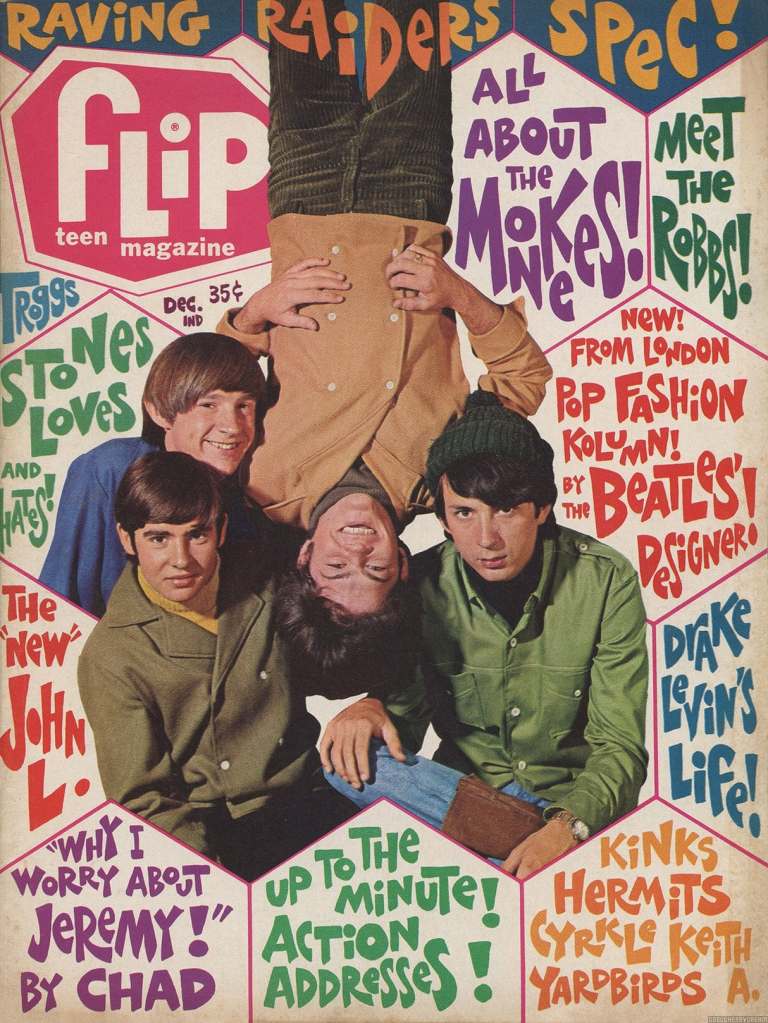
Flip’s Groovy Guide to the Groops!: Antidote to cultural provincialism

Flip’s Groovy Guide to the Groops! (1968)

FLIP’s GROOVY GUIDE TO THE GROOPS! happened because you asked for it.

It’s an outasite one-of-a-kind book!

FLIP’s entire staff in New York, London and Hollywood contributed to this book, but two people must be especially mentioned. Carol Deck, FLIP’s Hollywood Editor, served as the book’s supervising editor, and Tracy Thomas spent weeks tracking down most of the groups for the last and largest section of the book—the Groovy Groups.

And you had the most important part of all: You told us which 100 great groups to squeeze into the 240 picture-popping pages of this boss book!

STEPHEN KAHN
Publisher
FLIP Magazine


December 1966

Some will think that featuring a “groovy” book from 1968 is some sort of nostalgia trip. It is anything but.

Cultural perspective has two dimensions, breadth and depth. Broad, as in covering more than a little piece of your world. Deep, as in covering time before the time you were born or just a few years before that.

At college, I often researched at a huge university library. This was before digital conversion, so the stacks were overstuffed with bound volumes of newspapers and magazines that went far back into the previous century. I wasn’t “nostalgic” for cultural items from decades earlier. I was, and still am, trying to gain perspective on how things were, how we got here, and where we might go.

Jimmy Kimmel features a segment where people walking down Hollywood Boulevard, young and old, are asked basic questions about current events, geography, history, etc. Some might shake their head and laugh at ridiculous responses, maybe calling some of these people ignorant.

I prefer thinking of them as culturally provincial, with knowledge and perspective narrowing more and more into a small circle and the last thing that happened.

That’s why Flip’s Groovy Guide and other artifacts from different times and different places are so important, as an antidote to cultural provincialism. Plus, a lot of fun!

One more thing.

If you think this book reflects a frivolous time, here are other books that were advertised on the back page:


THE NEW YORK TIMES ELECTION HANDBOOK, 1968 edited by Harold Faber.
The political experts of The New York Times provide an authoritative, informative manual designed to help the public sort out the facts at work in a controversial election.

HOW TO GET OUT OF VIETNAM: A Workable Solution to the Worst Problem of Our Time by John Kenneth Galbraith.
The distinguished economist, political theorist, and bestselling author offers a practical plan for U. S. withdrawal from “a war we cannot win, should not wish to win, are not winning, and which our people do not support.”

THE HIPPIES by Burton Wolfe. At once highly critical and deeply sympathetic, this is an in-depth examination of the hippie kingdom—its “government,” its organizing principle, its leaders and members, the drug scene, the communes, the poverty, the disease.

BEST CAMPUS HUMOR OF THE SWINGING 60’s edited by Bill Adler.
A unique tribute to the freshness and diversity of college humor, ranging in subject from Vietnam to college exams, from LSD to campus sex.

THE SECOND CIVIL WAR: ARMING FOR ARMAGEDDON by Garry Wills.
An eye-witness account of the explosive racial crises that occurred in New York, Albany, and Detroit dur ing the summer of 1967.

THE HIPPIE PAPERS edited by Jerry Hopkins.
An eye-opening collection of outspoken articles from the nation’s underground press on subjects ranging from LSD to free love, from Vietnam to police brutality.