Bob Schwartz

Month: November, 2025

The whole Whole Earth archive of publications—all free for all!

Everybody should be familiar with and hopefully study the decades (1968-2002) of Whole Earth publications and ideas that began with the first Whole Earth Catalog in 1968.

This includes issues of Whole Earth Catalog, CoEvolution Quarterly, Whole Earth Software Review, Whole Earth Review and Whole Earth Magazine.

It is not hyperbole to say that few ongoing modern publications/cultural phenomena, if any, have been so continuously inspirational and idea/life generative. If it sounds as if Whole Earth changed lives and minds, that is exactly it. It might change yours.

The great news is that the entire archive of Whole Earth publications is now available for viewing and download at Whole Earth Index.

If you are someone who thinks of yourself open to possibilities, this is for you. If you are someone who wonders whether something first born in 1968 can have anything to offer you in 2025, you may not be as open as you think.

Please explore and enjoy.

Hard to admit it, but most of the major news media in America are now scared of or sympathetic with a corrupt administration

I have been an avid news consumer for as long as I could read, starting around age eight, when I scurried down to the local 7-11 to pick up the fat Sunday newspapers (when newspapers were fat and only on paper). I watched TV news too. This has gone on, with digital additions, for decades.

I am pretty good at discerning news quality—clarity, depth, intelligence, fairness and independence. There have long been publications, and later broadcasters, that stood above the rest. News gatherers like the New York Times, the Washington Post, and even the Wall Street Journal, which with a very strong editorial and opinion point of view, left the reporting side to do their work unhindered. On TV, the legacy networks of CBS, NBC and ABC built respected news operations. Then CNN came along and invented quality news reporting 24/7.

Which is what makes being skeptical, if not downright dismissive, of these news media difficult. The fact is I still subscribe to and read the Times, the Post and the Journal. And I still check in with CNN, CBS, NBC, ABC once in a while, though always now with a jaundiced eye and ear.

My first and primary read each day is the Guardian, my best weekly read is the Economist, both world-class news publications from the UK. First TV watch are Sky News and BBC ( both UK) and CBC (Canada). Besides their quality, the reason is simple.

Many American news media, including some of the historically legendary ones, are either afraid of the administration or sympathetic with its goals and strategies—or at least not doggedly pursuing unavoidable and undeniable truths.

It’s one thing to learn that a great musical artist you have loved had unfortunate ideological leanings. Well, you might reason, the politics are despicable but the songs remain irreplaceably great. I’ll keep listening and loving.

For the once-unassailable news media who, if not turning to the dark side, are at least averting their attention—and ours—it’s different. The news is their music. If what they are playing doesn’t sound as good and clear as it used to, we are, reluctantly, going to stop listening and trusting their clarity, depth, intelligence, fairness and independence.

We would love to come back to them. We’ll be back as soon as they are.

Veterans Day: Of Peaceful Intent

Veterans of the Battle of Gettysburg, Union and Confederate, meet in 1913 on the 50th anniversary of the battle.

Today, November 11, is Veterans Day in America. It honors all military veterans, living and dead, who have served in the Armed Forces.

It is also a reminder of peace. It originated as Armistice Day, marking the end of World War I on November 11, 1918.


Of Peaceful Intent
For the Fallen
By Marc A. Crowley

I was in the Navy in 1968-69,
and the only action I saw was
the war games we played in the Pacific
somewhere between San Diego and Hawaii.
But I have walked many battlefields—
like Yorktown, for example,
Gettysburg, Little Big Horn,
and Mountain Meadows.
They are broad fields of memories,
often with their own cemeteries
of countless headstones for the known
and the unknown.

When in those places,
I have to stop walking,
stop talking,
close my eyes,
and stand in silence.

The blood and clamor,
the wild screams of mangled bodies,
the masses of armies running headlong into
each other’s blast of cannon and gunfire,
and the treachery and murder of men,
women, and children at Mountain Meadows.
All anyone wished for was to survive
and go home.

Terror still inhabits the landscapes,
protected by nature’s eternal allies.
And in the quest for redemption,
nowhere in the world is untouched.
The fallen are not to be forgotten.

When the smoke and dust settle
and the roar in my ears quiets,
I open my eyes and everything
remains serene and sanctified.

With quiet steps of gratitude,
I walk with peaceful intent.

© 2025 Marc A. Crowley

An appreciation of Zelensky

Volodymyr Zelesnky became president of Ukraine in 2019.

In that time, American civic and political leadership has gone from terrible to okay to even more terrible. Meanwhile, Zelensky has led a country besieged by an overwhelming malevolent force with unyielding courage, intelligence and—it seems a strange but true characteristic to include—style. Not unlike Churchill.

Zelensky has given his people courage under the worst circumstances and has impressed other hard-to-impress world leaders. On the flip side, if people are known by the enemies they make, both Putin and Trump hate him. Because of his courage, intelligence, and in the case of Trump, definitely style.

Whether or not America and its opposition party, the Democrats, have or can find a Zelensky, it would definitely help. Unyielding courage, intelligence and style in the face of overwhelming malevolent force. That’s the ticket.

Everything says: You must change your life.

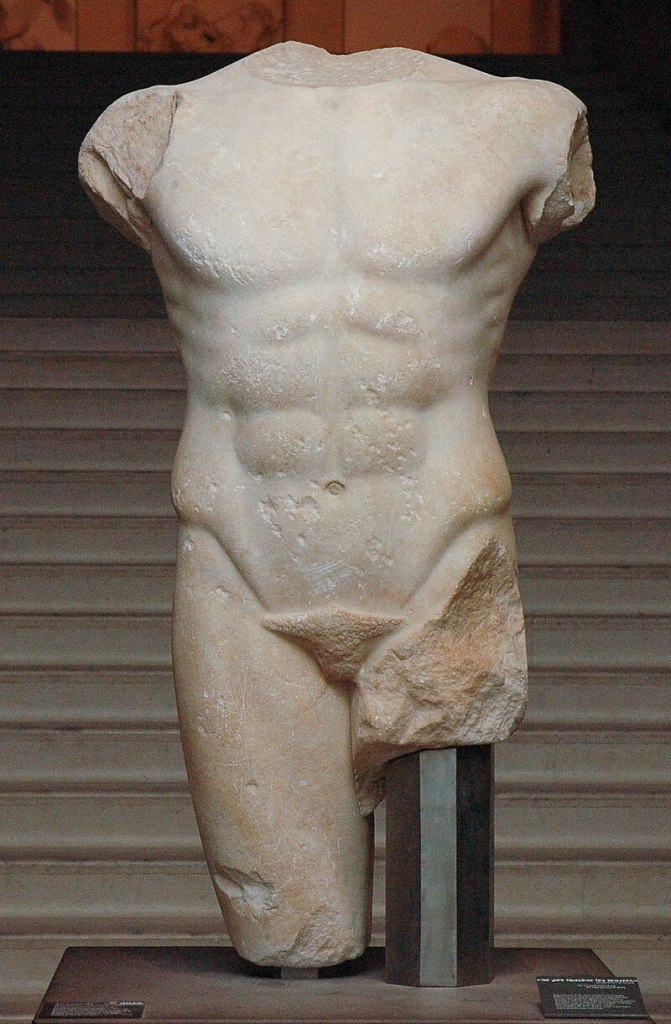
Miletus torso (c. 480–470 BC) at the Louvre

Archaic Torso of Apollo (1908)
By Rainer Maria Rilke
Translated By Stephen Mitchell

We cannot know his legendary head
with eyes like ripening fruit. And yet his torso
is still suffused with brilliance from inside,
like a lamp, in which his gaze, now turned to low,

gleams in all its power. Otherwise
the curved breast could not dazzle you so, nor could
a smile run through the placid hips and thighs
to that dark center where procreation flared.

Otherwise this stone would seem defaced
beneath the translucent cascade of the shoulders
and would not glisten like a wild beast’s fur:

would not, from all the borders of itself,
burst like a star: for here there is no place
that does not see you. You must change your life.


The famous last sentence of this poem has inspired much analysis.

It is thought that the above statue in the Louvre is the subject of Rilke’s poem. In any case, the message he took away from gazing at a statue is profound: You must change your life.

I am not Rilke or any of the talented exegetes of poetry or philosophy. But I have a suggestion.

Everything says: You must change your life.

It might be a situation or circumstance. It might be something you hear, not even a song but just a sound. It might be something you see in a museum. It might be something, anything, you encounter in the course of your day, of your day in a life. Anything, everything says: You must change your life.

There is a perspective, from science and religion, that says that everything is in a state of constant change. So if everything is constantly changing, why not you? Why not your life?

Is it possible that Trump wants to break America and that many Republicans think it’s a good idea?

If Trump is trying to break America, he is doing a good job.

Republicans in Congress could try to stop him. They haven’t and there is no indication they will.

Trump’s reason for breaking America is, appropriately for him, simple and primal. He is the boss and would be boss of a broken America, so he could reshape and rebuild it any way he wanted, to the advantage of himself and his friends.

Republicans in Congress are in part scared of losing their jobs and their power, such as it is. But many of them may also believe that current America is just too far gone for conventional reformation. It is, they believe, in need of a total tear down and new construction—with Trump, his circle and his party as architects.

Far-fetched? If that once had any meaning in imagining American governance, it doesn’t right now.

Colleges under attack in America can take comfort from the comic book hysteria of the 1950s

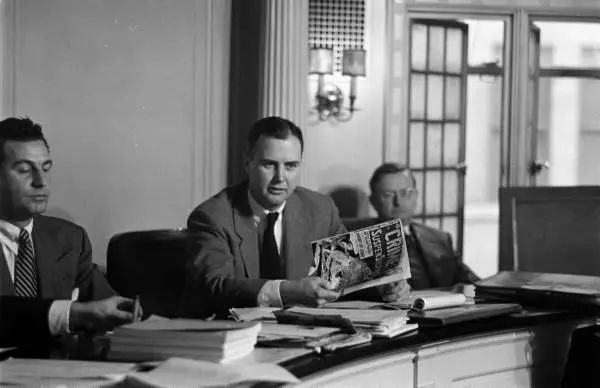
Senate Hearing (1954)

“We know that the dreams of adults often contain images of forbidden acts in which one of the participants belongs to a group of people considered socially inferior by the dreamer. In this way the forbidden act itself can break through the psychic censorship. Through such psychological mechanisms comic books give children a feeling of justification for violence, and sadism, frequently in fantasy and sometimes in acts. They supply a rationalization for these impulses. A large part of the violence and sadism in comics is practiced by individuals or on individuals who are depicted as inferior, sub-human beings. In this way children can indulge in fantasies of violence as something permissible.”
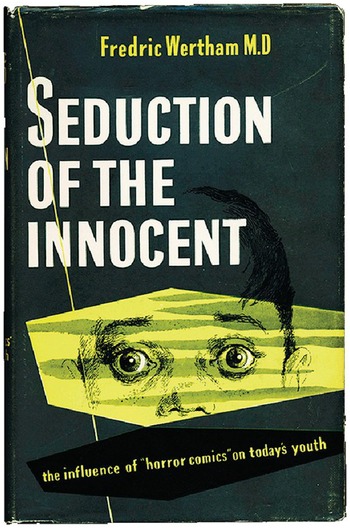
Fredric Wertham, Seduction of the Innocent

It may seem that colleges now under attack have nothing to do with or learn from the history of comic books in America. They do.

Comic books have been a major cultural force for decades. In the 1950s, between a million and a million-and-a-half copies were being sold each month in America, mostly to young people.

Then in 1954, psychiatrist Fredric Wertham published a book, Seduction of the Innocent. His treatment of young people and his observation of juvenile delinquency in America convinced him that the culprit was comic books.

His book and his analysis were a national sensation, reaching Congress and a series of damning hearings. The comic book industry, seeing its sales fall, established a self-policing Comics Code, assuring that horror, violence and weirdness were eliminated.

Senate Hearing (1954)

We know that comic books came back from this as a major multimedia cultural force. A force so overwhelming that it has generated not one but two huge media universes—the DC Universe (DCU) and the Marvel Universe. Generations of extraordinary crowd-pleasing creativity has been let loose, not to mention billions of dollars.

Colleges take heart. It would be better if colleges weren’t asked to compromise their freedom and independence, just as it would have been better for the comic book industry. The colleges may choose to self-police, just as the comic book publishers did. But there is a tomorrow where your greater, freer, more independent days are ahead. It worked for comic books. It can work for you.


I could not resist looking back at how colleges were being handled in the comic books of that era. The good news is that college was not a place of horror, violence and weirdness. Campus was apparently a place of love and romance. No nightmares there.

Campus Loves (1949)
Campus Romances (1950)

© 2025 Bob Schwartz

The problem with the new U.S. Department of Labor social media campaign is not only the depiction of all white men. The real problem is that it looks like Nazi Germany worker propaganda.

U.S. Department of Labor (2025)

“In the Nazi worldview, there was a close link between the German spirit and productive labor for the advancement of the Volksgemeinschaft. Tapping the full potential of worker productivity rested on improving worker morale and increasing worker support for the regime more generally.”

The Washington Post writes:


Labor Department social media campaign depicts a White male workforce

The campaign has drawn scrutiny, with critics saying the agency is not realistically portraying the diversity of the country and is sending messages that feel exclusionary.


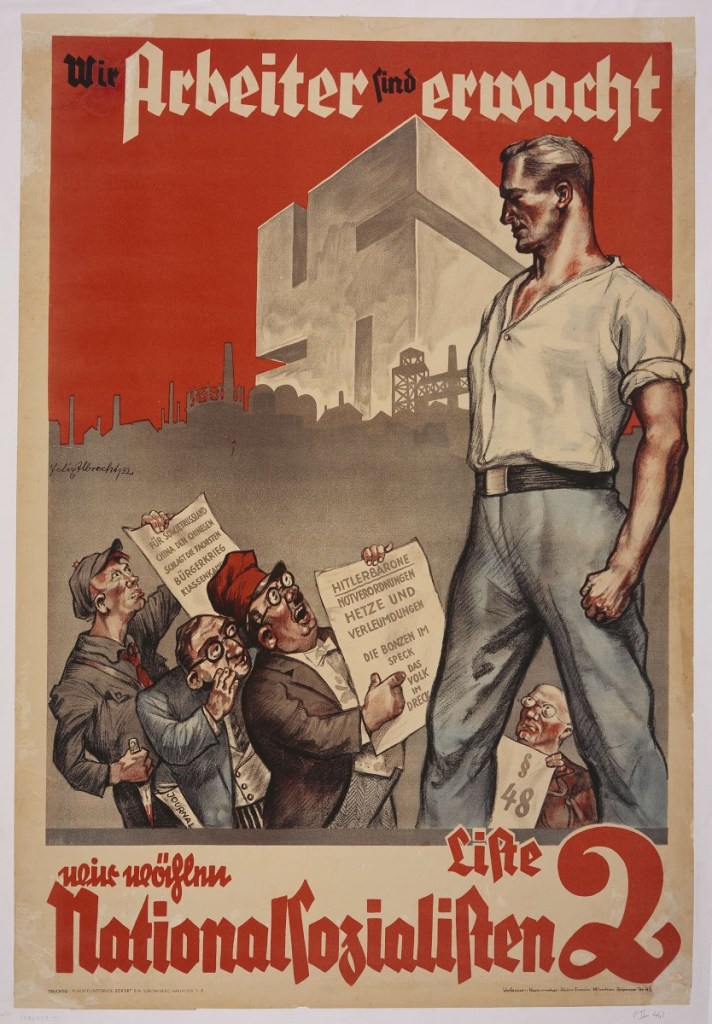
While the male whiteness of the campaign is problematic, that wasn’t my first impression. What it looked like to me was a workforce campaign you might have seen in Nazi Germany, not just because of the handsome and rugged Aryan men, but in the very style of the art. The inclusion of the word “homeland” doesn’t help, although it is better than “Build Your Fatherland’s Future.”

Or am I just oversensitive to those visual and verbal echos?

We Workers Have Awakened (1932)
You Are the Front (1940)
Beauty of Labor (1934)

Penguin love according to Buddhism

“If penguins don’t let go of their young at some point, the little ones will never grow up to be competent adult penguins.”

“Attachment may be the most difficult emotion to overcome, but we can make progress by continually observing how it brings us suffering and does us no good. In place of our attachment, we can cultivate a less self-centered love, a visionary love that is tuned in with the actual best interests of others. This kind of love often involves letting go. For instance, if penguins don’t let go of their young at some point, the little ones will never grow up to be competent adult penguins. They will never be free to live fully. By letting go, the parents are not rejecting love and care, but expressing a higher form of love. As lojong [mind training] practitioners, we can cultivate visionary love for those close to us, and then spread that love among all sentient beings, simply because they have the same desire to be happy that we do.”
Dzigar Kongtrul, The Intelligent Heart: A Guide to the Compassionate Life

Judging and projection

Gomo Tulku (1922-1985)

One of the most famous quotes about judging is from the Gospels:


Do not judge, so that you may not be judged.
Matthew 7:1


Despite that wisdom, Christians and others often tend to forget or ignore it. A lot of judging goes on.

Another similar perspective is taken in Buddhism, which is not to say that Buddhists don’t indulge in judging also.

A maxim from the classic 59 maxims of mind-training (lojong):


  1. Don’t reflect on others’ shortcomings.

We should train our minds to see others as pure by thinking that when we see a fault in someone, it’s because we project imaginary faults onto others due to things appearing to be impure from our own side. Practicing in this way, we will be able to protect ourselves from the tendency to judge others.
Gomo Tulku (1922-1985), Seven Steps to Train Your Mind


This goes farther than the Christian message that we shouldn’t judge others because we might get judged back. We don’t judge because whatever the other is doing, we are looking in a mirror. We are pure, though our self-importance keeps us from knowing it. The other is pure, but is also kept from knowing it. Our role is not to judge, but to help them see it and help ourselves see it.

Note that no one suggests that we put our critical thinking in neutral. If we find that what we or others do, say or think might be better, we can point it out, provided our motivation is making things better, and not proving ourselves better and smarter.