Bob Schwartz

Two books about lying

Some don’t think they need to read a book about lying because it is succinctly and definitively covered in “The Good Book”, that is, the Bible:

  1. You shall not bear false witness against your neighbor
    Exodus 20:16

(Or as universally interpreted, in any circumstance to anyone. In other words, don’t lie.)

If you do want to read a good book about lying, its subtleties and its damaging effects, following are a couple.

Lying: Moral Choice in Public and Private Life (1978) by Sissela Bok

This is the modern masterpiece on the subject. You might think, “well, it was written almost fifty years ago, and a lot has changed since then.” Of course, nothing has changed, either in lying or in the astute analysis of lying. If anything, you might observe that lying has come to play an even more important role, at least in American life—commandment or no commandment.

Chapters in Lying by Sissela Bok:

I IS THE “WHOLE TRUTH” ATTAINABLE?
II TRUTHFULNESS, DECEIT, AND TRUST
III NEVER TO LIE?
IV WEIGHING THE CONSEQUENCES
V WHITE LIES
VI EXCUSES
VII JUSTIFICATION
VIII LIES IN A CRISIS
IX LYING TO LIARS
X LYING TO ENEMIES
XI LIES PROTECTING PEERS AND CLIENTS
XII LIES FOR THE PUBLIC GOOD
XIII DECEPTIVE SOCIAL SCIENCE RESEARCH
XIV PATERNALISTIC LIES
XV LIES TO THE SICK AND DYING

As you can see, just reading the chapter titles is enough to get you thinking.

Lying (2013) by Sam Harris

This book is much shorter (83 pages, really a long essay) and more smoothly written than Bok’s book, given Harris’ bestselling skill as a writer. Obviously not as incisive and insightful.

A suggestion is to read them both, especially because Harris’ book is such a quick read. A much bigger suggestion is to pay attention to lying and to think about what you say and what you hear from any source. If it is someone, private or public, who claims allegiance to the mentioned Good Book and its commandments, it is worth thinking about whether the lies fit into any of the exceptional circumstances, or whether the principle is just being ignored entirely.

Beyond

Beyond

From a foothill
Face the foothill
Of the mountains beyond
Beyond that the hidden
Circling back to a foothill
From a foothill

© 2025 Bob Schwartz

Teach-ins are back

For some, teach-ins were an integral part of organized resistance and opposition to a war and to social and national injustice and inhumanity.


Teach-ins are extended educational gatherings where participants discuss and learn about controversial issues, typically combining lectures, debates, and workshops. They’re designed to raise awareness and foster critical thinking about social or political topics.

Teach-ins emerged in March 1965 at the University of Michigan as a response to the Vietnam War. Faculty members organized an overnight event with lectures and discussions as an alternative to striking, which would have disrupted students’ education. The format quickly spread to campuses nationwide.

Early teach-ins featured:

  • Marathon sessions (often 12+ hours)
  • Mix of presentations, debates, and open discussion
  • Focus on alternative perspectives to mainstream narratives
  • Emphasis on collective learning and action

The model became a signature protest tactic of 1960s-70s campus activism, addressing civil rights, environmental issues, and anti-war movements.


Teach-ins are back, not yet in the same number as in the past, but they are spreading.

Like this:


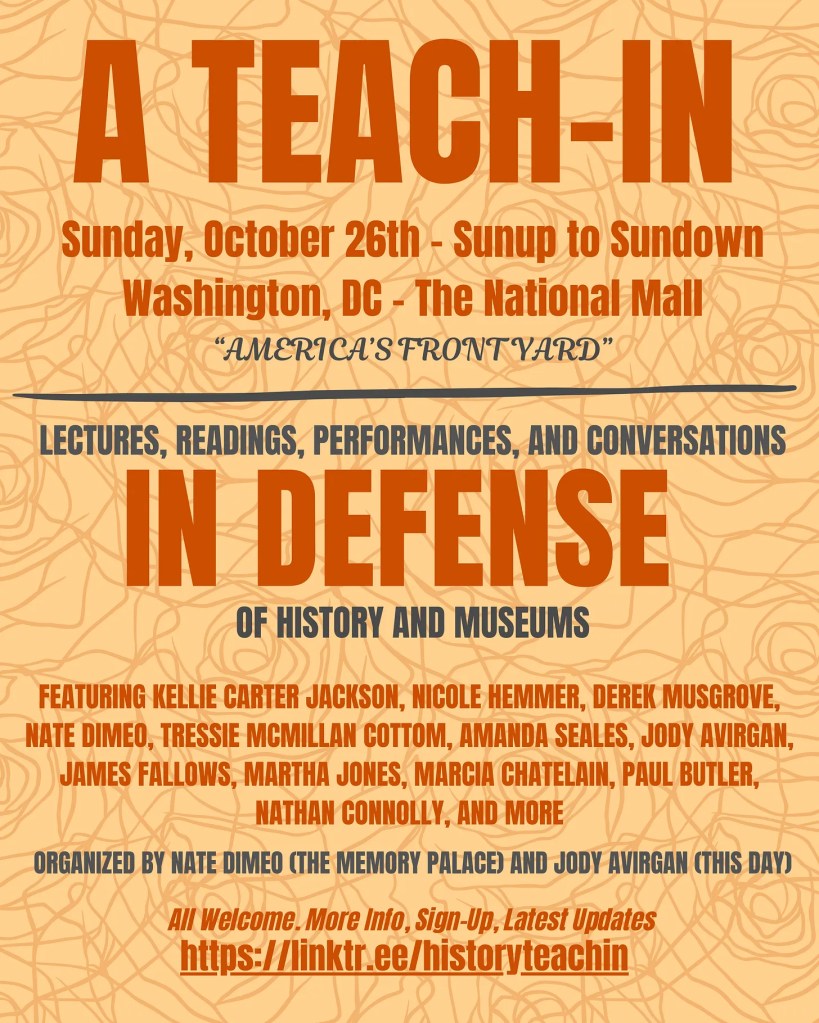
Why we’re holding a teach-in about American history at the Smithsonian

On 26 October, podcasters, professors, journalists and ordinary citizens will gather on the steps of the Smithsonian National Museum of American History for a teach-in in defense of history and museums.


If you look online, you’ll find many more happening, maybe in your own backyard.

Here’s the original teach-in at the University of Michigan in March 1965:

Here’s a Free Speech teach-in at Barnard in September 2025:

Is this nostalgia for a time when protest happened and sometimes worked? No. It is confirmation that when people effectively organize and educate, it is possible that eventually things can be turned around. Eventually (not to put a damper on this) as in the ten years between the University of Michigan teach-in and the end of the Vietnam War. But without the teach-ins and the marches and levitating the Pentagon (look it up), there is no telling how much more death and damage and suffering would have been inflicted.

It is worth teaching-in.