About 43 million Americans receive federal food assistance through the Supplemental Nutrition Assistance Program (SNAP). Those benefits ended today, though ongoing court cases might have them resume eventually. But not today, and maybe not soon.
Wherever you live in America, there are hungry people and a local food bank. You can find your local food banks here: Feeding America.
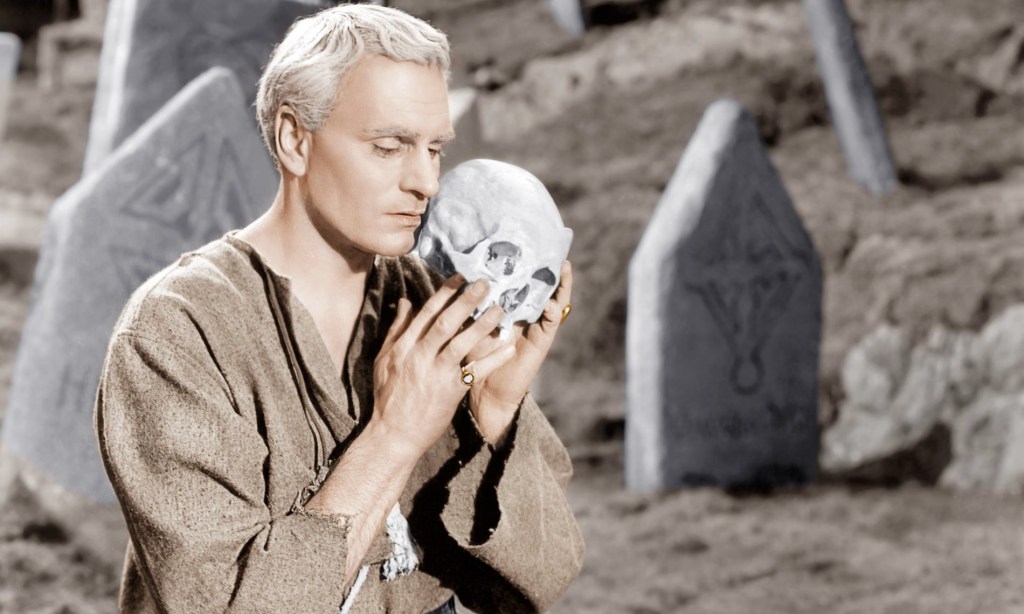
Alas poor Yorick! I knew him…” Hamlet, Act 5, Scene 1
Today, November 1, is Day of the Dead/Dia de los Muertos in Mexico and elsewhere. (It is also All Saints’ Day on many Christian calendars.)
Above is a famous skull scene from Hamlet. Shakespeare was all about everything, including death.
Here in Hamlet, Mercutio is stabbed, but still finds a way to pun his way out:
Ask for me tomorrow, and you shall find me a grave man. Hamlet, Act 3, scene 1
Dia de los Muertos has many traditions associated with remembering and honoring those in our hearts who have died before us. It is also a way of remembering that we too will die and be somebody’s memory. While thinking about that may sadden and scare us, it is not a dark day.
Skulls/calaveras are a main motif of Dia de los Muertos. Faces are painted as skulls. Candy sugar skulls are enjoyed.
A late tradition from the 19th century is the calavera literaria. These are humorous or sarcastic writings about someone who is still alive as if they were dead. What you might hear at a roast or wake.
Thinking about death on this Day of the Dead or any day:
“Cultivate the thought, “The time of my death is unknown, and were it to come suddenly, my sole recourse would be this practice….In this way, make sure you fortify your mind so that no matter when you die, you do so joyfully and with palpable warmth within.” Tibetan Buddhist master Sé Chilbu Chökyi Gyaltsen (1121-1189)
Today, November 1, is All Saints’ Day on many Christian calendars.
Saints are in short supply—in your family, in your community, at work, in politics, in your mirror. So if the search for them is likely to come up empty, what’s the point of looking?
In the intersecting realm of faith, policies and character, it is balance we seek, not absolutes or perfection. You stand certain on a line, maybe informed by your god and your traditions, and believe that everything else stands closer or farther on that line, in one direction or another. You can measure the distance and decide when someone has gone too far.
In the case of faith, policies and character, there are at least three dimensions. Trying to evaluate people in that space is hard and uncertain. Some think this gets us creeping toward relativism, where suddenly everyone and everything is acceptable. But it is no such thing. It just means that we are asked to look at everyone and every circumstance on its own, for itself, eyes wide open, in our own well-considered light. That is a lot of work, and so we want a shortcut. We may think we are able to take shortcuts, but there are no shortcuts, only understandably lazy paths.
Saints are in short supply because even saints are not saints. That is the point. Go easy on yourself and others, or go hard. Do the work, if you have the time and inclination, and don’t depend simply on a bible verse, a rule or an ideology. You are gifted, so use those gifts wisely.


 Bob Schwartz