Bob Schwartz

Month: October, 2025

“An education that in any way neglects imagination is an education into psychopathy.”

“An education that in any way neglects imagination is an education into psychopathy. It is an education that results in a sociopathic society of manipulations. We learn how to deal with others and become a society of dealers.”

I was talking today about the psychologist James Hillman, which brought me back to my previous posts about him (here and here).

One of those posts includes the following excerpt:


Descriptions of psychopathy, or sociopathic personalities, speak of their inability to imagine the other. Psychopaths are well able to size up situations and charm people. They perceive, assess, and relate, making use of any opportunity. Hence their successful manipulations of others. But the psychopath is far less able to imagine the other beyond a fantasy of usefulness, the other as a true interiority with his or her own needs, intentions, and feelings. An education that in any way neglects imagination is an education into psychopathy. It is an education that results in a sociopathic society of manipulations. We learn how to deal with others and become a society of dealers.

James Hillman
“Right to Remain Silent”
Journal of Humanistic Education and Development (1988)


Outside of a Small Circle of Friends (1967) by Phil Ochs: American apathy

Smoking marijuana is more fun than drinking beer
But a friend of ours was captured, and they gave him thirty years
Maybe we should raise our voices, ask somebody why
But demonstrations are a drag, besides we’re much too high
Phil Ochs, Outside of a Small Circle of Friends

Troubadours of the folk era could write and perform beautifully, ironically and topically.

Phil Ochs did all that. Changes and Pleasures of the Harbor are pristine and timeless ballads. His topical songs covered America in the 1960s, including the War (that is, the Vietnam War). He was aware of self-congratulatory do-gooding, as in Love Me I’m a Liberal.

Outside of a Small Circle of Friends is about apathy. In the history of America—the world—that has never gone away. Neither have the situations needing our active altruistic attention.


Oh, look outside the window, there’s a woman being grabbed
They’ve dragged her to the bushes, and now she’s being stabbed
Maybe we should call the cops and try to stop the pain
But Monopoly is so much fun, I’d hate to blow the game

And I’m sure it wouldn’t interest anybody
Outside of a small circle of friends

Riding down the highway, yes, my back is getting stiff
Thirteen cars have piled up, they’re hanging on a cliff
Now maybe we should pull them back with our towing chain
But we gotta move, and we might get sued and it looks like it’s gonna rain

And I’m sure it wouldn’t interest anybody
Outside of a small circle of friends

Sweating in the ghetto with the colored and the poor
The rats have joined the babies who are sleeping’on the floor
Now wouldn’t it be a riot if they really blew their tops?
But they got too much already, and besides we’ve got the cops

And I’m sure it wouldn’t interest anybody
Outside of a small circle of friends

Oh, there’s a dirty paper using sex to make her sales
The Supreme Court was so upset they sent him off to jail
Maybe we should help the fiend and take away his fine
But we’re busy reading Playboy and The Sunday New York Times

And I’m sure it wouldn’t interest anybody
Outside of a small circle of friends

Smoking marijuana is more fun than drinking beer
But a friend of ours was captured, and they gave him thirty years
Maybe we should raise our voices, ask somebody why
But demonstrations are a drag, besides we’re much too high

And I’m sure it wouldn’t interest anybody
Outside of a small circle of friends

Cherishing Trump as your spiritual friend

When I see ill-natured people,
Overwhelmed by wrong deeds and pain,
May I cherish them as something rare,
As though I had found a treasure-trove.
Eight Verses for Training the Mind

“You have heard that it was said, ‘Love your neighbor and hate your enemy.’ But I tell you, love your enemies and pray for those who persecute you, that you may be children of your Father in heaven. He causes his sun to rise on the evil and the good, and sends rain on the righteous and the unrighteous. If you love those who love you, what reward will you get? Are not even the tax collectors doing that? And if you greet only your own people, what are you doing more than others? Do not even pagans do that? Be perfect, therefore, as your heavenly Father is perfect.
Matthew 5:43-48

It’s hard. Exercise is hard. Training for any discipline is hard. Mind training and transformation are hard. Treasuring adversity and loving our enemy are hard.

There is so much and so many we find to reject and resist and oppose. So much anger and disgust and dislike, just at the sight of a face and the sound of a voice.

How can we cherish that? As a treasure trove? As a spiritual friend?

There must be a reason that our traditions teach us to treasure adversity and love our enemy.

Maybe think of it as weight lifting or resistance training. Heavier weights and increased resistance are how we build strength.

Looking in the public realm, many of us can quickly identify those who are “ill-natured people, overwhelmed by wrong deeds and pain.” Trump would probably be at the top of most lists.

Keep in mind that there is no being undeserving of our compassion—yes, even Trump and his minions. In that situation, with those people, exercising that compassion will make it stronger, more constant, more universal. If it was good enough for the Buddha and Jesus, it might be good enough for us.

© 2025 Bob Schwartz

The Plot Against America

Eight years ago, in the first weeks of the first Trump term, I posted this:

Dystopian Novels? Forget 1984. Read The Plot Against America: A Novel.

Here in the first year of the second term, I repeat the suggestion to read Philip Roth’s 2004 novel, and add that the HBO series based on the book is also worthy.

The story imagines the election of Charles Lindbergh, aviator hero, as President of the United States in 1940. Lindbergh and his followers are isolationists, and so keep America out of World War II. Lindbergh and his followers are friends of Nazi Germany and are themselves nationalists and fascists. The isolationism, the nationalism, and the fascism hold an appeal to many Americans who have tired of New Deal liberalism and of our helping the rest of the world. Some Jews support Lindbergh, ambitiously overlooking the worst, while other Jews are concerned, because his fiercest followers seem to be antisemitic, while Jews in Europe are being slaughtered without American intervention.

Orwell’s 1984 is a vision of what England could become. The Plot Against America is a vision of what America could become, or is becoming.

Keeping everyone happy as best as possible

“By putting the gods at peace, making the serpentine nāgas* tranquil, and keeping everyone happy as best as possible, when your last breath approaches, you will experience the beginning of true happiness, and you will turn your back on misery and travel from light to light, from joy to joy.”

*nāga. A class of serpent-like beings in Buddhist mythology. They are said to live in the underworld and inhabit a watery environment. Frequently considered to be benevolent, they are also believed to act as guardians of hidden texts.

Essential Mind Training – Thupten Jinpa


“Keeping everyone happy as best as possible” seems a perfect and perfectly open expression. Who is everyone? What is possible, under all the circumstances? Why try?

“From light to light, from joy to joy.”

Assessing the administration and its supporters on a scale from selfish to altruistic

There are few saints out there. Many people are selfish sometimes, altruistic other times. Some people will work on increasing or decreasing one or the other. We are human.

Still, it is an interesting measure. No judgment—well, maybe a little—just an assessment.

The current American administration—from the president to his administrators to his supporters—is on constant display. Seeing them in action, hearing their words, how would you assess these public servants and citizens on the scale of selfish to altruistic? Too selfish? Too altruistic?

Once you have made that assessment, ask whether it is consistent with your own personal beliefs and philosophy. If it isn’t, ask what the alternative might be.

© 2025 by Bob Schwartz

Kafka’s Parable (No answer to all questions, no solutions to all mysteries)

Note: This is the first day of Sukkot, the Jewish harvest festival that includes reading Ecclesiastes/Kohelet, one of my favorite books of the Hebrew Bible. Before writing a new post about Ecclesiastes, I reviewed my earlier posts that referenced it. It turns out the following was drafted but never published.


Kafka’s Parable (No answer to all questions, no solutions to all mysteries)

Kafka’s parable
Is a sounding of a bell
That half sickens me.
So obvious that
All searches do not succeed
Still hopeful that
Some do
Mine will.
Why embed the futility of Ecclesiastes
In a treasure map
That might as well say
Not here
Not here
Not anywhere.
Frustration is one thing
The waste of a life another.

© 2025 Bob Schwartz


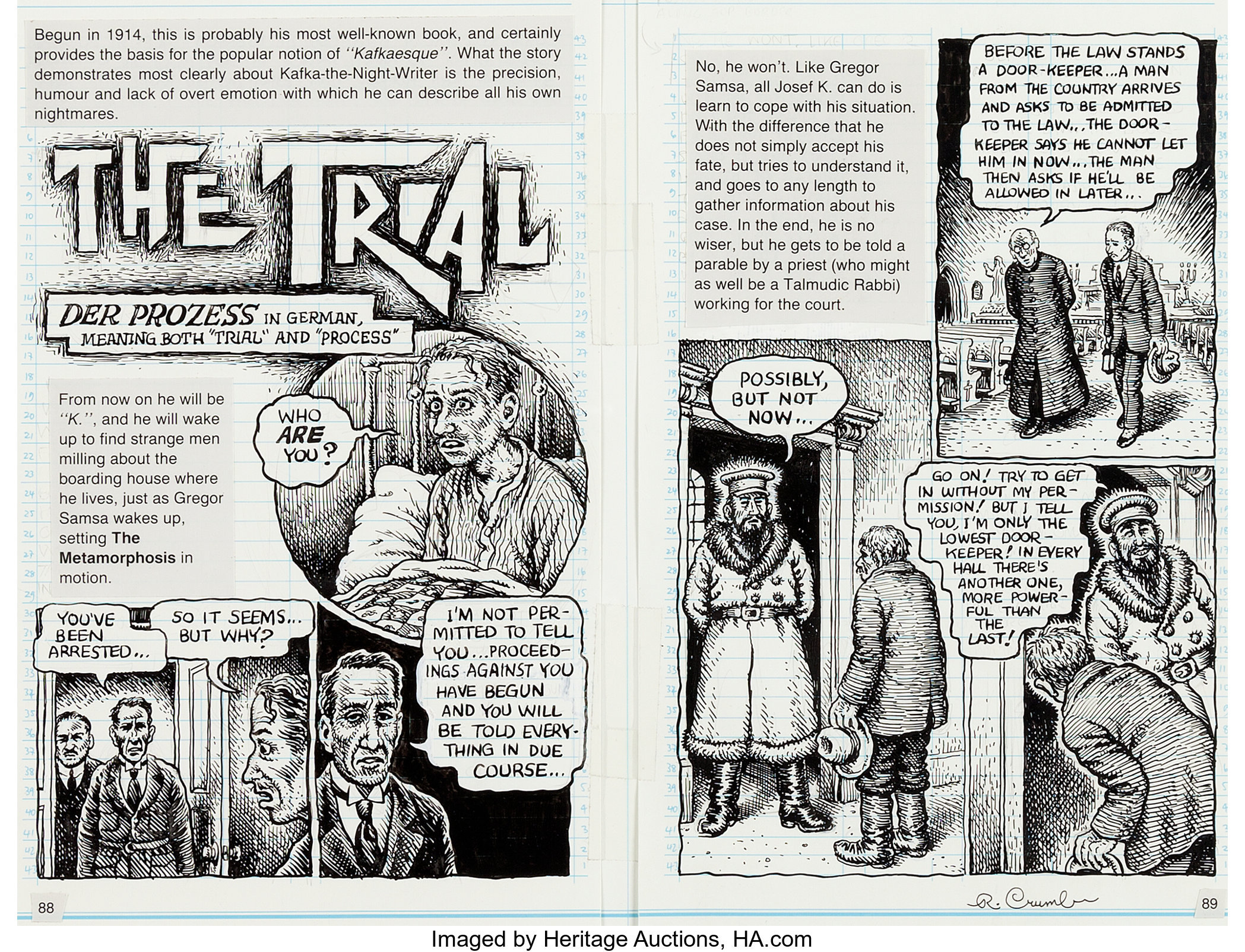
Kafka’s parable, found in his novel The Trial, “can be read as a religious allegory or as an allegory of human justice.” (see below).

The futility found in Ecclesiastes (entitled in Hebrew Kohelet) refers to a repeated theme of the biblical book, starting with its famous opening passage. While there is much disagreement about the English translation of the biblical Hebrew word hevel—air, vapor, breath, mist, smoke, futility, meaningless, absurd, pointless or useless—the line “hevel hevelim, kol hevel” it is best known in English this way:

Futility, futility, all is futility.


From Tree of Souls:The Mythology of Judaism by Howard Schwartz

BEFORE THE LAW

Before the Law stands a man guarding the door. To this doorkeeper comes a man from the country who asks to be admitted to the Law. But the doorkeeper says that he cannot grant him entry. The man thinks about it and asks if, in that case, he will be permitted to enter later. “Possibly,” says the doorkeeper, “but not now.”

As the gateway to the Law is, as always, open, and the doorkeeper steps aside, the man stoops to look within. When the doorkeeper sees this, he laughs and says, “If it tempts you that much, just try to get in. But be aware that I am mighty. And I am only the lowliest doorkeeper. From hall to hall there are doorkeepers, each mightier than the one before. Even I can no longer bear the sight of the third of these.”

The man from the country has not expected such difficulties. Surely, he thinks, the Law ought to be accessible to everybody, always, but now as he looks more carefully at the doorkeeper, with his big pointed nose and long, thin, black Tatar beard, he decides he’d rather wait for permission to enter. The doorkeeper gives him a stool and has him sit down beside the door. There he sits for days and for years. He often tries to be admitted, and wearies the doorkeeper with his pleas. The doorkeeper frequently questions him, asks him about where he comes from and many other things, but they are distant inquiries, the sort great men make, and in the end he always says that he cannot let him in yet. The man, who has equipped himself for his journey with many things, employs everything, however valuable, to bribe the doorkeeper. He takes it all, saying however, “I accept this only so you won’t think you’ve failed to do anything.”

All these long years the man watches the doorkeeper unceasingly. He forgets the other doorkeepers, and this first one seems to be the only obstacle between him and the Law. He curses his miserable luck, at first recklessly and loudly; later, as he grows old, he only grumbles to himself. He becomes childish, and since his years of scrutiny of the doorkeeper have enabled him to recognize even the fleas in his fur collar, he asks even the fleas to help change the doorkeeper’s mind. Finally his eyes grow feeble, and he doesn’t know if it’s really getting darker around him or if his eyes are only tricking him. But in the darkness he now observes an inextinguishable radiance streaming out of the door of the Law.

Now he will not live much longer. Before he dies all he has been through converges in his mind into one question that he has never yet asked the doorkeeper. He signals to him, as he can no longer raise his stiffening body. The doorkeeper has to bend down low to him, as their difference in size has altered, much to the man’s disadvantage. “What do you want to know now?” asks the doorkeeper. “There’s no satisfying you.” “Everyone struggles to reach the Law,” says the man. “How can it be that in all these years no one but me has asked to get in?” The doorkeeper recognizes that the man’s life is almost over and, because his hearing is failing, he roars at him, “No one else could be allowed in here. This entrance was intended only for you. I am now going to close it.”

* * *

This famous parable by Kafka from The Trial can be read as a religious allegory or as an allegory of human justice. Although it is generally thought of more in terms of the latter, it has the distinct elements of a religious allegory. The key image is that “of an inextinguishable radiance streaming out of the door of the Law.” This clearly suggests the eternal nature of the Law, which, of course, draws this eternal quality from God. This shifts the focus of the parable from human justice to the need for divine justice, and hints at the remoteness of God.

The doorkeeper guarding the gate to the Law is reminiscent of the angel placed at the gate of the Garden of Eden, with the flaming sword that turned every way, to guard the way to the tree of life (Gen. 3:24). Also echoed is the popular Christian conception of St. Peter serving as the doorkeeper at the Gates of Heaven.

Gershom Scholem has said that there are three pillars of Jewish mystical thought: the Bible, the Zohar, and the writings of Kafka. Thus he viewed Kafka’s writings, which have been interpreted in a multitude of ways, as mystical texts. Scholem pointed out parallels between “Before the Law” and passages in the Hekhalot texts about angels guarding the gates of the palaces of heaven. For a description of these angels, see “The Entrance of the Sixth Heavenly Palace,” p. 178. Compare this description with Kafka’s description of the doorkeeper in “Before the Law.” The parallels are striking, but since this Hekhalot text was little known during Kafka’s lifetime, it is not likely that he had direct knowledge of it. Moshe Idel also identifies the quest in this tale as the remnant of a mystical one. See Kabbalah: New Perspectives, p. 271.

Another perspective is suggested by Zohar 1:7b: Open the gates of righteousness for me . . . . This is the gateway to the Lord (Ps. 68:19-20). Assuredly, without entering through that gate one will never gain access to the most high King. Imagine a king greatly exalted who screens himself from the common view behind gate upon gate, and at the end, one special gate, locked and barred. Said the king: “He who wishes to enter into my presence must first of all pass through that gate.”

Another parallel is found in Ibn Gabirol’s eleventh century treatise, The Book of the Selection of Pearls (ch. 8): “The following laconic observations are said to have been addressed to a king, by one who stood by the gate of the royal palace, but who failed to obtain access. First: Necessity and hope prompted me to approach your throne. Second: My dire distress admits of no delay. Third: My disappointment would gratify the malice of my enemies. Fourth: Your acquiescence would confer advantages, and even your refusal would relieve me from anxiety and suspense.”

Max Brod, Kafka’s close friend and biographer, comments about this parable: “Kafka’s deeply ironic legend ‘Before the Law’ is not the reminiscence or retelling of this ancient lore, as it would seem at first glance, but an original creation drawn deeply from his archaic soul. It is yet another proof of his profound roots in Judaism, whose potency and creative images rose to new activities in his unconscious.” (Johannes Reuchlin und sein Kampf, Stuttgart: 1965, pp. 274-275).

Of course, “Before the Law” can also be read as a personal statement of the kind of obstruction Kafka experienced at the hands of his father. The role of the gatekeeper can also be identified with Kafka’s mother, for Kafka gave his mother the epic letter he wrote to his father, to pass on to him, but she decided not to do so. In such a reading Kafka’s father represents the Law, the strict, godlike figure. See Kafka’s Letter to His Father.

Also, Kafka’s parable is relevant to human justice, where, on many occasions, people have been denied justice by the very ones who were supposed to provide it for them. In doing so they perform the obstructive role of the gatekeeper, who was supposed to welcome the man from the country at the gate intended only for him, but instead prevented him from entering at all.

Readers may wonder why a modern parable by Franz Kafka has been included in a book of Jewish mythology. There are several reasons for this. Kafka’s fiction possesses a strong mythic element, and scholars have become increasingly aware of the strong influence on it of Jewish tradition; Kafka’s writing in general, and this parable in particular, has taken on the qualities of a sacred text in our time; and there are strong parallels between this parable and traditional Jewish myths about the quest to reach God, but also a strong element of doubt in Kafka’s parable that reflects the modern era. Just as the evolution of Jewish mythology did not end with the canonization of the Bible or the Talmud, and continued to flourish in the kabbalistic and hasidic era, so too it can be seen to continue in the modern era in the writings of Kafka. It also can be found in other seminal Jewish authors, such as I. L. Peretz, S. Y. Agnon, Bruno Schulz, and I. B. Singer.


Moon Plane

Imagine my surprise at dawn to find a plane heading for the moon. Safe journey! It is a long trip!

Goldfinger: The fat man who cheats at golf and loves only gold

Auric Goldfinger prepares to cheat at golf

Golden words he will pour in your ear
But his lies can’t disguise what you fear

Goldfinger (1965) is the classic James Bond movie of the Sean Connery era. (streaming on Prime)

The villain is Auric Goldfinger, a “big operator” who loves gold, only gold. He is fat, cheats at cards and golf, and tries to rob Fort Knox. He is helped by a pilot named Pussy Galore, who leads her own Flying Circus.

Pussy Galore’s Flying Circus

Goldfinger does not succeed. He is sucked out of an airplane piloted by Miss Galore.

Science note: Goldfinger kills a girl by having her covered with gold paint. Supposedly this will stop her from breathing through her skin. This is not scientifically accurate.

Culture note: If you wonder why the current movement to return to the “good old days” of 1965 is not wholly a good idea, this movie, fun as much of it is, explains.

Goldfinger
He’s the man
The man with the Midas touch
A spider’s touch
Such a cold finger
Beckons you to enter his web of sin
But don’t go in

Golden words he will pour in your ear
But his lies can’t disguise what you fear
For a golden girl knows when he’s kissed her
It’s the kiss of death from Mr. Goldfinger

He loves gold
He loves only gold

When will Trump declare himself supreme and absolute ruler, not subject to Congress, the Supreme Court, the laws and the Constitution?

When will Trump declare himself supreme and absolute ruler, not subject to Congress, the Supreme Court, the laws and the Constitution?

So far he hasn’t had to expressly declare that, with an acquiescent Republican Congress and a sympathetic Supreme Court. But that could change, a little or a lot.

If there is a change in acquiescence (sycophancy) or a change in sympathy, Trump might feel forced to declare what he already believes.

We have more than hints at his belief. “Trump 2028” is a constitutionally forbidden third term, but is already being promoted. This is not a gray area. If by some outlandish chance the Supreme Court finds a way around the clear prohibition, Trump’s declaration would actually be unnecessary. He would already be in total charge.

But what if, for the sake of argument, the Court rules he cannot run for another term. Or what if dozens of other Trump attempts at defying law and Constitution are stymied by the Congress or the courts. That will be the moment for Trump to declare a national emergency, one that exceeds the powers of Congress or the Courts to address, an emergency only he can solve. That will be the moment Trump declares himself supreme and absolute ruler, not subject to Congress, the Supreme Court, the laws and the Constitution.

For those who still go around using words like “unprecedented” and “unthinkable”, and haven’t yet dropped them from their vocabulary, you might consider doing that.