Bob Schwartz

Month: October, 2025

The Poetry of Citizenry

“You are Whitman, you are Poe, you are Mark Twain, you are Emily Dickinson and Edna St. Vincent Millay, you are Neruda and Mayakovsky and Pasolini, you are an American or a non-American, you can conquer the conquerors with words.”
Lawrence Ferlinghetti, Poetry as Insurgent Art

“There is a strong underground tradition of the poetry of engagement, which we might also call the poetry of citizenzry.”
Edward Hirsch, A Poet’s Glossary

“Poetry, an act of the imagination, is subject to historical forces, but it also talks back to history. The idea of witnessing should be widened to go beyond the documentary response to events. ‘I am the man . . . I suffered . . . I was there,’ Walt Whitman declared. A broad imaginative sympathy was part of his lived experience.”
Edward Hirsch, A Poet’s Glossary

I’ve written before about poetry as insurgent art, a term used by Lawrence Ferlinghetti. Here I add to the conversation with three entries from A Poet’s Glossary by Edward Hirsch—an essential book for those who read write study or teach poetry.

It is no surprise to regular readers that I think these are extraordinary times. And that I think people in all quarters should consider the ways they can help right the ship and steer it in a different direction. That is, all hands on deck, including poets.

How well that works, or whether it works at all, is to be determined. But as the student Sophie Scholl said of her tiny but morally mighty White Rose resistance movement in Nazi Germany, which boldly distributed simple leaflets, “Somebody, after all, had to make a start.” As well poets as anyone else.


From A Poet’s Glossary by Edward Hirsch:

political poetry

Poetry of social concern and conscience, politically engaged poetry. The feeling often runs high in the social poetry of engagement, especially when it is partisan. Poets write on both sides of any given war, defend the State, attack it. All patriotic and nationalistic poetry is by definition political. Political poetry, ancient and modern, good and bad, frequently responds vehemently to social injustice. Thus the poet is Jeremiah crying out to the assembly to witness the folly, unprecedented in both West (Cyprus) and East (Kedar), of a people who have forsaken the fountain of living waters for the stagnant water at the bottom of a leaky cistern. The Lamentations of Jeremiah, a series of poems mourning the desolation of Jerusalem and the sufferings of her people after the siege and destruction of the city and the burning of theTemple by the Babylonians, is also a political poem.

Strabo came up with the label stasiotika (“stasis-poems”) for Alcaeus’s partisan songs, political poems, which are propagandistic poems of civil war and exile, accounts of his political commitments. The premise of political poetry is that poetry carries “news” or information crucial to the populace. Political poetry is a poetry self-consciously written inside of history, of politics. It responds to external events. “Mad Ireland hurt you into poetry,” W. H. Auden famously decreed in his elegy for W. B. Yeats, and so, too, we might say that the madness of any country’s brutality has often wounded its poets into a political response in poetry. “I stand as a witness to the common lot, / survivor of that time, that place,” Anna Akhmatova wrote in 1961. Behind the poem in quest of justice, these lines from Shakespeare’s Antony and Cleopatra (1623): “our size of sorrow, / Proportion’d to our cause, must be as great / As that which makes it.”

There is an ephemeral quality to a lot of political poetry—most of it dies with the events it responds to—but a political poem need not be a didactic poem. It can be a poem of testimony and memory. For the best political poems of the twentieth century, I think of Vahan Tekeyan’s poems of the Armenian genocide; of the Spanish Civil War poet Miguel Hernandez’s haunting prison poems, especially “Lullaby of the Onion” (1939); and the Turkish poet Nazim Hikmet’s equally poignant prison poems, especially “On Living” (1948) and “Some Advice to Those Who Will Spend Time in Prison” (1949); of Bertolt Brecht’s World War II poems and Nelly Sachs’s Holocaust poems. I think of the Italian poet Cesare Pavese’s testimonies to ordinary people in trouble, Hard Labor (Lavorare stanca, 1936), and Pablo Neruda’s epic testament, Canto General (1950). I think of the many poems of indictment and summons, of land and liberty, collected in the Nigerian writer Wole Soyinka’s breakthrough anthology, Poems of Black Africa (1975).

There is a strong tradition in England of political poems. Edmund Spenser’s Complaints (1591) takes aim at social and political targets. John Milton wrote a series of pro-Cromwellian short poems in the 1640s and ’50s. Some of John Dryden’s greatest poetry was written in response to events, such as his two-part political satire Absalom and Achitophel (1681, 1682). William Wordsworth’s political poems are among his best, such as his sonnet “To Toussaint L’Ouverture” (1803), though a few of his late patriotic poems are also among his worst. Percy Bysshe Shelley’s The Mask of Anarchy (1819), which was “Written on the Occasion of the Massacre at Manchester” (“I met Murder on the way—/ He had a mask like Castlereagh”), is a frankly political poem that always gives me a chill. Elizabeth Barrett Browning published two striking books of political poetry during her Italian sojourn, Casa Guidi Windows (1850) and Poems Before Congress (1860). The most popular Victorian poet, Alfred, Lord Tennsyon, never distinguished between the personal and the political, the private and the public.

Political poetry has always seemed somewhat suspect in American literary history. “Our wise men and wise institutions assure us that national political events are beyond the reach of ordinary, or even extraordinary, literary sensitivity,” Robert Bly writes. Yet there is a strong underground tradition of the poetry of engagement, which we might also call the poetry of citizenzry. This runs from Walt Whitman’s political poems of the 1850s, which prefigure Leaves of Grass, and John Greenleaf Whittier’s Anti-Slavery Poems (1832–1887), to leftist poets of the 1930s (Kenneth Fearing, Edwin Rolfe, Muriel Rukeyser). The civil rights movement and the Vietnam War enraged poets, and, as Bly points out, some of the most inward poets, such as Robert Duncan, Denise Levertov, and Galway Kinnell, wrote some of the best poems against the Vietnam War. Most poetry of the 1940s and ’50s shunned politics, but Thomas McGrath (“Ode for the American Dead in Korea,” retitled in the early 1970s “Ode for the American Dead in Asia”) and Kenneth Rexroth (“A Christmas Note for Geraldine Udell,” 1949) bucked the trend. For forty years, Adrienne Rich was one of the most outspoken political poets in late twentieth-century American poetry, a model for a generation of political and activist poets. She went through several phases in relationship to polemics. She proposed a position that resists didacticism in “Power and Danger: Works of a Common Woman” (1978), her introduction to a collection of poems by Judy Grahn:

No true political poetry can be written with propaganda as an aim, to persuade others “out there” of some atrocity or injustice (hence the failure, as poetry, of so much anti-Vietnam poetry of the sixties). As poetry, it can come only from the poet’s need to identify her relationship to atrocities and injustice, the sources of her pain, fear, and anger, the meaning of her resistance.

protest poetry 

Poetry of dissent, of social criticism. It protests the status quo and tries to undermine established values and ideals. The protest poet is a rebellious citizen, speaking out, expressing disapproval of a political policy or social action. Protest poetry, the most earnest of genres, is timely, oppositional, reactive, urgent. It is an activist type of political poetry born from outrage and linked to social action. It turns poetry into a medium for polemics.

The reprehensible policy of apartheid in South Africa, which legislated racism, also stimulated a powerful tradition of protest poetry. The Zulu poet Herbert I. E. Dhlomo’s long poem Valley of a Thousand Hills (1941) is the most extended work of South African protest poetry. One thinks of the contributions of Dennis Brutus (1924–2009), whose work is brought together in Poetry and Protest: A Dennis Brutus Reader (2006); Arthur Nortje (1942–1970), whose work is published posthumously in Dead Roots (1973) and Lonely Against the Light (1973); and Mazisi Kunene (1930–2006), who first sounded his aggressive, telegraphic note in Zulu Poems (1970). The New Black poetry of the 1970s, or Soweto poetry, was a protest poetry of black consciousness. In the United States, there is also a strong tradition of African American poetry that protests racism. It extends from the Harlem renaissance to the Black Arts movement. Most antiwar poetry is protest poetry. The combatant antiwar poetry of Wilfred Owen (1893–1918) and Siegfried Sassoon (1886–1967) protested the technological horrors of modern warfare. The Spanish Civil War generated both local and global protest poetry. The Vietnam War galvanized a tremendous amount of protest poetry by such poets as Robert Lowell, Allen Ginsberg, Adrienne Rich, and Robert Bly. These poets felt a cultural imperative to speak out against the war. The repression and disintegration of the American imagination is one of the persistent themes of Vietnam-era protest poetry. Much of the feminist poetry of the 1960s and ’70s is protest poetry. “A patriot is not a weapon,” Adrienne Rich writes in her long poem An Atlas of the Difficult World (1981). “A patriot is one who wrestles for the soul of her country / as she wrestles for her own being.” Sam Hamill’s anthology Poets Against the War (2003) was a hastily gathered book of protest poems against the war in Iraq. The strength of protest poetry is its sense of immediacy and outrage. However, most of these politically motivated poems, which are often made in outrage against a specific atrocity, don’t outlive their historical moment.

witness of poetry, poetry of witness 

Poetry of testimony. In the early 1990s, Carolyn Forché transformed the Polish poet Czeslaw Milosz’s phrase the witness of poetry (taken from the book of the same name, 1983) into “the poetry of witness.” Her anthology Against Forgetting: Twentieth-Century Poetry of Witness (1993) gathers together the work of 145 poets “who endured conditions of historical and social extremity during the twentieth century—through exile, state censorship, political censorship, house arrest, torture, imprisonment, military occupation, warfare, and assignation. Many poets did not survive, but their works remain with us as poetic witness to the dark times in which they lived.” Poetry, an act of the imagination, is subject to historical forces, but it also talks back to history. The idea of witnessing should be widened to go beyond the documentary response to events. “I am the man . . . I suffered . . . I was there,” Walt Whitman declared. A broad imaginative sympathy was part of his lived experience.

In 1944, the Hungarian poet Miklós Radnóti wrote four harrowing “Postcard” poems in the midst of a forced march westward across Hungary. Radnóti was one of twenty-two prisoners murdered and tossed into a collective grave. After the war, his widow had his body exhumed and these poems were found in his field jacket, written in pencil in a small Serbian exercise book. Thus his poems nearly literally rise up from a mass grave. They inscribe a suffering unimaginably intense, a consciousness of death nearly unbearable. They are purposefully entitled “Postcards.” Here the informality of the postcard (dashed off, superficial) is belied by the scrupulousness with which Radnóti describes and re-creates the scene of his impending death. The postcard is a message directed to another person. It has a particular reader in mind, but its openness also suggests that it can be read by anyone. Thus the poem in the guise of a postcard is a testimony back to life, a signal that Radnóti had pushed back the silence long enough to embody a final experience. His poems of witness display the classical brevity and poise of an Orphic art that comes back from the underworld to give testimony.
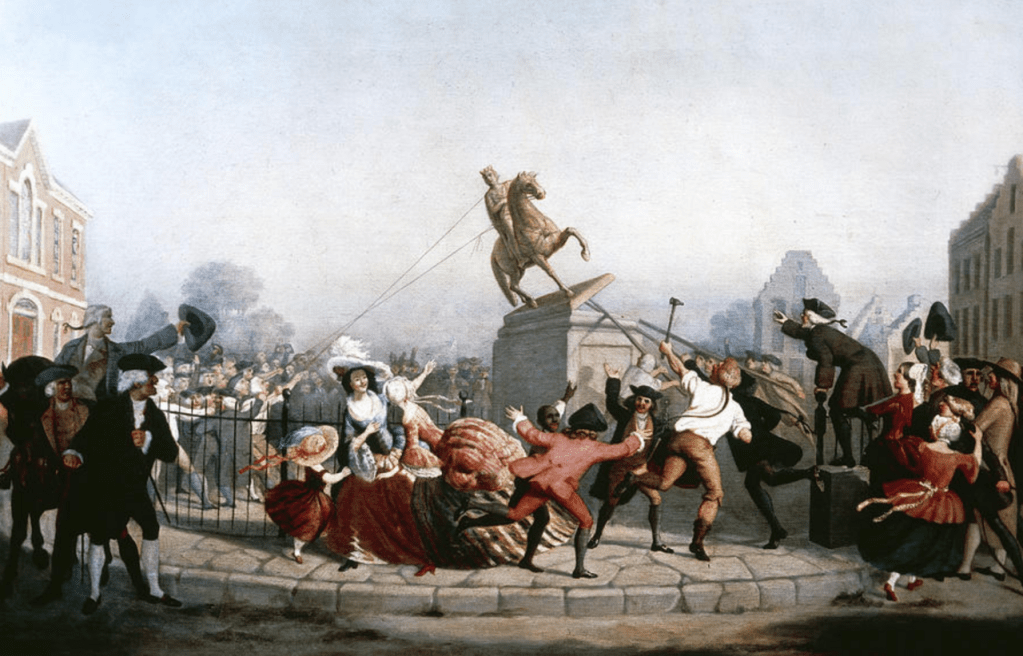
No Kings: 1776 and now

Pulling down the statue of Mad King George III at Bowling Green, New York City, July 9,1776 (painting by William Walcutt, 1854).

PLEASE go back and read this recent post: ‘I love Hitler’: Leaked messages expose Young Republicans’ racist chat.

I have never before begged readers to go back and read a previous post or the underlying Politico exclusive. This is the exception. It is that important, but has not gotten the media attention it deserves.

It is important because the Republican Party, the party in power, knowingly or negligently has become a haven and breeding ground for future leaders who are hateful, racist, misogynistic, antisemitic fans of Hitler and Nazism.

This is not to say the Republican Party is entirely, or mostly, filled with haters, racists, misogynists, antisemites and fans of Hitler and Nazism. But if the party hasn’t already figured out before this revelation that a number of its future leaders are and have been just that, the party doesn’t deserve to lead America. Because one day, those leaders of tomorrow, especially the many others not in this chat, become the leaders of today.

Democracy and distractions

The quality and well-being of government, which in America is some form of constitutionally-supported democracy, is inversely proportional to the volume, availability, intensity and attractiveness of non-essential distractions.

Trump’s university compact: What would Ben Franklin (founder University of Pennsylvania) and Thomas Jefferson (founder University of Virginia) do?

Trump is not a student of history and not a student of higher education.

He doesn’t know or care that two of the nine universities that received his demand for his academic hegemony were founded by Ben Franklin (University of Pennsylvania) and Thomas Jefferson (University of Virginia), eminent figures in the founding of America on a platform of freedom.

The University of Pennsylvania just rejected the offered compact, as have three of the other schools. The University of Virginia has expressed opposition, but no decision has been announced.

If the remaining universities need inspiration and encouragement, beyond what other schools have already done, I suggest asking the questions: WWBFD and WWTJD. I think they and we know.

Two postscripts:

The seal of the University of Pennsylvania includes its motto: Leges sine moribus vanae. Laws without morals are in vain.

Trump University was an education scam perpetrated by Trump before he became president. It offered a few seminars, but nothing like a degree. It folded in the wake of numerous lawsuits. But it did have a big beautiful logo.

Coyote meets the Desert Fathers

For MC

The Desert Fathers were early Christian hermits and ascetics who withdrew to the Egyptian desert in the 3rd-4th centuries CE to pursue spiritual perfection through prayer, solitude, and self-discipline.


If we want to set our lives right and find peace,
it is not the tolerant attitude of others
that will do it for us.
It will come about, rather, by our learning
how to show compassion to them.
If we try to avoid this hard struggle of compassion,
by preferring a withdrawn and solitary life,
we will simply drag our unhealed obsessions
into solitude with us.
We might well have hidden them.
We certainly will not have eliminated them.
If we do not seek liberation from our obsessions,
then becoming more withdrawn and less social
may even make us more blind to them,
since it can mask them.
—John Cassian


We cannot escape anything by consenting tacitly to be defeated.

“We cannot escape anything by consenting tacitly to be defeated. Despair is an abyss without bottom. Do not think to close it by consenting to it and trying to forget you have consented.”


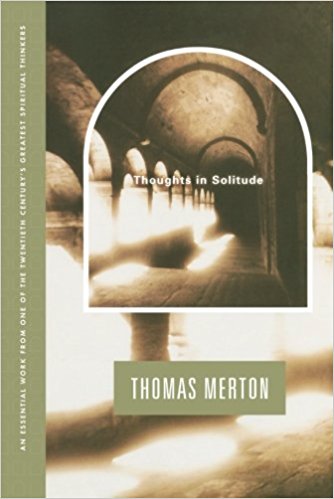
From Thomas Merton, Thoughts in Solitude:

The Desert Fathers believed that the wilderness had been created as supremely valuable in the eyes of God precisely because it had no value to men. The wasteland was the land that could never be wasted by men because it offered them nothing. There was nothing to attract them. There was nothing to exploit. The desert was the region in which the Chosen People had wandered for forty years, cared for by God alone. They could have reached the Promised Land in a few months if they had travelled directly to it. God’s plan was that they should learn to love Him in the wilderness and that they should always look back upon the time in the desert as the idyllic time of their life with Him alone.

The desert was created simply to be itself, not to be transformed by men into something else. So too the mountain and the sea. The desert is therefore the logical dwelling place for the man who seeks to be nothing but himself—that is to say, a creature solitary and poor and dependent upon no one but God, with no great project standing between himself and his Creator.

This is, at least, the theory. But there is another factor that enters in. First, the desert is the country of madness. Second, it is the refuge of the devil, thrown out into the “wilderness of upper Egypt” to “wander in dry places.” Thirst drives man mad, and the devil himself is mad with a kind of thirst for his own lost excellence—lost because he has immured himself in it and closed out everything else.

So the man who wanders into the desert to be himself must take care that he does not go mad and become the servant of the one who dwells there in a sterile paradise of emptiness and rage….

The desert is the home of despair. And despair, now, is everywhere. Let us not think that our interior solitude consists in the acceptance of defeat. We cannot escape anything by consenting tacitly to be defeated. Despair is an abyss without bottom. Do not think to close it by consenting to it and trying to forget you have consented.


‘I love Hitler’: Leaked messages expose Young Republicans’ racist chat. Thousands of private messages reveal young GOP leaders joking about gas chambers, slavery and rape.

It is hard to know how best to post about this explosive story, a Politico exclusive:


‘I love Hitler’: Leaked messages expose Young Republicans’ racist chat
Thousands of private messages reveal young GOP leaders joking about gas chambers, slavery and rape.


This is a story about the future of the Republican Party, and about its serving as a safe haven and even incubator for haters. The story should be seen by every American, but it probably won’t be, because much of the mainstream media will be fearful of upsetting those in power.

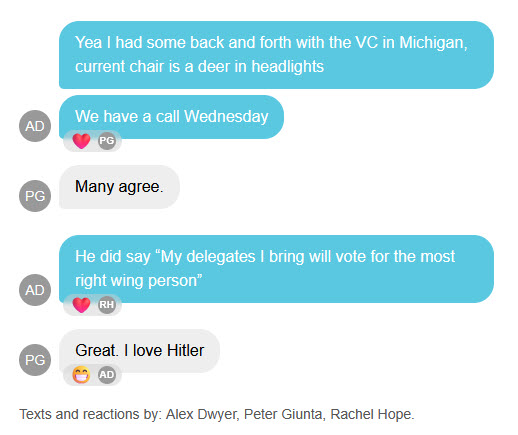
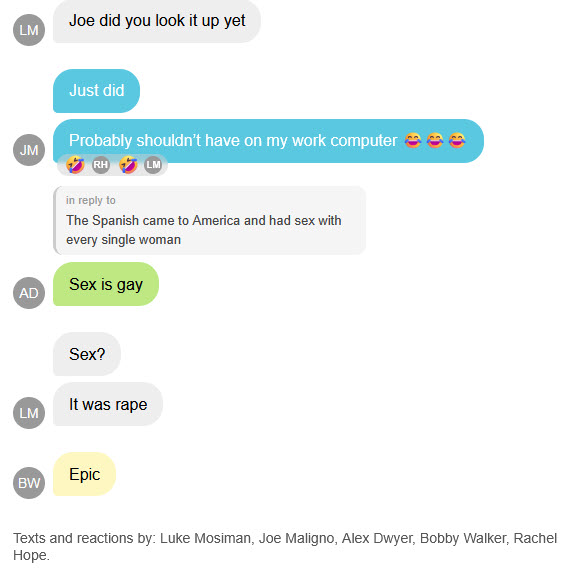
The story as published in Politico punctuates the text with graphics of a few of the chat conversations. Here I have put those graphic chats up front, followed by text of the entire story, in case you don’t link out to it.

The closing chat quote from one of the future GOP leaders is infinitely ironic:

“If we ever had a leak of this chat we would be cooked fr fr,” he wrote.

Let’s hope that this cooks them and the party for real for real.


Politico Exclusive

‘I love Hitler’: Leaked messages expose Young Republicans’ racist chat
Thousands of private messages reveal young GOP leaders joking about gas chambers, slavery and rape.
Texts and reactions from Young Republicans.
By Jason Beeferman and Emily Ngo
10/14/2025 01:15 PM EDT

NEW YORK — Leaders of Young Republican groups throughout the country worried what would happen if their Telegram chat ever got leaked, but they kept typing anyway.

They referred to Black people as monkeys and “the watermelon people” and mused about putting their political opponents in gas chambers. They talked about raping their enemies and driving them to suicide and lauded Republicans who they believed support slavery.

William Hendrix, the Kansas Young Republicans’ vice chair, used the words “n–ga” and “n–guh,” variations of a racial slur, more than a dozen times in the chat. Bobby Walker, the vice chair of the New York State Young Republicans at the time, referred to rape as “epic.” Peter Giunta, who at the time was chair of the same organization, wrote in a message sent in June that “everyone that votes no is going to the gas chamber.”

Giunta was referring to an upcoming vote on whether he should become chair of the Young Republican National Federation, the GOP’s 15,000-member political organization for Republicans between 18 and 40 years old.

The exchange is part of a trove of Telegram chats — obtained by POLITICO and spanning more than seven months of messages among Young Republican leaders in New York, Kansas, Arizona and Vermont. The chat offers an unfiltered look at how a new generation of GOP activists talk when they think no one is listening.

Since POLITICO began making inquiries, one member of the group chat is no longer employed at their job and another’s job offer was rescinded. Prominent New York Republicans, including Rep. Elise Stefanik and state Senate Minority Leader Rob Ortt, have denounced the chat. And festering resentments among Young Republicans have now turned into public recriminations, including allegations of character assassination and extortion.
A liberating atmosphere

The 2,900 pages of chats, shared among a dozen millennial and Gen Z Republicans between early January and mid-August, chronicle their campaign to seize control of the national Young Republican organization on a hardline pro-Donald Trump platform. Many of the chat members already work inside government or party politics, and one serves as a state senator.

Together, the messages reveal a culture where racist, antisemitic and violent rhetoric circulate freely — and where the Trump-era loosening of political norms has made such talk feel less taboo among those positioning themselves as the party’s next leaders.

“The more the political atmosphere is open and liberating — like it has been with the emergence of Trump and a more right wing GOP even before him — it opens up young people and older people to telling racist jokes, making racist commentaries in private and public,” said Joe Feagin, a Texas A&M sociology professor who has studied racism for the last 60 years. He’s also concerned the words would be applied to public policy. “It’s chilling, of course, because they will act on these views.”

The dynamic of easy racism and casual cruelty played out in often dark, vivid fashion inside the chats, where campaign talk and party gossip blurred into streams of slurs and violent fantasies.

The group chat members spoke freely about the pressure to cow to Trump to avoid being called a RINO, the love of Nazis within their party’s right wing and the president’s alleged work to suppress documents related to wealthy financier Jeffrey Epstein’s child sex crimes.

‘They’re causing real harm’: Kevin Hassett on the Dems’ shutdown strategy

“Trumps too busy burning the Epstein files,” Alex Dwyer, the chair of the Kansas Young Republicans, wrote in one instance.

Dwyer and Kaykaty declined to comment. Maligno and Hendrix did not return requests for comment.

But some involved in the chat did respond publicly.

Giunta claimed the release of the chat is part of “a highly-coordinated year-long character assassination led by Gavin Wax and the New York City Young Republican Club” — an allusion to a once obscured internecine war that has now spilled into the open.

“These logs were sourced by way of extortion and provided to POLITICO by the very same people conspiring against me,” he said. “What’s most disheartening is that, despite my unwavering support of President Trump since 2016, rouge [sic] members of his administration — including Gavin Wax — have participated in this conspiracy to ruin me publicly simply because I challenged them privately.”

Wax, a staffer in Trump’s State Department, formerly led the New York Young Republican Club — a separate, city-based group that is at odds with the state organization, the New York State Young Republicans. He declined to comment.

Despite his allusions to infighting, Giunta still apologized.

“I am so sorry to those offended by the insensitive and inexcusable language found within the more than 28,000 messages of a private group chat that I created during my campaign to lead the Young Republicans,” he said. “While I take complete responsibility, I have had no way of verifying their accuracy and am deeply concerned that the message logs in question may have been deceptively doctored.”

At least one person in the Telegram chat works in the Trump administration: Michael Bartels, who, according to his LinkedIn account, serves as a senior adviser in the office of general counsel within the U.S. Small Business Administration. Bartels did not have much to say in the chat, but he didn’t offer any pushback against the offensive rhetoric in it either. He declined to comment.

A notarized affidavit signed by Bartels and obtained by POLITICO also sheds light on the intraparty rivalry that led the “RESTOREYR WAR ROOM” Telegram chat to be made public. Bartels references Wax as well. He wrote that he did not give POLITICO the chat and that Wax “demanded” in a phone call that he provide the full chat log.

“When I attempted to resist that demand, after providing some of the requested information, Wax threatened my professional standing, and raised the possibility of potential legal action related to an alleged breach of a non-disclosure agreement,” Bartels claimed in the affidavit. “My position within the New York Young Republican Club was directly threatened.”

Various blue, green and gray chat bubbles with censored offensive language and rhetoric with emojis overlapped on top of each other.

Walker, who now leads the New York State Young Republicans, touched on a similar theme, saying that he believes portions of the chat “may have been altered, taken out of context, or otherwise manipulated” and that the “private exchanges were obtained and released in a way clearly intended to inflict harm.”

He also apologized.

“There is no excuse for the language and tone in messages attributed to me. The language is wrong and hurtful, and I sincerely apologize,” Walker said. “This has been a painful lesson about judgment and trust, and I am committed to moving forward with greater care, respect, and accountability in everything I say and do.”

251 times

Mixed into formal conversations about whipping votes, social media strategy and logistics, the members of the chat slung around an array of slurs — which POLITICO is republishing to show how they spoke. Epithets like “f—-t,” “retarded” and “n–ga” appeared more than 251 times combined.

In one instance, Walker — who at the time was a staffer for Ortt — talked about how a mutual friend of some in the chat “dated this very obese Indian woman for a period of time.”

Giunta responded that the woman “was not Indian.”

“She just didn’t bathe often,” Samuel Douglass, a state senator from northern Vermont and the head of the state’s Young Republicans, replied to Giunta.

In a separate conversation, Giunta shared that his flight to Charleston, South Carolina, landed safely. Then, he offered some advice for his fellow Young Republicans.

“If your pilot is a she and she looks ten shades darker than someone from Sicily, just end it there. Scream the no no word,” Giunta wrote.

Douglass did not respond to requests for comment.

In a statement, Ortt called for members of the chat to resign.

“I was shocked and disgusted to learn about the racist, anti-Semitic, and misogynistic comments attributed to members of the New York State Young Republicans,” Ortt said. “This behavior is indefensible and has no place in our party or anywhere in public life.”

Walker had been in line to manage Republican Peter Oberacker’s campaign for Congress in upstate New York, but a spokesperson for the campaign said Walker won’t be brought on in light of the comments in the chat.

Seeking Trump’s endorsement

The private rhetoric isn’t happening in a vacuum. It comes amid a widespread coarsening of the broader political discourse and as incendiary and racially offensive tropes from the right become increasingly common in public debate. Last month, Trump posted an artificial intelligence-generated video that showed House Minority Leader Hakeem Jeffries in a sombrero beside Senate Minority Leader Chuck Schumer, whose fabricated remarks were about trading free health care for immigrant votes — a false, long-running GOP trope. The sombrero meme has been widely used to mock Democrats as the government shutdown wears on.

In his 2024 campaign, Trump spread false reports of Haitian migrants eating pets and, at one of his rallies, welcomed comedian Tony Hinchcliffe, who called Puerto Rico a “floating island of garbage” and joked about Black people “carving watermelons” on Halloween.

Liz Huston, a White House spokesperson, rejected the idea that Trump’s rhetoric had anything to do with the chat members’ language.

“Only an activist, left-wing reporter would desperately try to tie President Trump into a story about a random groupchat he has no affiliation with, while failing to mention the dangerous smears coming from Democrat politicians who have fantasized about murdering their opponent and called Republicans Nazis and Fascists,” she said. “No one has been subjected to more vicious rhetoric and violence than President Trump and his supporters.”

In the “RESTOREYR WAR ROOM” chat, Giunta tells his fellow Republicans that he spoke with the White House about an endorsement from Trump for his bid to become chairman of the national federation. Trump and the Republican National Committee ultimately decided to stay neutral in the race.

A White House official said that it has no affiliation with Restore YR and that hundreds of groups ask the White House for its endorsement.

Giunta was the most prominent voice in the chat spreading racist messages — often encouraged or “liked” by other members.

When Luke Mosiman, the chair of the Arizona Young Republicans, asked if the New Yorkers in the chat were watching an NBA playoff game, Giunta responded, “I’d go to the zoo if I wanted to watch monkey play ball.” Giunta elsewhere refers to Black people as “the watermelon people.”

Hendrix made a similar remark in July: “Bro is at a chicken restaurant ordering his food. Would he like some watermelon and kool aid with that?”

Hendrix was a communications assistant for Kansas’ Republican Attorney General Kris Kobach until Thursday. He also said in the chat that, despite political differences, he’s drawn to Missouri’s Young Republican organization because “Missouri doesn’t like f–s.”

POLITICO reached out to Danedri Herbert, a spokesperson for the attorney general who also serves as the Kansas GOP chair, and shared with her excerpts of the chat involving Hendrix. In response, Herbert said that “we are aware of the issues raised in your article” and that Hendrix is “no longer employed” in Kobach’s office.

In another exchange, Dwyer, the Kansas’ chair, informs Giunta that one of Michigan’s Young Republicans promised him the group “will vote for the most right wing person” to lead the national organization.

“Great. I love Hitler,” Giunta responded.

Dwyer reacted with a smiley face.

Few minority groups spared

Giunta, who serves as chief of staff to New York state Assemblymember Mike Reilly, ultimately fell six points short of winning the chairship to lead the Young Republican National Federation earlier this year — despite earning endorsements from Stefanik and longtime Trump adviser Roger Stone.

Reilly did not respond to requests for comment.

Earlier this year, Stefanik accepted an award from the New York State Young Republicans. She lauded Giunta for his “tremendous leadership” in August and had her campaign and the political PAC she leads donate to that state organization. Alex deGrasse, a senior adviser for Stefanik, said the congresswoman “was absolutely appalled to learn about the alleged comments made by leaders of the New York State Young Republicans and other state YRs in a large national group chat.”

“According to the description provided by Politico, the comments were heinous, antisemitic, racist and unacceptable,” he continued, noting Stefanik has never employed anyone in the chat. “If the description by Politico is accurate, Congresswoman Stefanik calls for any NY Young Republicans responsible for these horrific comments in this chat to step down immediately.”

Stone also condemned the comments in a statement.

“I of course, have never seen this alleged chat room thread,” he said. “If it is authentic, I would, of course, denounce any such comments in the strongest possible terms, This would surprise me as it is inconsistent with Peter that I know, although I only know him in his capacity as the head of the New York Young Republicans, where I thought he did a good job.”

Few minority groups are spared from the Young Republican group’s chat. Their rhetoric — normalized at most points as dark humor — mirrors some popular conservative political commentators, podcasters and comedians amid a national erosion of what’s considered acceptable discourse.

Giunta’s line on a darker-skinned pilot, for example, echoes one used by slain conservative activist Charlie Kirk last year when he said, “If I see a Black pilot, I’m going to be like, boy, I hope he’s qualified.” Kirk was discussing how diversity hiring “invites unwholesome thinking.”

Walker also uses the moniker “eyepatch McCain” (originally coined by conservative commentator Tucker Carlson) in an apparent reference to GOP Rep. Dan Crenshaw. Crenshaw lost his eye while serving as a Navy SEAL in Afghanistan. Walker also makes the remark, “I prefer my war heroes not captured,” a repeat of a similar 2015 line from Trump.

Art Jipson, a professor at the University of Dayton who specializes in white racial extremism, surmised the Young Republicans in the chat were influenced by Trump’s language, which he said is often hyperbolic and emotionally charged.

“Trump’s persistent use of hostile, often inflammatory language that normalizes aggressive discourse in conservative circles can be incredibly influential on young operatives who are still trying to figure out, ‘What is that political discourse?’” Jipson said.
White supremacist symbols

Jipson reviewed multiple excerpts of the Young Republicans’ chat provided by POLITICO. One was a late July message where Mosiman, the chair of the Arizona Young Republicans, mused about how the group could win support for their preferred candidate by linking an opponent to white supremacist groups. But Mosiman then realized the plan could backfire — Kansas’ Young Republicans could end up becoming attracted to that opponent.

“Can we get them to start releasing Nazi edits with her… Like pro Nazi and faciam [sic] propaganda,” he asked the group.

“Omg I love this plan,” Rachel Hope, the Arizona Young Republicans events chair, responded.

“The only problem is we will lose the Kansas delegation,” Mosiman said. Hope and the two Kansas Young Republicans in the chat reacted with a laughing face to the message. Hope did not respond to requests for comment. Mosiman declined to comment.

Jipson said the Young Republicans’ conversations reminded him of online discussions between members of neo-Nazi and white supremacist groups.

“You say it once or twice, it’s a joke, but you say it 251 times, it’s no longer a joke,” Jipson said. “The more we repeat certain ideas, the more real they become to us.”

Weeks later, someone in the chat staying in a hotel asks its members to “GUESS WHAT ROOM WE’RE IN.”

“1488,” Dwyer responds. White supremacists use the number 1488 because 14 is the number of words in the white supremacist slogan “We must secure the existence of our people and a future for white children.” H is the eighth letter in the alphabet, and 88 is often used as a shorthand for “Heil Hitler.”

In another conversation in February, Giunta talks approvingly about the Orange County Teenage Republican organization in New York — which appears to be part of the network of national Teen Age Republicans — and how he was pleased with its young members’ ideological bent.

“They support slavery and all that shit. Mega based,” he said. The term “based” in internet culture is used to express approval with an idea, often one that’s bold or controversial.

In a statement, Orange County GOP Chair Courtney Canfield Greene said the party was disappointed to learn its teen group was mentioned in the chat.

“Our teen volunteers have no affiliation with the NYSYR’s or the YRNF,” she said. “This behavior has no home within the Republican Party in Orange County.”

Ed Cox, the chair of the New York State GOP, also condemned the remarks made in the chat.

“I was shocked and disgusted to learn about the reports of comments made by a small group of Young Republicans,” he said. “Just as we call out vile racist and anti-Semetic rhetoric on the far left, we must not tolerate it within our ranks.”

Vicious words for enemies

Members of the Telegram chat speak about their personal lives, too. Extensive discussions about their everyday lives include one exchange about how devoutly Catholic some chat members are and how often they attend church.

Many of the slurs, epithets and violent language used in the chat often appear to be intended as jokes.

Mosiman was derided by members of the chat as “beaner” and “sp-c.”

“Stay in the closet f—-t,” Walker of New York also jested in July, though he is the group’s main target for the same epithet.

The group used slurs against Asians, too.

“My people built the train tracks with the Chinese,” Walker says at one point, referring to his Italian ancestors.

“Let his people go!” Maligno responds. “Keep the ch–ks, though.”

In another instance, Mosiman tells the group that, “The Spanish came to America and had sex with every single woman.”

“Sex is gay,” Dwyer writes.

“Sex? It was rape,” Mosiman replies.

There’s more explicit malice in some phrases, too, especially when they turn their ire on opponents outside the chat, such as the leader of the rival Grow YR slate, Hayden Padgett, who defeated Giunta and was reelected chairman of the Young Republican National Federation this summer.

“So you mean Hayden F—-t wrote the resolution himself?” Giunta asked the group about the National Young Republicans chair in late May.

“RAPE HAYDEN,” Mosiman declared the following month.

“Adolf Padgette is in the F—-tbunker as we speak,” Walker said in July.

Padgett responded to the chat’s language in a statement.

“The Young Republican National Federation condemns all forms of racism, antisemitism, and hate,” Padgett said. “I want to be clear that such behavior is entirely inconsistent with our values and has no place within our organization or the broader conservative movement.”
Samuel Douglass is pictured.

Samuel Douglass. | Vermont Legislature

Giunta also had expletive-laden criticism for the Young Republicans in states that were supporting or leaning toward Padgett’s faction.

“Minnesota – f—-ts,” he messaged, continuing: “Arkansas – inbred cow fuckers Nebraska – revolt in our favor; blocked their bind and have a majority of their delegates Maryland – fat stinky Jew … Rhode Island – traitorous c—s who I will eradicate from the face of this planet.”

Giunta also said he planned to make one of the competing Young Republicans “unalive himself on the convention floor.”

In another instance, Douglass, the Vermont state senator, describes to the group members how one of Padgett’s Jewish colleagues may have made a procedural error related to the number of Maryland delegates permitted at the national convention.

“I was about to say you’re giving nationals to [sic] much credit and expecting the Jew to be honest,” Brianna Douglass, Sam’s wife and Vermont Young Republican’s national committee member, replied to her husband’s message. Brianna Douglass did not respond to repeated requests for comment.
‘If we ever had a leak of this chat…’

While reporting this article, POLITICO was examining a separate allegation: that Giunta and the Young Republicans mismanaged the New York organization’s finances and hadn’t paid at least one venue for a swanky holiday party it hosted last year. POLITICO’s report detailed how the organization was missing required financial disclosure forms and how their subsequent efforts to file the forms revealed the organization was in more than $28,000 of debt. As of Tuesday, updated records show the organization is in more than $38,000 of debt.

Donations to New York State Young Republicans’ political account must be reported to the state Board of Elections. Expenditures must be reported too.

At the time, Giunta told POLITICO the allegations were “nothing more than a sad and pathetic attempt at a political hit job.” But in their “RESTOREYR WAR ROOM” chat, he and Walker speak flippantly about mishandling the club’s finances.

“NYSYR Account be like: $500 – Balding cream $1,000 – Ozempik,” Walker said in one message. “NYSYR will be declaring bankruptcy after this I just know it,” he said in another.

“I drained $10k tonight to pay for my next vacation to Italy,” Giunta appeared to joke about the organization’s bank account.

“I spent it on massage,” he says of another check that was deposited in the account.

“Great. Can’t wait to get sued by our venue,” Walker replies.

Members of the chat occasionally appeared to be aware of its toxicity and even made remarks that considered the possibility someone outside their tight-knit group could view it.

Walker seemed to consider that possibility the most.

In one instance, he joked about bombing the Young Republican National Federation’s convention in Nashville and then remarked, “Just kidding for our assigned FBI tracker.”

In another, he considered the totality of the thousands of messages he and his peers had written, and what would happen if the public saw them come to light.

“If we ever had a leak of this chat we would be cooked fr fr,” he wrote.

© 2025 POLITICO LLC


The more we think about Trump the less time we have to think about being better and having a better life.

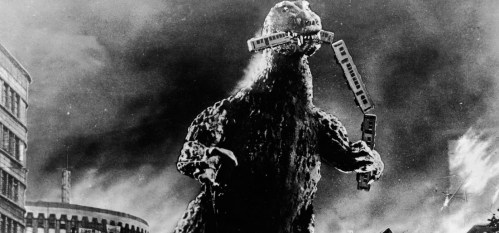
That’s Godzilla above. The monster was created in Japan after World War II, embodying the dangers of the atomic weapons that had destroyed two Japanese cities, but also embodying the evil that haunted a war-ravaged nation.

Trump owns the minds of millions, positively for some, negatively for many more. Part of that ownership is about who the people are in that regime, part of it is about how much he and they have changed the face of America and our lives.

As a practical matter, we can’t move on from Trump and company. They will be with us for more than another three years.

As a mind matter, we have a choice. Some things can’t beneficially be ignored, especially when we can envision remediation and taking effective counteraction, because those things directly affect our lives and the lives of those around us. But we can and should spend more balanced time thinking about how we as people can be better, despite the circumstances, and about the better life that can happen once we are better.

It was hard to ignore Godzilla as it emerged from Tokyo Bay, especially after years of war. But it was and is possible to think about something other than Godzilla. We can. We should.

© 2025 Bob Schwartz

If every life is precious, does scale of death matter?

Any man’s death diminishes me.
John Donne, No Man Is an Island

I listened to an interview about the developing ceasefire in Gaza. The subject of the interview said there was much left to be done, and emphasized that international law had to be upheld. The implication was that the war in Gaza had breached such law.

The interviewer said that surely the man was happy to see the return of the hostages taken by Hamas. Of course, the man replied.

Throughout the Gaza war, this has been a tension. Talking about the war, whether in the news, in politics, or in the congregation, involves measured attention to either or both the horrific massacre that prompted the war and the responsive death and destruction inflicted on Gaza and its people. A certain degree of equivocal heartbreak is not entirely inappropriate, nor is situationally ignoring one to emphasize the other.

This does raise a question. If every life is precious—it is—does scale of death matter?

Reports of all sorts of mayhem, from family shootings, to mass shootings, to pandemics, to wars, inevitably mention scale. Modern Jewish life includes one the largest scale deaths by hatred in history—the extermination of the six million.

So it seems that scale of death does matter. One way we balance death at scale is by virtue of a cause. To return, as so much of modern history does, to Hitler, the scale of military and civilian casualties is in relation to the victory in World War II over unrestrained evil.

Scale of death can sometimes mask the individuality of the suffering, which is the point that John Donne makes in his famous line of poetry. Whether 400 dead or 50,000 dead or 6,000,000 dead, the meaning of each death is a personal pain with singular effect.

The return of the Hamas-held hostages is worth celebrating, as the death of those Israelis on October 7 or in captivity is worth grieving. But in Gaza tens of thousands of innocents have been killed and most of a territory—homes, businesses, hospitals, etc.—has been destroyed.

Every report and every discussion doesn’t have to reflect both of these related matters. But everyone raising—stressing—the grief and suffering of the people in Gaza should not be considered thoughtless and heartless, let alone antisemitic, when it comes to any and every person, Israeli and Palestinian, who has been and continues to be a victim. Any person’s death diminishes all of us.

© 2025 Bob Schwartz