I was reading about the quirky behaviors and preferences of Gen Z (don’t use capital letters, don’t learn how to drive, don’t run bar tabs, etc.). I don’t much believe in the generational taxonomy. I belong to a generation of about 75 million people, and the list of shared important characteristics (other than approximate distance to death) is a short one. Still, demos matter to media and marketers, so I’ll go skeptically along with it.
I can’t quite explain, but thinking about how Gen Z thinks of itself as special and suited for the times, I thought about a different generation and a different time. Specifically, I thought about Kurt Cobain, Nirvana, and Smells Like Teen Spirit (1991). The artist, the band, the genre and the song are solidly Gen X.
Teen Spirit contains watchwords of disaffection that have endured for the generations since:
I feel stupid and contagious Here we are now, entertain us… Oh well, whatever, never mind
That thought led me to Chris Cornell, Soundgarden, and Black Hole Sun (1994), another enduring anthem of the generation.
What does this have to do with Gen Z, Gen X or my generation? I don’t know. If anything, I guess my hope is that whatever Gen Z is up to with its quirky and special ways, they listen to this music and learn to love this music and the gifted artists who made it. (Is it worth mentioning that the YouTube video of Teen Spirit has over 2 billion views?)
Regimes thrive in an environment of insanity and imbalance. They encourage it. Whatever process or technique you use to cultivate more sanity and balance, practice it or find one. You cannot resist a regime if you and your cohort are not thinking straight. So move toward sane and balanced and help others to get there.
Strategize
Once you are thinking straight, think strategically. This means knowing what you want to achieve, what the point is, and how to achieve it. There is a natural tendency to conceive the ultimate objective as the end of a regime. In the case of a democracy that has become authoritarian, that takes the form of planning to win the next elections. Winning elections is a worthy goal, but that is going to take time, and is not guarantee. Reigmes are built piece by piece, and resistance must be built piece by piece.
Mockery, ranting and rhetoric are not action
Mockery, ranting and rhetoric can be cathartic. These may have a strategic point, as in encouraging ourselves to be optimistic and committed. And it’s really fun to laugh. Some combination of laughter and anger may be beneficial and uplifting. We may not want to stop, but it is important to investigate what the laughter and anger accomplish by way of resistance.
Don’t be distracted
This is a time of almost literally infinite distractions. Our interests and passions are elements of our lives. But just as being over-obsessed with a regime imbalances us, so does over obsession with any of these distractions. Is it “important” that a superstar is launching the latest era of their career? Nothing says you have to care more about the rise of the regime than you do about that superstar. It’s a matter of balance.
Hieronymus Bosch, The Garden of Earthly Delights (center panel)
“I want to try and get to heaven, if possible. I’m hearing I’m not doing well. I am really at the bottom of the totem pole. But if I can get to heaven, this [peace in Ukraine] will be one of the reasons.” Trump this morning on Fox & Friends
Random talk is nothing new for Trump. This comment has some saying it’s a joke. It doesn’t sound like a joke.
My guess has a couple of parts.
First is that death is universal and at some point in life people think about it, a little or a lot, occasionally or often. Whether Trump never thought about it or rarely thinks about it still, he thinks about it.
Second is that Trump, to the extent he remembers, knows what he’s done, whatever that is. When he says “I’m hearing I’m not doing well” he means “I’m thinking I’m not doing well.” We didn’t know much about what he believes about the afterlife, but we now know it involves heaven, and possibly hell. For him, like all things, it is transactional. He is the dealmaker and has calculated what it might take to get into heaven—or stay out of hell.
This may not change anything Trump does or says. On the Ten Commandments scorecard, he is not doing well. But being concerned about heaven may be a good sign.
Analogies can be effective teaching tools, for the smart and the stupid. Sometimes complex ideas can be introduced by an apt analogy, followed up by more sophisticated analysis. Sometimes ideas are simple.
The European leaders at yesterday’s meeting about Ukraine concluded that perhaps Trump didn’t really understand what it meant for Russia, who invaded Ukraine, to be awarded territory in a peace deal, including territory Russia did not fight for and does not yet control.
So they tried an analogy. What if the eastern part of Florida was just given away? Would that be right?
Reports are that maybe that had some impact on Trump.
Maybe. If there was ever an accurate assessment of Trump’s intelligence and knowledge, that seems no longer possible. The only evidence we have of Trump’s thinking is what he says and does. The European leaders are, as are so many others, unsure of his intelligence and knowledge. So they dumbed down a basic concept of fairness, confident he wouldn’t notice he was being condescended to.
The European leaders, like so many others, find themselves in uncharted territory, and will try anything to get inside Trump’s head. We wish them and ourselves good luck.
Life and language began In the sea Teeming with single cells and letters Go fish and catch Dock your boat On the desert shore Wander where the word Withers in the wilderness There it began and may end In pristine dry overheated Silence
In recent months, frequent episodes of disorganized and incoherent public speech have been reported. Some claim that it is just an idiosyncratic personal style, while others attribute it to the possibility of more serious issues. Looking back to the disorders mentioned above, it is worth considering what this disorganized and incoherent speech might indicate.
Disorganized speech is associated with the condition of schizophrenia. But such speech patterns may be indicative of something else.
Disorganized speech can occur in several other psychiatric and medical conditions beyond schizophrenia that may be worth considering.
Other Psychotic Disorders:
Brief psychotic disorder
Schizophreniform disorder
Schizoaffective disorder
Delusional disorder (less commonly)
Substance/medication-induced psychotic disorder
Psychotic disorder due to another medical condition
Mood Disorders:
Bipolar disorder during manic or mixed episodes (flight of ideas, pressured speech)
Major depressive disorder with psychotic features
Severe depression (psychomotor retardation can affect speech organization)
Severe anxiety disorders (circumstantial or tangential speech)
Personality disorders with psychotic features
The relationship between disorganized speech and Narcissistic Personality Disorder (NPD) or antagonism is more complex and indirect.
Narcissistic Personality Disorder: The DSM-5 doesn’t typically associate NPD with truly disorganized speech in the clinical sense. However, people with NPD may exhibit speech patterns that can appear disorganized or problematic:
Circumstantial speech – taking lengthy, roundabout paths to make points, often to showcase knowledge or importance
Tangential speech – going off on tangents, particularly when the topic shifts away from themselves
Grandiose or inflated language – using exaggerated or pompous speech that may seem disconnected from reality
Rapid topic changes when feeling criticized or when seeking to regain attention
Incoherent explanations when confronted with evidence that contradicts their self-image
Antagonism (as a personality trait): Antagonism itself doesn’t directly cause disorganized speech, but highly antagonistic individuals might display:
Aggressive or hostile speech patterns that derail conversations
Manipulative communication that can seem illogical to others
Defensive rambling when challenged
Important Distinctions:
These speech patterns in NPD are typically motivated and goal-directed (even if maladaptive), unlike the genuinely disorganized speech in psychotic disorders
The person usually maintains logical connections in their thinking, even if their conclusions are distorted by narcissistic beliefs
Speech organization typically improves when the person feels secure or admired
When It Might Overlap: True disorganized speech might occur in someone with NPD if they also have:
Comorbid psychotic features
Severe personality decompensation under extreme stress
Substance use
Underlying neurocognitive issues
Antisocial Personality Disorder (ASPD) is not typically associated with disorganized speech in the clinical sense described in the DSM-5. However, there are some nuanced considerations:
Typical Speech Patterns in ASPD: People with ASPD generally maintain organized, coherent speech and often exhibit:
Superficial charm and articulate communication when it serves their purposes
Manipulative rhetoric that is actually quite organized and goal-directed
Smooth talking or “con artist” speech patterns
Logical presentation of lies or deceptions
When Speech Might Appear Disorganized:
Under interrogation or confrontation – may become evasive, contradictory, or rambling when caught in lies
During aggressive outbursts – speech may become rapid, hostile, and less organized
When intoxicated – substance use can affect speech organization
Fabricating complex lies – may create inconsistent or convoluted narratives
Comorbid Conditions: True disorganized speech in someone with ASPD would more likely result from:
Comorbid substance use disorders (very common in ASPD)
Traumatic brain injury (higher rates in antisocial populations)
Comorbid psychotic disorders
Severe personality decompensation under extreme stress
Key Distinction: The manipulative, deceptive, or aggressive speech patterns in ASPD are typically purposeful and organized at a cognitive level, even if they appear chaotic or contradictory to observers. The person usually maintains logical thinking processes, unlike the genuine thought disorganization seen in psychotic conditions.
Today, August 6, is the 80th anniversary of the atomic bombing of the Japanese city of Hiroshima by the U.S near the end of World War II. It is only one of the two times in history that a nuclear weapon has been used in war. The second time came three days later, when the U.S. bombed Nagasaki.
Japan was already losing the war. It surrendered about a month later. For eighty years the matter of whether dropping the first bomb, and then the second, was necessary to end the war. Some say that Japan would never have given up without it, and many American and Allied troops were saved. Others say that the destruction of the cities and the death of 160,000 civilians—and the health effects for many more—was unnecessary.
This anniversary did not make the front page or top story in news media, even in Japan. There are reports that the peaceful non-military attitude of Japan is receding. The bombed cities are rebuilt, the horror is distant, and giving peace a chance seems a luxury in this time and this world. As Kurt Vonnegut said in writing about his experience of the Allied bombing of another beautiful city, Dresden, in World War II: So it goes.
These times are not the first or last when we live through the calculus of horror. How much should we inflict? How much should we endorse? How much should we bear? Who is the enemy? Who and what should we follow? Who and what should we refuse?
Today is the 80th anniversary of the atomic bombing of Hiroshima, which is not on the front page or a top story. Maybe the calculus of horror should be.
1. Citizens believe in life going on, especially when the authoritarian actions don’t affect them directly.
2. Citizens believe that diversions and distractions are harmless. Rome used a “bread and circuses” strategy to distract from political issues, and the strategy has never gone out of style.
3. Citizens believe that the normal cyclical ups and downs will moderate things, or at least someone or something will come along to restore balance and normality.
4. Citizens believe that even the worst things happen slowly, so there will be time to make corrections.
According to history, all of those beliefs are lies. Life stops going on when the authorities come for you or those you care about. Distractions are harmful if they divert attention and action from current misfeasance. Ups and downs don’t always balance out extremes, and someone or something may not be coming along to restore balance and normality. What seems a slow roll can accelerate, becoming a disaster before there is time left to effectively react.
What seems a slow roll into authoritarianism can accelerate, becoming a disaster before there is time left to effectively react. That’s what history teaches.
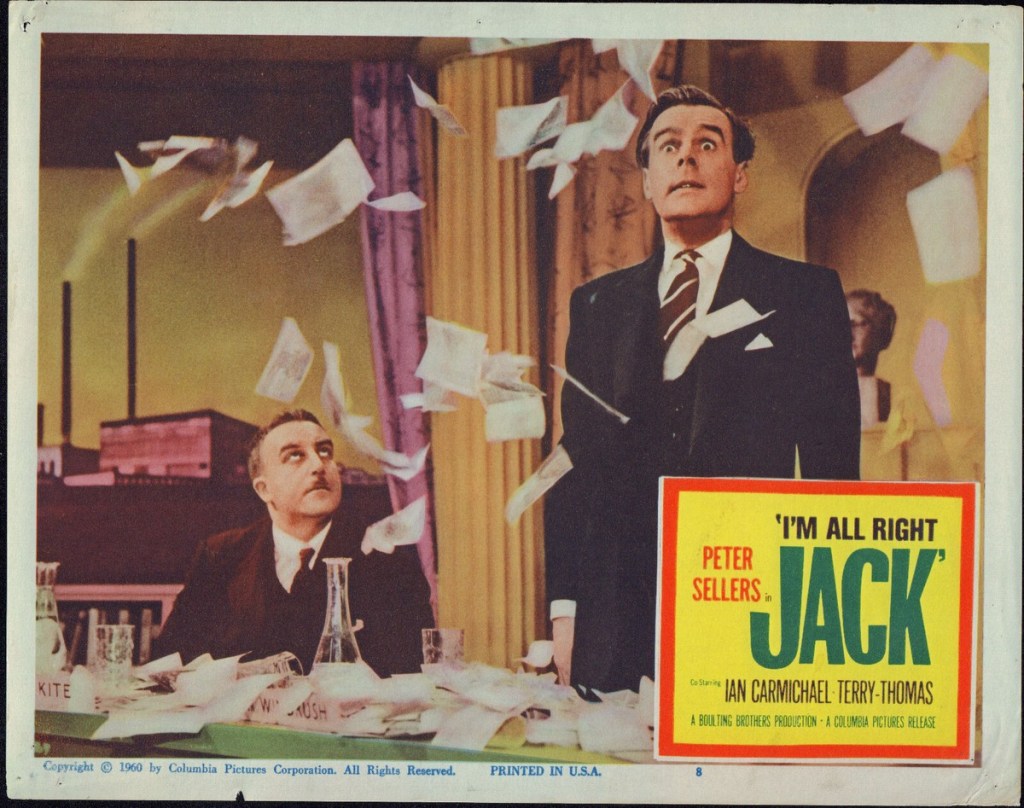
In the wake of World War II, Britain was still recovering and struggling in the 1950s. That is the background for the expression “I’m all right, Jack.” It is the title and theme of a 1959 British comedy movie.
It is said that among Royal Navy sailors, after a ladder was slung over the side of a ship, the last sailor to climb on board would say, “I’m all right Jack; pull up the ladder.” Translated to British postwar life—and for later eras in other places—it means that once you have made it, those that come after should take care of themselves.
Maybe it is British and old school, but the expression still resonates, however you want to say it today. Whatever we have, resources or opportunities, little or lots, others don’t. Selfishness is on public display and, quietly or loudly, celebrated.



 Bob Schwartz