“In my thoughts I visualize a grand whatever.”
by Bob Schwartz
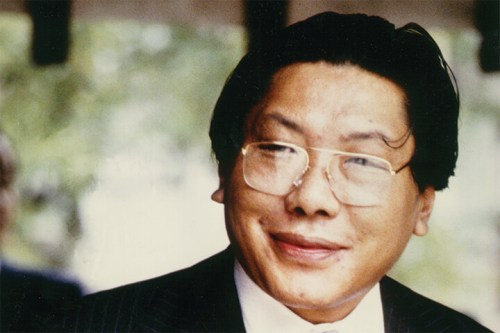
As you read this message from Chogyam Trungpa, from his book Training the Mind and Cultivating Loving-Kindness, you will find his unique way of talking about practice and wisdom in relatable conversational ways.
This is about a concept that is hard for even the best teachers to put in a short and easy form. Hard because, on top of its complexity, it refers to an aspirational experience and not just a concept. So this very brief excerpt can’t possibly do it justice.
But his description of how we think about our thoughts is worth passing on, even if the antidote is treated by Trungpa and others at greater length and with more clarity. I recognize myself and maybe you will too.
Seeing confusion as the four kayas
Is unsurpassable shunyata protection.
As you continue to practice mindfulness and awareness, the seeming confusion and chaos in your mind begin to seem absurd. You begin to realize that your thoughts have no real birthplace, no origin, they just pop up as dharmakaya*. They are unborn. And your thoughts don’t go anywhere, they are unceasing. Therefore, your mind is seen as sambhogakaya. And furthermore, no activities are really happening in your mind, so the notion that your mind can dwell on anything also begins to seem absurd, because there is nothing to dwell on. Therefore, your mind is seen as nirmanakaya. Putting the whole thing together, there is no birth, no cessation, and no acting or dwelling at all—therefore, your mind is seen as svabhavikakaya. The point is not to make your mind a blank. It is just that as a result of supermindfulness and superawareness, you begin to see that nothing is actually happening—although at the same time you think that lots of things are happening.
Realizing that the confusion and the chaos in your mind have no origin, no cessation, and nowhere to dwell is the best protection. Shunyata** is the best protection because it cuts the solidity of your beliefs. “I have my solid thought” or “This is my grand thought” or “My thought is so cute” or “In my thoughts I visualize a grand whatever” or “The star men came down and talked to me” or “Genghis Khan is present in my mind” or “Jesus Christ himself manifested in my mind” or “I have thought of a tremendous scheme a for how to build a city, or how to write a tremendous musical comedy, or how to conquer the world”—it could be anything, from that level down to: “How am I going to earn my living after this?” or “What is the best way for me to sharpen my personality so that I will be visible in the world?” or “How I hate my problems!” All of those schemes and thoughts and ideas are empty! If you look behind their backs, it is like looking at a mask. If you look behind a mask, you see that it is hollow. There may be a few holes for the nostrils and the mouth—but if you look behind it, it doesn’t look like a face anymore, it is just junk with holes in it. Realizing that is your best protection. You realize that you are no longer the greatest artist at all, that you are not any of your big ideas. You realize that you are just authoring absurd, nonexistent things. That is the best protection for cutting confusion.
Chogyam Trungpa
*kaya: Literally, “body.” The four kayas refer in this text to four aspects of perception. Dharmakaya is the sense of openness; nirmanakaya is clarity; sambhogakaya is the link or relationship between those two; and svabhavikakaya is the total experience of the whole thing.
**shunyata: “Emptiness,” “openness.” A completely open and unbounded clarity of mind.
 Bob Schwartz