Congress has long mandated that after the death of U.S. presidents, official flags at the Capitol fly at half-staff for thirty days.
Jimmy Carter died on December 29 at the age of 100. So during the Inauguration on January 20, flags would be flown at half-staff. But Trump objected crudely, saying that Democrats were “giddy” at the possibility. Speaker of the House Mike Johnson thus ordered that during the Inauguration the flags would be fully flown.
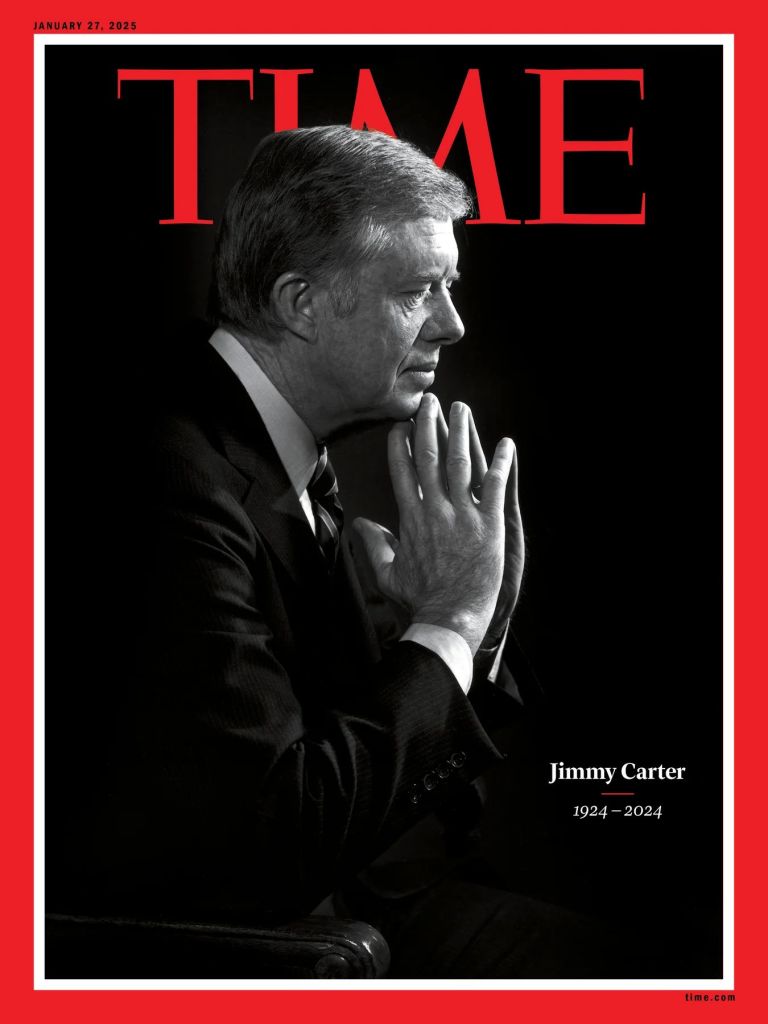
Trump was Time magazine’s Person of the Year for 2024. But for their magazine cover on Inauguration week, we appreciate that it is this particular former president who is featured. We don’t know how Trump feels about this, though we might yet hear.
If America needs role models for moral leadership and exemplary living, we have had few presidents, maybe none, who fit the role better than Jimmy Carter.
The great American film-maker died this week, leaving behind a body of work unmatched in its seductive strangeness and transcendent mystery. We put it in order.
While these kinds of rankings can be controversial, there is little doubt—for me at least—that Twin Peaks is at the top. Hoad wrote:
1. Twin Peaks S1 & 2 (1990-91)
A damn fine cup of coffee. A girl wrapped in plastic. A log-carrying oracle. Grief expressed through novelty song. Thumbs up from Dale Cooper. Canada as the source of all corruption. Backwards talk from dwarves and dames. Traffic lights in the night. The leering demon behind the sofa. Like a fish in a percolator, the original Twin Peaks was where the Lynchian sensibility filtered irreversibly into the zeitgeist.
Audiences had never seen anything like it: an ostensible homage to the comforts of daytime soap opera, none of it facile or ironic, but cut with Lynch’s habitual 1950s pop-culture references, dadaist skits and appalling sexual brutality. Not only did it expand the parameters of television but it amounted to the fullest and most seductive statement of the director’s worldview; his great American cosmology, in which the forces of good and evil warred for the souls of small-town prom queens and FBI agents alike.
Yes, the second season dips badly after Laura Palmer’s killer is revealed, and Lynch was occupied with Wild at Heart and other things. But his collaborators’ flailing attempts to replicate Lynchian weirdness in his absence only served to highlight his inimitable talent for finding the offbeat route to overwhelming emotion. Every time the series called for revelatory violence or charged metaphysics (“It is happening again!”), he returned to the director’s chair and unfailingly delivered. Thanks for warning us about the Black Lodge, Mr Lynch – and see you in the White one.
By 1990, some of us had already watched thousands of hours of TV, and had already seen the dazzling strangeness of Lynch films like Blue Velvet. We had also seen some interesting and inspiring experiments in television programs. But as Hoad wrote, and is worth repeating, “Audiences had never seen anything like it.”
(On a personal note, in the midst of Season 1, I organized a viewing party for friends and printed up a little Twin Peaks booklet to follow along.)
Before Lynch’s death, I was already in the process of rewatching Twin Peaks. The moment Episode 1 began, when I heard the unforgettable theme music, and watched the opening credits, I was reminded of a central message that the experience of Twin Peaks, and other Lynch creations, reflects: Things are strange, everything is strange, and that is wonderful.
The original Twin Peaks series is streaming on Paramount+ and available on other services.

 Bob Schwartz