Thinking and learning about The Bomb now—and its essential and existential relevance to this moment
by Bob Schwartz
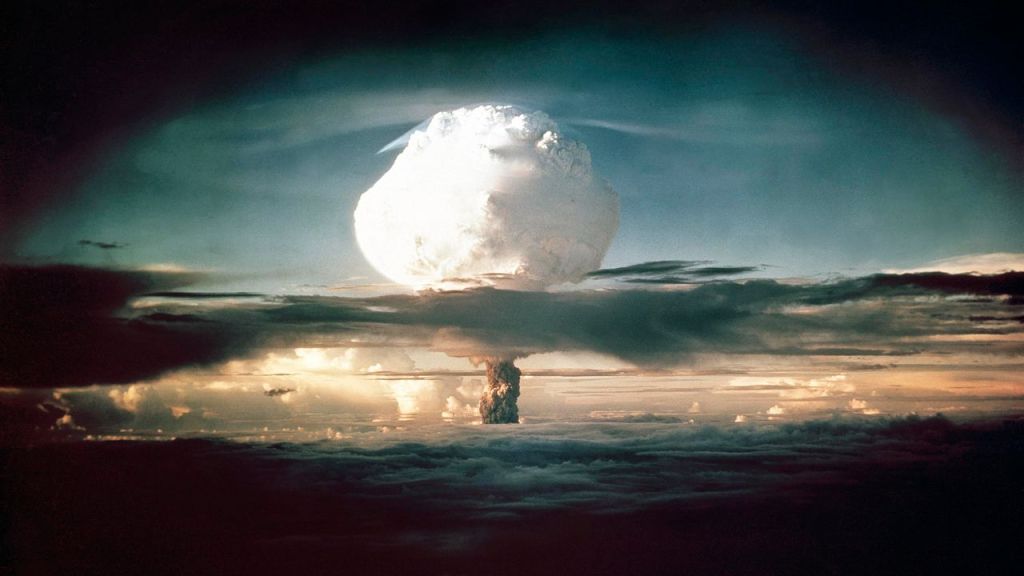
“I know not with what weapons World War III will be fought, but World War IV will be fought with sticks and stones.”
― Albert Einstein
“If in the first act you have hung a pistol on the wall, then in the following one it should be fired. Otherwise don’t put it there.”
—attributed to Anton Chekhov (a dramatic principle known as Chekhov’s Gun)
The Netflix documentary series, Turning Point: The Bomb and the Cold War, is recommended.
Nine nations have an estimated 13,000 nuclear weapons. According to the principle of Chekhov’s Gun, if you have hung 13,000 guns on stage, in the ensuing global drama, one of those weapons will be used. As one expert notes in the series, that we haven’t experienced nuclear Armageddon is not because we are smart, but because we are lucky.
We are either living in a new Cold War or never left the first one. Either way, as dark as it may be, we need to learn and contemplate exactly what a Cold War equipped with so many available nuclear weapons means.
That is the theme of the series. It covers the histories, up to the present, of the Cold War and The Bomb, which are inextricably linked. The world after World War II cleaved into two mighty factions, both convinced the other was an existential threat and must be defeated or removed. The difference from every other fight before in history is that those powers posed a literal existential threat—and still do.
Daniel Ellsberg is famous for his Vietnam War-era whistle-blowing, with his leaking of the so-called Pentagon Papers, revealing that the war was a costly and unwinnable lost cause. But years before that, Ellsberg was one of the brains at the Rand think tank, which was asked in the 1950s to evaluate the possible outcome of a thermonuclear war. Ellsberg relates his shock then and now. The estimate was that 600 million people might be killed—20% of the world’s population at the time.
© 2025 by Bob M. Schwartz
 Bob Schwartz