My collection of paperback books from the 1930s to the 1970s—I consider them cultural archaeology—includes some fascinating topics. Two of the topics are sex and college life. In the case of these books, they come together.
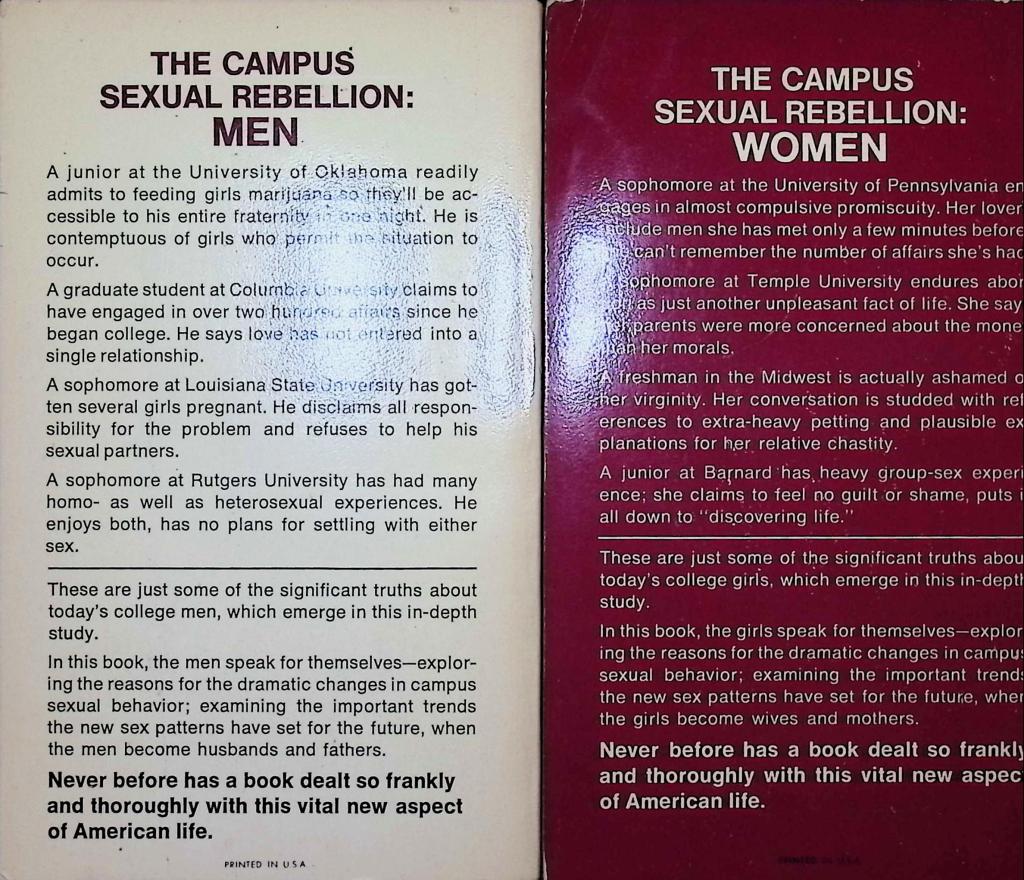
The two-book set, Sexual Appetites on Campus, consists of one volume each for college men and women. It is written by Weldon Douglas Melick, based on recorded interviews with typical students. The Introduction is by Martin Maloney, Ph.D. It is published by Award Books in the U.S., Tandem Books in the U.K.
These books open:
Not a dry sociological study, not meaningless statistics, not an academic report from a psychiatrist—this book is a warm, personal document that lets American college girls and men tell their own stories.
Here is sample back cover copy:
A sophomore at the University of Pennsylvania engages in almost compulsive promiscuity. Her lovers include men she has met only a few minutes before; she can’t remember the number of affairs she has had.
In the book, this is how she is described:
Evelyn
Evelyn is a lethal combination—an incurable romantic with a face and figure that make men turn and drool on the street. She has one flaw—she’s like a Ferrari without brakes.
If that copy makes you think that maybe these aren’t actual interviews, or that maybe the experiences and profiles have been embellished, you may not be wrong. These “warm, personal documents” can only be described as “hot”.
Which is not to say that the sexual appetites on campus in 1968—or 2025—didn’t and don’t include a lot of unrestrained emotions and activity. As it always has and will. Also worth mentioning, for the socio-critico-analytical, the women are consistently described as “girls” while the men are just men.
It isn’t necessary to rehash Trump’s entire babbling first reaction to the tragic plane crash last night. Even before there was any evidence or investigation, the Aeronautical Engineer-in-Chief knew exactly what happened and who was responsible: it was DEI policies and Democrats to blame for incompetent people being hired as air traffic controllers.
He listed all the DEI categories he could think of. And then, at the end of his list, he added dwarfism. That is, in his mind, dwarves had been hired to do the job—thanks Democrats!—despite their lack of ability.
Dwarfism is an umbrella medical term covering hundreds of conditions that affect the growth of bone or cartilage, resulting in short stature.
It is a frightening mission to explore Trump’s mind. The fact is that exploration isn’t needed, since he freely expresses, at length, what he is thinking, if anything. Which is equally frightening.
In this case, nothing more to say, except that we still don’t know very much about the cause of this crash, and when we do, it is possible that we will find that unqualified air traffic controllers with a dwarfism condition were involved or responsible. At least that’s what Trump thinks, if he does.
“Somebody, after all, had to make a start.” Sophie Scholl, age 21, at her Nazi trial in 1943
This is not the first time I have written about Sophie Scholl. I did that a year ago, and before that, because resistance to tyranny is on my mind, and maybe yours.
She was executed for treason by the Nazis in 1943, along with her brother and a friend. They had founded the White Rose, a tiny group of students who distributed leaflets opposing Hitler and his war. She was 21.
At her trial she said, “Somebody, after all, had to make a start.”
She is celebrated in Germany, though less known elsewhere, including America. In a poll by a German women’s magazine, she was voted the most important woman of the 20th century.
A dramatic movie was made about her in 2005, Sophie Scholl — The Final Days, now available online.
How long have we known that resistance has a price? As long as tyrants, authoritarians, dictators have been around. How many have the courage to stand up and pay the price? Some, including a 21-year-old girl.
Will Elon Musk run against Cosmo Spacely for mayor of Orbit City?
There are many Americans unhappy with the return of Trump to the White House. While it is an extreme response, a small number have decided to leave the country to live elsewhere, or at least claim they will.
Surprisingly, two of the destinations for refugees may be Bedrock and Orbit City. These places are best known from the reality shows The Flintstones and The Jetsons. These popular programs followed the day-to-day lives of typical families in different eras—the Flintstones in a time when most things involved rocks and dinosaurs did much of the heavy lifting, the Jetsons in a time when people traveled by flying cars and both maids and dogs were robots.
Will it be better in Bedrock or Orbit City than it currently is in America? Only time will tell. However, it is thought that presidential advisor Elon Musk is seriously considering not only moving to Orbit City, but becoming its mayor. Is Musk unhappy? Will he end up running against Cosmo Spacely, George Jetsons’ boss and the wealthy CEO of Spacely Space Sprockets, Inc.? Once again, time will tell.
I am not going to try to explain the movie Hundreds of Beavers, available on Prime and elsewhere.
There are plenty of positive reviews online and it made plenty of best of lists, as possibly the funniest and funnest movie of the year. I read one of those praise-filled reviews. It included a description, which barely made sense, which is why I was compelled to actually watch it.
Now that I have watched it, I cannot describe it, as I said, but I can recommend it. Bigly.
It is imagination that is going to help save us.
This movie, by creators Mike Cheslik and Ryland Tews, is bursting, overflowing with imagination.
Therefore, this movie is going to help save us. And help save you, should you agree.
Here is the very brief description from the movie’s official website, which description tells you little about the actual movie:
In this 19th century, supernatural winter epic, a drunken applejack salesman must go from zero to hero and become North America’s greatest fur trapper by defeating hundreds of beavers.
Yeah, well, kind of. As I said, you just gotta see it for yourself.
WASHINGTON, DC – JANUARY 21: Bishop Mariann Edgar Budde (L) arrives as U.S. President Donald Trump looks on during the National Prayer Service at Washington National Cathedral on January 21, 2025 in Washington, DC. Tuesday marks Trump’s first full day of his second term in the White House. (Photo by Chip Somodevilla/Getty Images)
Rt. Rev. Marian Edgar Budde, Episcopal Bishop of Washington, presided over the National Prayer Breakfast, giving the sermon at the National Cathedral on Tuesday. Trump and many officials were in attendance.
In the sermon, she pled with Trump to show mercy and compassion toward scared individuals, including immigrants, those fleeing war and persecution, and gay, lesbian and transgender children. After the service, Trump and others attacked her, including some within her own church who believe that “politics” does not belong at the pulpit or in the pews.
This opposition may come from a category error. If this is purely and solely about “politics”—who you vote for and who you support for election—then the category applies. But it isn’t, and never has been. In many cases, and particularly in the current environment, the more fitting categories are ideology and philosophy.
Ideology and philosophy are the siblings of belief, if not identical twins. As for the religious traditions, belief is the central and essential element.
If the ideology and philosophy reflected in political support—the beliefs—are different, contrasting, contradictory to the beliefs of those religious traditions, how can it not be an issue for discussion by those traditions?
This is in no way to question the good faith and conscientiousness of those in the traditions who see politics as a categorical red line. It is just, at this moment and many moments past, the wrong category. The faithful may and sometimes do hold ideologies, philosophies and beliefs that are anathema to the core of traditions.
Which is exactly what Bishop Budde was saying, for which she now says she has nothing to apologize for. Others may say that she was not doing her job, touching on politics. She wasn’t touching on politics. She was affirming the very soul of her faith. That is her job.
“We can’t tailor the world to suit ourselves, or force it to fit into our vision of things. This doesn’t mean we shouldn’t aspire to make things better.” Traleg Kyabgon
The 59 slogans of lojong mind training are divided into Seven Points.
Point Three: Transforming Adversity into the Path of Awakening
We now come to the instructions on how to train our minds amid the unfavorable and unwanted circumstances of our lives. We have been born into an imperfect world, characterized by unpredictability and adversity, as finite human beings that have foibles, make mistakes, get confused, and think irrationally. There is much to contend with, and our ability to prevent or circumvent difficulty is quite limited. We aren’t omnipotent beings, and while we try to protect ourselves and maintain order in our lives, we simply don’t have the ability to safeguard ourselves from its disasters.
It is self-evident that the natural world doesn’t behave in a predictable way or do our bidding. We can see this in the recent examples of the Indian Ocean tsunami and the hurricane that decimated New Orleans. Natural disasters have occurred repeatedly in the past and are likely to continue to do so in the future. Millions of people have lost their lives, are losing their lives, and will lose their lives to disease: the typhoid, cholera, dysentery, and bubonic plagues of the past; the HIV epidemic of the present; and so on. Even at a personal level, many things go awry, and our efforts to complete projects are constantly thwarted and disrupted by sickness, mental distress, and all kinds of deception and mistreatment by others.
Adverse circumstances and situations are an integral part of conditioned existence. They tend to arise as sudden interruptions, so we shouldn’t be surprised that natural calamities and upheavals occur in both our private and our public lives. Buddhists do not believe in divine authorship or omnipotent governance of any kind; things just happen when the proper conditions and circumstances come together….
We can’t tailor the world to suit ourselves, or force it to fit into our vision of things. This doesn’t mean we shouldn’t aspire to make things better. The bodhisattva ideal specifically recommends trying to improve our world to the best of our ability, but that ideal is based on a realistic recognition that the world is imperfect and likely to remain that way. Things may sometimes work a little better, sometimes a little worse, but so long as there is ignorance, hatred, jealousy, pride, and selfishness, we will all be living in a world that is socially and politically imperfect….
If things are interdependent, as Buddhists say, we can never expect to protect ourselves against unexpected occurrences, because there is no real order to existence apart from the regularity of certain natural processes. The fact that anything and everything can and does happen would then come as no real surprise to us. The question then becomes not so much why these things happen, but what we can do about them once they do. We cannot control the environment in any strict sense, so we must try to change our attitude and see things in a different light. Only then will we be able to take full advantage of our situation, even if it happens to be a bad one. While it often seems there is nothing we can do in the face of insurmountable obstacles, the lojong teachings tell us this is not true. The imperfect world can be an opportunity for awakening rather than an obstacle to our goals.
Sometimes things just happen, and there may be nothing we can do to change that, but we can control our responses to events. We don’t have to despair in the face of disaster. We can either continue to respond in the way we’ve always done and get progressively worse, or we can turn things around and use our misfortune to aid our spiritual growth. For example, if we suffer from illness, we should not allow despondency to get the better of us if our recovery is slow. Despite seeing the best doctors and receiving the best medication, we should accept our situation with courage and fortitude and use it to train our minds to be more accommodating and understanding. No matter what situation we encounter, we can strengthen our minds by incorporating it into our spiritual journey….
We grow more quickly if we are open to working with difficulties rather than constantly running away from them. The lojong teachings say that when we harden ourselves to suffering, we only become more susceptible to it. The more harsh or cruel we are toward others, the more vulnerable we become to irritation or anger that is directed at us. Contrary to our instincts, it is by learning to become more open to others and our world that we grow stronger and more resilient. It is our own choice how we respond to others. We can capitulate to the entrenched habits and inner compulsions deeply ingrained in our basic consciousness, or we can recognize the limitations of our situation and apply a considered approach. Our conditioned samsaric minds will always compel us to focus on what we can’t control rather than questioning whether we should respond at all. However, once we recognize the mechanical way in which our ego always reacts, it becomes possible to reverse that process.
The great strength of the lojong teachings is the idea that we can train our minds to turn these unfavorable circumstances around and make them work to our advantage. The main criterion is that we never give up in the face of adversity, no matter what kind of world we are confronted with at the personal or political level. When we think there is nothing we can do, we realize there is something we can do, and we see that this “something” is actually quite tremendous.
An aerial photograph taken by a drone shows displaced Palestinians returning to Rafah, a day after the ceasefire deal between Israel and Hamas came into effect, Gaza Strip, Monday, Jan. 20, 2025. (AP Photo/Mohammad Abu Samra)Palestinians walk through the rubble caused by the Israeli air and ground offensive in Rafah, southern Gaza Strip, Monday, Jan. 20, 2025. (AP Photo/Mariam Dagga)Displaced Palestinians return to Rafah, Gaza Strip, Monday, Jan. 20, 2025 a day after the ceasefire deal between Israel and Hamas went into effect. (AP Photo/Jehad Alshrafi)Hussein Barakat sits on a couch with two others, atop the rubble of his destroyed home a day after the ceasefire deal between Israel and Hamas came into effect, in Rafah, southern Gaza Strip, Monday, Jan. 20, 2025,(AP Photo/Abdel Kareem Hana)An aerial photograph taken by a drone shows displaced Palestinians returning to Rafah, a day after the ceasefire deal between Israel and Hamas came into effect, Gaza Strip, Monday, Jan. 20, 2025. (AP Photo/Mohammad Abu Samra)Palestinians walk through the destruction caused by the Israeli air and ground offensive in Jabaliya, a day after the ceasefire deal between Israel and Hamas came into effect, Monday, Jan. 20, 2025. (AP Photo/Abed Hajjar)
Just as every cop is a criminal And all the sinners saints As heads is tails, just call me Lucifer Cause I’m in need of some restraint
In 1968, French director Jean Luc Godard filmed the Rolling Stones recording the track Sympathy for the Devil for the album Beggars Banquet. The final film, Sympathy for the Devil (1 + 1) interspersed many scenes of political and social elements that made it into a Godard film, and not just a typical music documentary—for the time and for now.
(The film is available for rent or sale on many platforms, but not currently for free. Instead, included below are a few clips that give you the flavor of the work.)
Opinions have long differed about this as film art or music art. At the very least it is a slice of time, a time before the Rolling Stones became billionaires, a time when John Lennon—who is seen dancing—was not yet killed, a time when artists like Godard (maybe not so much the Stones) believed in the power of art to expose, incite and transform.
As for the song, which I played before breakfast this morning:
Please allow me to introduce myself I’m a man of wealth and taste I’ve been around for a long, long year Stole many a man’s soul and faith
I was ’round when Jesus Christ Had his moment of doubt and pain Made damn sure that Pilate Washed his hands and sealed his fate
Stuck around St. Petersburg When I saw it was a time for a change Killed the Tsar and his ministers Anastasia screamed in vain
I rode a tank Held a general’s rank When the blitzkrieg raged And the bodies stank
I watched with glee While your kings and queens Fought for ten decades For the gods they made
I shouted out “Who killed the Kennedys?” When after all It was you and me
Just as every cop is a criminal And all the sinners saints As heads is tails, just call me Lucifer Cause I’m in need of some restraint
So if you meet me, have some courtesy Have some sympathy, and some taste Use all your well-learned politeness Or I’ll lay your soul to waste
Pleased to meet you Hope you guess my name But what’s puzzling you Is the nature of my game












 Bob Schwartz