Bodhi Day
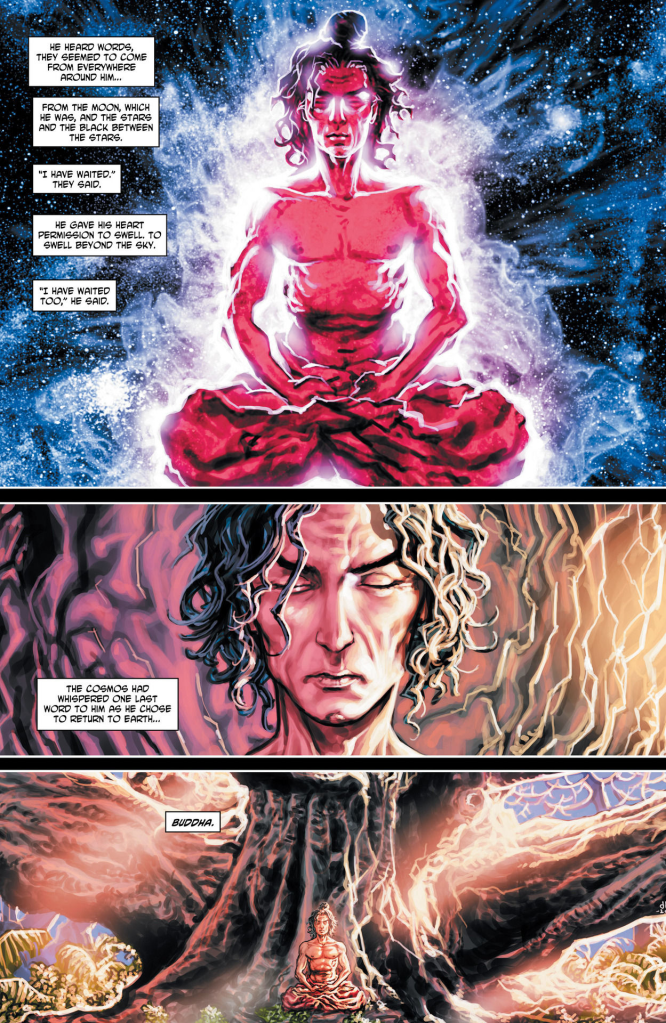
Following yesterday’s Tomorrow is Bodhi Day, today is Bodhi Day.
From the Dhammapada, Chapter 3, The Mind:
The Mind
The restless, agitated mind,
Hard to protect, hard to control,
The sage makes straight,
As a fletcher the shaft of an arrow.
Like a fish out of water,
Thrown on dry ground,
This mind thrashes about,
Trying to escape Māra’s* command.
The mind, hard to control,
Flighty—alighting where it wishes—
One does well to tame.
The disciplined mind brings happiness.
The mind, hard to see,
Subtle—alighting where it wishes—
The sage protects.
The watched mind brings happiness.
Far-ranging, solitary,
Incorporeal and hidden
Is the mind.
Those who restrain it
Will be freed from Māra’s bonds.
For those who are unsteady of mind,
Who do not know true Dharma,
And whose serenity wavers,
Wisdom does not mature.
For one who is awake,
Whose mind isn’t overflowing,
Whose heart isn’t afflicted
And who has abandoned both merit and demerit,
Fear does not exist.
Knowing this body to be like a clay pot,
Establishing this mind like a fortress,
One should battle Māra with the sword of insight,
Protecting what has been won,
Clinging to nothing.
All too soon this body
Will lie on the ground,
Cast aside, deprived of consciousness,
Like a useless scrap of wood.
Whatever an enemy may do to an enemy,
Or haters, one to another,
Far worse is the harm
From one’s own wrongly directed mind.
Neither mother nor father,
Nor any other relative can do
One as much good
As one’s own well-directed mind.
Translated by Gil Fronsdal
*Māra: The personification of evil in Buddhism and often referred to as the Buddhist “devil” or “demon”. According to some accounts of the Buddha’s enlightenment experience, when the he sat under the bodhi tree, vowing not to rise until he attained liberation from the cycle of rebirth, he was approached by Māra, who sought to dissuade him from his quest. When he refused, Māra sent his minions to destroy him, but their weapons were transformed into flower blossoms.
Following is an outline of Buddhism, found in The Basic Teachings of the Buddha (2007) by Glenn Wallis. Wallis is a far-reaching, creative and iconoclastic scholar of Buddhism, as reflected in his later work, such as A Critique of Western Buddhism (2019), which is available to read and download free.
HABITAT
1. We are like ghosts sleepwalking in a desolate and dangerous domain.
DE-ORIENTATION
2. We remain transfixed there, enchanted by pleasure and flamboyant speculation.
3. The most enthralling belief of all is that of supernatural agency.
4. There is a safeguard against this bewitchment: knowing for yourself.
RE-ORIENTATION
5. The means of “knowing for yourself” is immediately available: it is the sensorium.
6. But the modes of perception are miragelike, and the perceived like a magical display.
7. And there is no self, no integral perceiver, behind those modes of perception.
8. To hold on to the miragelike perceiver, the phantom self, is a stultifying burden.
MAP
9. When we reflect on these propositions, four preeminent realities become obvious,
10. as do the emergence and cessation of our incessant “worlding.”
DESTINATION
11. Our genuine refuge from this whirlwind of worlding is to be unbound;
12. to eradicate infatuation, hostility, and delusion. Eradicated, quenched, unbound.
13. Binding is concomitant with the fabricated.
14. Unbinding is concomitant with the unfabricated.
GOING
15. Cultivation of present-moment awareness is the means to conspicuous unbinding.
16. Application of this awareness in daily life is concomitant with living as a buddha: awakened.
Glenn Wallis


 Bob Schwartz