On May 4 I published a post about the National Guard shootings at Kent State University on May 4, 1970.
Later that day, on May 4, I was tidying up a large media cabinet, looking for extra space. The cabinet contains CDs, DVDs, books, and an assortment of other items. I found a small pile of stuff taking up space, a pile I hadn’t looked at in years. I pulled out the pile and unstacked it. There between the CDs was a little brochure.
It was a brochure from a long-ago visit to the May 4 Visitors Center at Kent State University (see above).
I can’t explain it. Actually, I can come up with different explanations, none of which I can be certain of. While I haven’t calculated the odds of this happening by chance, they are astronomical. But things happen by chance. On the other hand, forces are at work that we can’t fully know, no matter how smart we claim to be. As Hamlet said, “There are more things in heaven and earth, Horatio, than are dreamt of in your philosophie [science].”
There is magic in the universe. Believing in it makes us bigger and better.
“You see these bums, you know, blowing up the campuses. Listen, the boys that are on the college campuses today are the luckiest people in the world, going to the greatest universities, and here they are burning up the books, storming around about this issue. You name it. Get rid of the war there will be another one.”
Three days later, on May 4, 1970, the National Guard shot and killed four and wounded nine at Kent State University in Ohio.
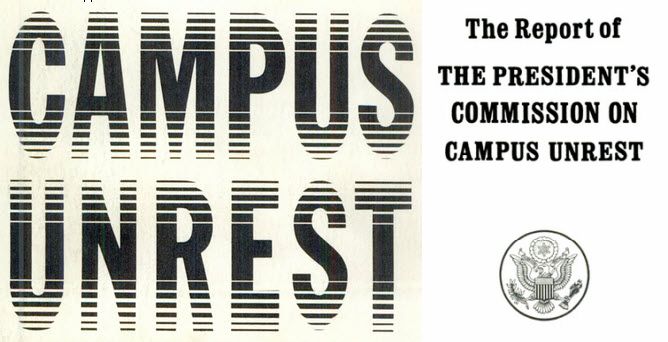
Nixon won election in 1968 on a platform of law and order. He had no use for student protests. But even those Americans who still supported the Vietnam War and agreed that student protestors were “bums” were troubled. So Nixon ordered a Commission on Campus Unrest. The Commission, under the leadership of former Pennsylvania governor William Scranton, investigated and issued a 537-page report. It included a special section on Kent State, containing a detailed day-by-day, minute-by-minute description, leading up to this moment:
Major Jones said he first heard an explosion which he thought was a firecracker. As he turned to his left, he heard another explosion which he knew to be an M-1 rifle shot. As he turned to his right, toward Taylor Hall, he said he saw guardsmen kneeling (photographs show some crouching) and bringing their rifles to their shoulders. He heard another M-1 shot, and then a volley of them. He yelled, “Cease fire!” several times, and rushed down the line shoving rifle barrels up and away from the crowd. He hit several guardsmen on their helmets with his swagger stick to stop them from firing.
General Canterbury stated that he first heard a single shot, which he thought was fired from some distance away on his left and which in his opinion did not come from a military weapon. Immediately afterward, he heard a volley of M-1 fire · from his right, the Taylor Hall end of the line. The Guard’s fie was directed away from the direction from which Canterbury thought the initial, nonmilitary shot came. His first reaction, like that of Fassinger and Jones, was to stop the firing.
Canterbury, Fassinger, and Jones–the three ranking officers on the hill–all said no order to fire was given. Twenty-eight guardsmen have acknowledged firing from Blanket Hill. Of these, 25 fired 55 shots from rifles, two fired five shots from .45 caliber pistols, and one fired a single blast from a shotgun. Sound tracks indicate that the firing of these 61 shots lasted approximately 13 seconds. The time of the shooting was approximately 12:25 p.m.
Four persons were killed and nine were wounded.
A map from the report:
Any lessons for today and beyond?
Whenever a university or a government decides to enforce its standard of order against gatherings and protests, that enforcement should be pursued carefully and judiciously, if at all. Things can and will happen when those forces are let loose. The choice of enforcement should be pursued only if there are no other options, which there almost always are. Emotions run high on all sides. Whenever weapons are officially introduced—from batons to rubber bullets to tear gas to guns and rifles—they can easily be used indiscriminately. And fatally.
Few things are more tragically ironic than anti-war protestors being injured or killed. It doesn’t have to be.
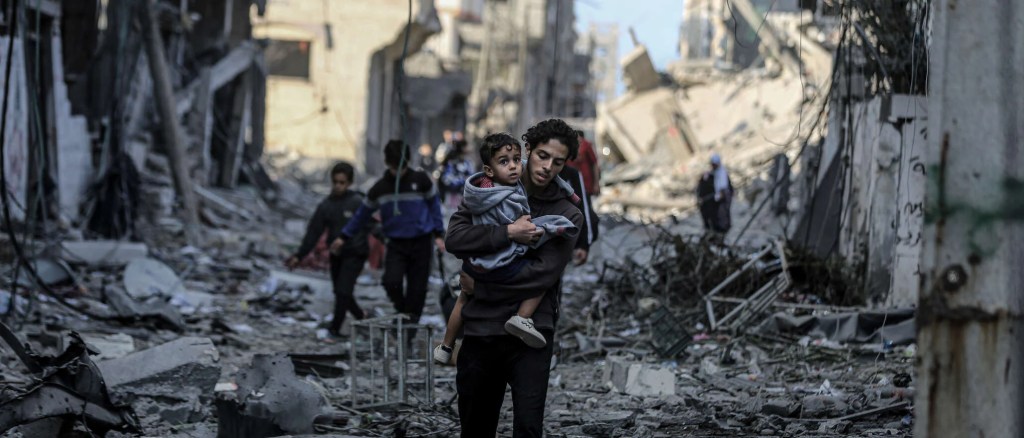
The primary point of the protests is bringing attention to the continuing horrors inflicted on Gaza. Most politicians of both parties and many media find this point uncomfortable and inconvenient for their purposes. So they would rather feature the protests themselves. Politicians believe too much attention to the underlying situation distracts from a law-and-order position or from support of Israel. Media believe that the protests are appropriately showy and newsworthy. A few injured or mistreated protestors make a good story. Thousands of dead, injured and mistreated don’t make for must-see TV and demand context.
Don’t forget that the primary point of the protests is Gaza. The protests have not surprisingly been mishandled by universities and government, and they will be. Free speech has been stifled, and it will be. These are important issues. But the people of Gaza, the families of the dead, injured, starving and displaced don’t care. They just want people to pay attention and act to help them.



 Bob Schwartz