Is thoughtlessness the root of evil?
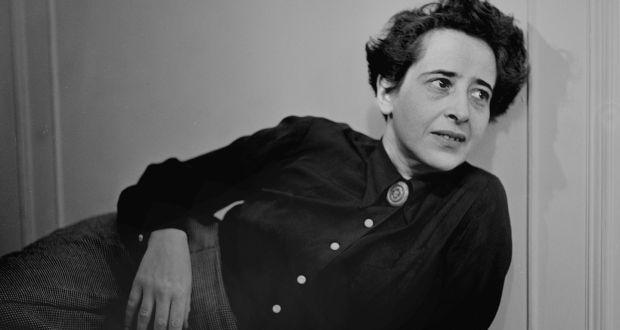
“The question that imposed itself was: Could the activity of thinking as such, the habit of examining whatever happens to come to pass or to attract attention, regardless of results and specific content, could this activity be among the conditions that make men abstain from evil-doing or even actually “condition” them against it?”
When I confront the stubborn presence of regressive right-wing political and social initiatives in America (Trumpism, etc.), I might want to say that there are too many not smart/stupid people. I don’t say that, first because it is harsh, second because some number of those people seem smart/not stupid.
This brings me again to the brilliant political philosopher Hannah Arendt, who once covered and wrote about the trial of Adolf Eichmann for his role in the Holocaust. She proposed, in a phrase that has continued to cause trouble for her, decades after her death, “the banality of evil”. Put simply, thoughtlessness is a source of some extreme evildoing.
For me, that is an enlightening explanation of so much that we see, not only in history, but now. The antidote to the poison? Thinking, really thinking.
Thinking is the subject of Arendt’s final and unfinished work, The Life of the Mind. Following is from the Introduction.
Factually, my preoccupation with mental activities has two rather different origins. The immediate impulse came from my attending the Eichmann trial in Jerusalem. In my report of it I spoke of “the banality of evil.” Behind that phrase, I held no thesis or doctrine, although I was dimly aware of the fact that it went counter to our tradition of thought—literary, theological, or philosophic—about the phenomenon of evil. Evil, we have learned, is something demonic; its incarnation is Satan, a “lightning fall from heaven” (Luke 10:18), or Lucifer, the fallen angel (“The devil is an angel too”—Unamuno) whose sin is pride (“proud as Lucifer”), namely, that superbia of which only the best are capable: they don’t want to serve God but to be like Him. Evil men, we are told, act out of envy; this may be resentment at not having turned out well through no fault of their own (Richard III) or the envy of Cain, who slew Abel because “the Lord had regard for Abel and his offering, but for Cain and his offering he had no regard.” Or they may be prompted by weakness (Macbeth). Or, on the contrary, by the powerful hatred wickedness feels for sheer goodness (Iago’s “I hate the Moor: my cause is 2 hearted”; Claggart’s hatred for Billy Budd’s “barbarian” innocence, a hatred considered by Melville a “depravity according to nature”), or by covetousness, “the root of all evil” (Radix omnium malorum cupiditas). However, what I was confronted with was utterly different and still undeniably factual. I was struck by a manifest shallowness in the doer that made it impossible to trace the uncontestable evil of his deeds to any deeper level of roots or motives. The deeds were monstrous, but the doer—at least the very effective one now on trial —was quite ordinary, commonplace, and neither demonic nor monstrous. There was no sign in him of firm ideological convictions or of specific evil motives, and the only notable characteristic one could detect in his past behavior as well as in his behavior during the trial and throughout the pre-trial police examination was something entirely negative: it was not stupidity but thoughtlessness. In the setting of Israeli court and prison procedures he functioned as well as he had functioned under the Nazi regime but, when confronted with situations for which such routine procedures did not exist, he was helpless, and his cliché-ridden language produced on the stand, as it had evidently done in his official life, a kind of macabre comedy. Clichés, stock phrases, adherence to conventional, standardized codes of expression and conduct have the socially recognized function of protecting us against reality, that is, against the claim on our thinking attention that all events and facts make by virtue of their existence. If we were responsive to this claim all the time, we would soon be exhausted; Eichmann differed from the rest of us only in that he clearly knew of no such claim at all.
It was this absence of thinking—which is so ordinary an experience in our everyday life, where we have hardly the time, let alone the inclination, to stop and think—that awakened my interest. Is evil-doing (the sins of omission, as well as the sins of commission) possible in default of not just “base motives” (as the law calls them) but of any motives whatever, of any particular prompting of interest or volition? Is wickedness, however we may define it, this being “determined to prove a villain,” not a necessary condition for evildoing? Might the problem of good and evil, our faculty for telling right from wrong, be connected with our faculty of thought? To be sure, not in the sense that thinking would ever be able to produce the good deed as its result, as though “virtue could be taught” and learned—only habits and customs can be taught, and we know only too well the alarming speed with which they are unlearned and forgotten when new circumstances demand a change in manners and patterns of behavior. (The fact that we usually treat matters of good and evil in courses in “morals” or “ethics” may indicate how little we know about them, for morals comes from mores and ethics from ethos, the Latin and the Greek words for customs and habit, the Latin word being associated with rules of behavior, whereas the Greek is derived from habitat, like our “habits”) The absence of thought I was confronted with sprang neither from forgetfulness of former, presumably good manners and habits nor from stupidity in the sense of inability to comprehend—not even in the sense of “moral insanity,” for it was just as noticeable in instances that had nothing to do with so-called ethical decisions or matters of conscience.
The question that imposed itself was: Could the activity of thinking as such, the habit of examining whatever happens to come to pass or to attract attention, regardless of results and specific content, could this activity be among the conditions that make men abstain from evil-doing or even actually “condition” them against it? (The very word “con-science,” at any rate, points in this direction insofar as it means “to know with and by myself,” a kind of knowledge that is actualized in every thinking process.) And is not this hypothesis enforced by everything we know about conscience, namely, that a “good conscience” is enjoyed as a rule only by really bad people, criminals and such, while only “good people” are capable of having a bad conscience? To put it differently and use Kantian language: after having been struck by a fact that, willy-nilly, “put me in possession of a concept” (the banality of evil), I could not help raising the quaestio juris and asking myself “by what right I possessed and used it.”
—HannahArendt, The Life of the Mind
Note: The Life of the Mind (Kindle) is currently on sale for $2.99.
 Bob Schwartz