Nuclear weapons are now mostly a cultural afterthought. Maybe Oppenheimer will have people thinking again.
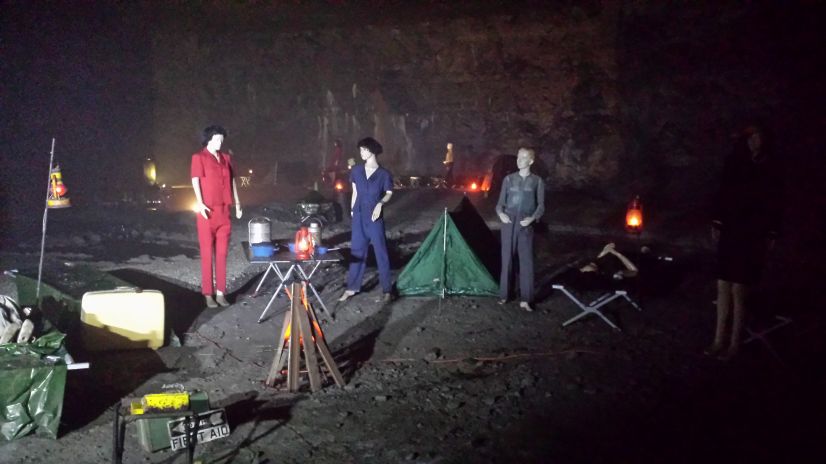
Above: Mega Cavern in Louisville, Kentucky. Once planned as a fallout shelter for 50,000 people, which would make it the largest civil defense shelter in America. This is a recreation of what it would have been like.
The first and only time atomic or nuclear weapons were deployed was in August 1945, with America dropping the first atomic bombs (nuclear fission) on Hiroshima and Nagasaki. Thermonuclear weapons (nuclear fusion, hydrogen bombs) have been tested—once frequently, now not at all—but never used.
Nuclear weapons are very much still with us. Nine countries have them: United States, Russia, France, China, the United Kingdom, Pakistan, India, Israel, and North Korea. The global stockpile is almost 13,000 weapons, less than the 60,000 during the Cold War, but still enough to end life in this world.
The passage of time and other challenges have put this on the cultural back burner. Real threats keep coming (climate, AI, etc.). We talk about the possibility of Russia using strategic nuclear weapons, but what does that really mean to most people today? The atomic bomb was last used almost 80 years ago; the last nuclear tests were about 30 years ago.
Christopher Nolan’s new movie Oppenheimer contemplates the complexities of ultimate weapons and warfare as scientific and moral challenges, for individuals and societies. Renewed interest and attention aren’t likely to have substantial effect on our policies and global relationships. Politics and tribalism cloud our minds and culture, as Oppenheimer’s story highlights.
If you do want to explore beyond Oppenheimer, read The Making of the Atomic Bomb (1986, revised 2012) by Richard Rhodes. The definitive book, awarded the Pulitzer Prize, the National Book Award, and the National Book Critics Circle Award. Long (1499 pages, 2749 footnotes) but perfectly readable and compelling storytelling.
For fun and education, visit online or in Albuquerque the National Museum of Nuclear Science & History:
The National Museum of Nuclear Science & History was established in 1969 as an intriguing place to learn the story of the Atomic Age, from early research of nuclear development through today’s peaceful uses of nuclear technology. Visitors can explore how nuclear science continues to influence our world. The museum strives to present, through permanent and changing exhibits and displays, the diverse applications of nuclear science in the past, present, and future along with the stories of the field’s pioneers.
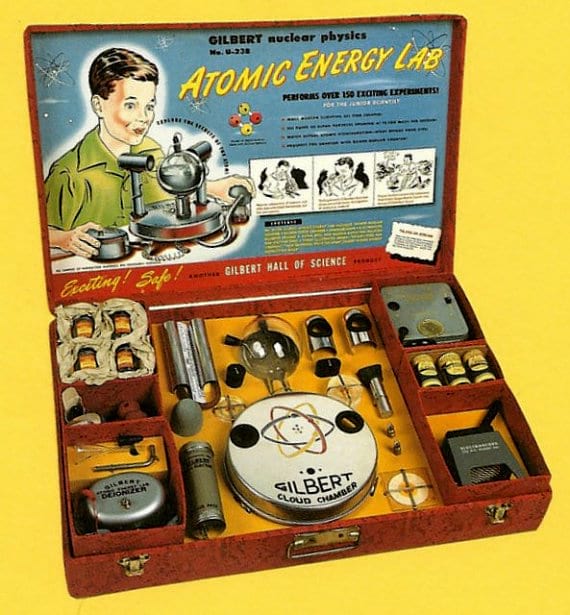
The upcoming exhibit at the museum, At Play in the Atomic Age is a playfully serious supplement to Oppenheimer:
The toys of the Atomic Age reflect the times and culture of their day. The Atomic Age was born with the Manhattan Project and blasted into the public’s consciousness in 1945. Almost as soon as the public became aware of the existence of the bomb, all things “atomic” became marketable. The promise of a technological future and the threat of nuclear war is reflected in the toys, games, music, and books produced. Their makers sought to provide children with the tools to help them to relate to the world around them and prepare them for a potentially bright but uncertain future.
A few examples of kids “playing” in the Atomic Age:


© 2023 by Bob Schwartz
 Bob Schwartz