Bob Schwartz

Month: March, 2018

Will Eisner Week

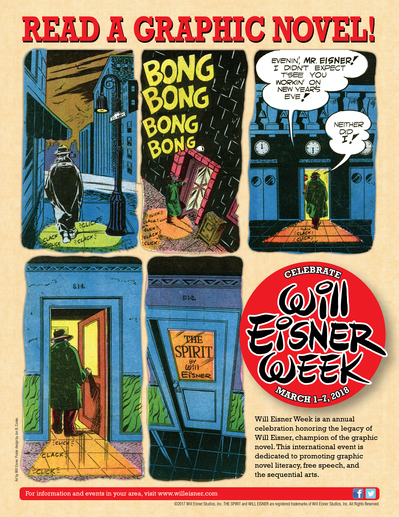
Will Eisner (1917-2005) was a pioneer in the comic art form, the godfather of the graphic novel with publication of A Contract with God (1978), a teacher and theoretician of the medium with publication of Comics and Sequential Art (1985). The major award in the medium is named after him.

This is officially his week.

I see myself age 7, standing on a corner in the Bronx, reading a Superboy comic book I had just bought at the candy store. I couldn’t wait to get it back to our apartment.

I didn’t know then that comic books would shape me as much as any other cultural influence. I didn’t know that comic books would evolve into “real” literature in the form of graphic novels. I didn’t know that by 2018 comic books and graphic novels would end up being the multi-billion dollar backbone of the movie and TV industry.

I didn’t know about Will Eisner either, but I would learn that he, more than any other person, was responsible for the breakthrough that turned cheap disposable entertainment for kids into a major art form of the twentieth—and now the twenty-first—century.

The poster for Will Eisner Week says “Read a Graphic Novel!” If you haven’t ever, you should.

As with all literature, “best” is a matter of taste and interest. For me, and for many others, it is Watchmen (1986) by Alan Moore and Dave Gibbons. Time magazine listed it as one of the 100 Best Novels since 1923—that is best novels, not just graphic novels. Like all supreme literary works, it weaves so much into its pages that the reader is mesmerized way after the book is closed for the first, fifth or nth time. And like many works—including now many comic books and graphic novels—the attempt to transform it into film was good but only partly successful, and still not the experience of reading the book. So whether it is Watchmen or one of the many other worthies—Read a Graphic Novel!

Without Opinion

The Great Way is not difficult
for those who have no preferences.
When love and hate are both absent
everything becomes clear and undisguised.
Make the smallest distinction, however,
and heaven and earth are set infinitely apart.

If you wish to see the truth
then hold no opinions for or against anything.
To set up what you like against what you dislike
is the disease of the mind.

From Hsin-hsin Ming: Verses on the Faith-Mind by Seng-ts’an, translated By Richard B. Clarke

Try going for one day without having or expressing an opinion. For one hour. One minute. Oh but, you will say, my job requires me to make distinctions. Or, you will say, opinions make for interesting conversation and diversion. If I have no opinion, I will end up with an unsuitable lunch or an unsuitable friend or an unsuitable leader. Maybe so. Still, it might be worth a try.


When a Man Meets Himself

One of man’s greatest difficulties is also his most obvious drawback. It could be corrected if anyone troubled himself to point it out often and cogently enough.

It is the difficulty that man is describing himself when he thinks that he is describing others.

How often do you hear people say, about me:

“I regard this man as the Qutub (magnetic Pole) of the Age”?
He means, of course: “I regard this man…”

He is describing his own feelings or convictions, when what we might want to know is something about the person or thing being described.

When he says: “This teaching is sublime,” he means: “This appears to suit me.” But we might have wanted to know something about the teaching, not how he thinks it influences him.

Some people say: “But a thing can truly be known by its effect. Why not observe the effect upon a person?”

Most people do not understand that the effect of, say, sunlight on trees is something constant. In order to know the nature of the teaching, we would have to know the nature of the person upon whom it has acted. The ordinary person cannot know this: all he can know is what that person assumes to be an effect upon himself – and he has no coherent picture of what “himself” is. Since the outward observer knows even less than the person describing himself, we are left with quite useless evidence. We have no reliable witness.

Remember, that while this situation still obtains, there will generally be an equal number of people saying: “This is marvelous,” as are saying: “This is ridiculous.” “This is ridiculous” really means: “This appears ridiculous to me,” and “this is marvelous” means: “This appears marvelous to me.”

Do you really enjoy being like that?

Many people do, while energetically pretending otherwise.

Would you like to be able to test what really is ridiculous or marvelous, or anything in between?

You can do it, but not when you presume that you can do it without any practice, without any training, in the midst of being quite uncertain as to what it is you are and why you like or dislike anything.

When you have found yourself you can have knowledge. Until then you can only have opinions. Opinions are based on habit and what you conceive to be convenient to you.

The study of the Way requires self-encounter along the way. You have not met yourself yet. The only advantage of meeting others in the meantime is that one of them may present you to yourself.

Before you do that, you will possibly imagine that you have met yourself many times. But the truth is that when you do meet yourself, you come into a permanent endowment and bequest of knowledge that is like no other experience on earth.

Sufi master Tariqavi in Wisdom of the Idiots by Idries Shah

Winnie the Pooh Censored in China

China President Xi Jinping wants to change the constitution to remain in power beyond the limit of two terms. China Digital Times  explains:

Chinese state media announced on Sunday a list of proposed amendments to China’s constitution, which are expected to be adopted next month at the National People’s Congress session in Beijing. Among the 21 proposed amendments, the one with perhaps the deepest potential impact on the future of Chinese politics and society deals with paragraph 3 of article 79, which would eradicate the current limit of PRC presidents and vice-presidents to two five-year terms. This would effectively set President Xi Jinping up to maintain his seat as president indefinitely….

Following state media’s announcement, censorship authorities began work to limit online discussion.

As part of that censorship, a growing list of terms have been blocked from being posted on the search engine Weibo. Along with seeming innocent phrases that are protest memes and obvious authors such as George Orwell, for a while the list also included the letter “N”:

N — While the letter “N” was temporarily blocked from being posted, as of 14:27 PST on February 26, it was no longer banned. At Language Log, Victor Mair speculates that this term was blocked “probably out of fear on the part of the government that “N” = “n terms in office”, where possibly n > 2.”

Most ridiculous of all is the blocking of Winnie the Pooh:

Winnie the Pooh (小熊维尼) — Images of Winnie the Pooh have been used to mock Xi Jinping since as early as 2013. The animated bear continues to be sensitive in China. Weibo users shared a post from Disney’s official account that showed Pooh hugging a large pot of honey along with the caption “find the thing you love and stick with it.”

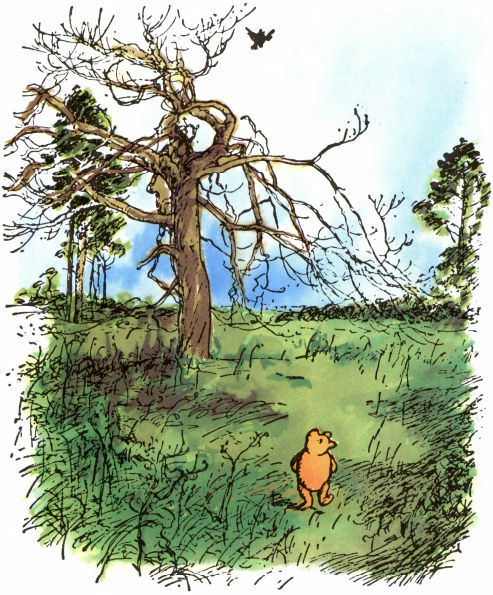
I’ve written before about my high regard for Winnie the Pooh—the books by A.A. Milne, not the Disney version. It is great literature, not least in the character of the sweet, loyal, interesting, but seemingly not very smart bear (as he calls himself, “a bear of very little brain.”) Seemingly, because he may also be a bit of an enigmatic Zen master:

On Monday, when the sun is hot
I wonder to myself a lot:
“Now is it true, or is it not,”
“That what is which and which is what?”

I have never thought of Pooh as a political subversive. And yet, if you are a supreme ruler aiming to become eternally supreme, enemies are everywhere. Even a letter of the alphabet or a simple and adorable bear.