Bob Schwartz

The Weird Randomness of Life
The Catcher in the Rye

I went to the gym this morning for my regular morning workout. The TV was on, but nobody was there. I saw that the remote control was gone. I climbed on a chair, pushed the power button and turned the TV off.

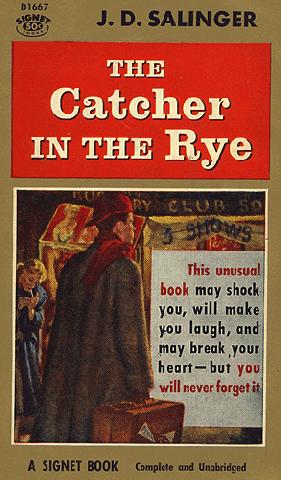
On further search for the remote, I discovered a handbag on the seat of stationery bike. I didn’t want to pry, but I peeked in to see if the remote had ended up there. Instead, I saw a copy of The Catcher in the Rye by J.D. Salinger.

Are people still reading The Catcher in the Rye? They should and apparently they are. It is a great and famous novel. Once upon a time controversial, when it was published in 1951, because Salinger included the word “fuck” multiple times.

After this novel, another novel, and a book of stories, Salinger disappeared, like the remote control. He is considered the most reclusive and mysterious of contemporary fiction writers. W.P. Kinsella included a character based on Salinger in his novel Shoeless Joe, which became a character in the movie version Field of Dreams. The character in the movie is played by James Earl Jones, a big black man with a booming voice. Salinger was a white Jewish man, as far as we can tell regular size and regular voice.

In high school, I wrote a book report on The Catcher in the Rye, one that was supposed to be read aloud. The English teacher was one of those young, hip women, so I thought it would be alright. I was a little concerned about some of the quotes, specifically the ones that included the word “fuck.” In that class was a girl who was a friend, not a girlfriend, who read it before class and urged me to read it just as it was. She was a popular and cool girl, but mostly I wanted to seem cool to her because she was pretty and had really big breasts.

So I read the report out loud. This is one of the passages I read. The confused and questioning adolescent Holden Caulfield says:

I went down by a different staircase, and I saw another “Fuck you” on the wall. I tried to rub it off with my hand again, but this one was scratched on, with a knife or something. It wouldn’t come off. It’s hopeless, anyway. If you had a million years to do it in, you couldn’t rub out even half the “Fuck you” signs in the world. It’s impossible.

I wasn’t particularly confused, but I was punished. Someone in the class took offense and told the principal. I was called down to his office, and despite his liking me a lot and despite my record as a star student, he believed some sort of sanction for my indiscretion was necessary. The sentence was that my entry into the National Honor Society was to be delayed one year.

If I had it to do all over again, I would know that none of this mattered. I read the book, still love it, and maybe my book report led someone else to read it. If I was somebody else, then or now, I might have said something to the principal that was clever and super-meta, such as “Go fuck yourself.” I didn’t and wouldn’t.

On the other hand, if I go down to the gym tomorrow, and still can’t find it, I might say to myself—only to myself and not out loud—“Where’s the fucking remote?”

Respected Political Journalist John Heilemann Calls Trump a Lunatic

Eclipse

You lock the door
And throw away the key
There’s someone in my head but it’s not me

John Heilemann is one of the most respected, talented and fair-minded political journalists in America.

He and his partner Mark Halperin  have written two of the most insightful and entertaining presidential campaign books of all time: Game Change: Obama and the Clintons, McCain and Palin, and the Race of a Lifetime  and Double Down: Game Change 2012. They are the Managing Editors of Bloomberg Politics. They have a weekly show about the campaign on Showtime called The Circus: Inside the Greatest Political Show on Earth. They have a daily show for Bloomberg Politics that airs on MSNBC called With All Due Respect.

It was on that show that something extraordinary happened yesterday. It was a tiny moment, one that could go unnoticed and unremarked. Talking about Donald Trump and the week he has had, Heilemann called Trump a lunatic.

One possibility is that despite the overwhelming evidence of a career marked by even-handed reporting, Heilemann has all along been a substandard journalist with a secret partisan agenda. The other possibility is that Heilemann is a great professional journalist who just finally had enough and could not avoid speaking the obvious.

In the event, hearing the word brought to mind the song I think about any time the word lunatic pops up, Pink Floyd’s Brain Damage from Dark Side of the Moon. It is the penultimate track on the album, leading into the closing Eclipse. The song is inspired in part by the tragic story of original Pink Floyd member Syd Barrett, whose genius was paired with and compromised by mental illness.

This may have absolutely nothing to do with the presidential campaign and election. Then again…

The lunatic is on the grass
Remembering games and daisy chains and laughs
Got to keep the loonies on the path

The lunatic is in the hall
The lunatics are in my hall
The paper holds their folded faces to the floor
And every day the paper boy brings more

And if the dam breaks open many years too soon
And if there is no room upon the hill
And if your head explodes with dark forebodings too
I’ll see you on the dark side of the moon

The lunatic is in my head
You raise the blade, you make the change
You re-arrange me ’til I’m sane
You lock the door
And throw away the key
There’s someone in my head but it’s not me

And if the cloud bursts, thunder in your ear
You shout and no one seems to hear
And if the band you’re in starts playing different tunes
I’ll see you on the dark side of the moon

Delayed Autumn

Dawn Trees - Bob Schwartz

Dawn Trees – Bob Schwartz

Delayed Autumn

Still green trees
Still a fresh memory of summer.
Am I fooled by the colors
Thinking red leaves are flowers?
They are only
Splendidly dying.

The trick is to be no more caught up in the autumn and winter of autumn and winter than in the spring and summer of spring and summer. Hard, hard.

Donald Trump Stays Up All Night Tweeting About National Security (Just Kidding)

Twitter Bird

The Twitter bluebird never sleeps. Neither does Donald Trump.

Last night, his tirade of overnight tweets wasn’t actually about national security, the economy, or anything else significant. Instead, he couldn’t sleep because of, among many other topics, a comment Hillary Clinton made in the Monday debate about the possibility that Trump is rudely disrespectful toward women/human beings. Specifically, toward Alicia Machado, a past winner of his Miss Universe pageant, who Trump mercilessly criticized for gaining weight during her royal reign. (Note the times of the tweetstorm, which began around 3:00am, and here resumes after 5:00am.)

Trump Tweets

Millions of people stay up all night tweeting nonsense. It’s a free country and a free social medium, and God bless those who have the time for this or don’t need the sleep. But Donald Trump, as has become apparent, is not one of the millions. He is one in a million, maybe one in a billion. And he is running for President.

It might be interesting to learn what he would be tweeting in the middle of the night if he becomes President. But not nearly interesting enough to have anything to do with helping to make that happen.

Dragon Poems (About a Plant)

Madagascar Dragon

The Dragon at the Wall

The dragon guards the wall
I sit before.
A fine pair we are.
I breathe in the oxygen
He breathes out.
He asks for water and light
I ask to learn to sit
As naturally as he does.

The Dragon Awakes

The dragon wakes up
When I open the blinds
Long green scales
Gracefully still
In the morning light.

These poems are about a plant. A dracaena marginata, which means “Madagascar dragon.” Whether or not it is a real dragon is a question.

In his Treasury of the True Dharma Eye (Shobo Genzo), Dogen Zenji also writes about a dragon and a plant. Actually, a tree. Fascicle 65, Dragon Song, includes the question “Is there a dragon singing in a withered tree?” Is there?

Touzi, Great Master Ciji of Shu Region, was once asked by a monk, “Is there a dragon singing in a withered tree?”

Touzi replied, “I say there is a lion roaring in a skull.”

Discussions about a withered tree and dead ash [composure in stillness] are originally teachings outside the way. But the withered tree spoken of by those outside the way and that spoken of by buddha ancestors are far apart. Those outside the way talk about a withered tree, but they don’t authentically know it; how can they hear the dragon singing? They think that a withered tree is a dead tree which does not grow leaves in spring.

The withered tree spoken of by buddha ancestors is the understanding of the ocean drying up. The ocean drying up is the tree withering. The tree withering encounters spring. The immovability of the tree is its witheredness. The mountain trees, ocean trees, and sky trees right now are all withered trees. That which sprouts buds is a dragon singing in a withered tree. Those who embrace it one hundredfold, one thousand-fold, and one myriadfold are descendants of the withered tree.

Zen and Intellectualism: Sit Down and Dance

By inclination and training, I can do some pretty fancy intellectual dancing. There’s a lot of stuff I can understand and learn to understand, a lot of stuff I can talk about and write about in complex and sometimes coherent ways.

Yet I’ve cultivated a view that doesn’t exactly see all that as real, a view that puts every bit of that in perspective.

I was just reading a summary of the development of literary theory, from ancient times to modern. Structuralism. Formalism. Deconstruction. Poststructuralism. On and on. Like all of the sophisticated intellectual arts, this requires real work to understand what analysts and proponents are up to, and even more to get into the conversation and make a contribution. In the end, the aim of practitioners is not only to fill journals and books with these thoughts, but to affect and improve the way we live. Sometimes, they succeed.

Yet there is a part of me that is certain that no matter how cogent and valuable this is, by its nature it misses the target. I am so certain because I am certain of what the nature of that target is, and it doesn’t look, sound or feel like that.

If you think I am suggesting an end to all that as futile and pointless, I am not. There is no point in dancing, but many people love it, and engage in it spontaneously, as soon as they hear the beat. The only suggestion is to consider gaining the perspective that poststrucuralism is poststructuralism, dancing is dancing, and not those are not those.

My intellect loves to dance. Especially when I’m sitting down.

Music of Other Tables

Breakfast

Music of Other Tables

Half listen so
Duets from other tables
Are sounds minus meaning
Words to notes
Scales of breakfast
And lives.

How to Prepare Spiritually for the Debate

The Clinton-Trump debate is taking place tonight, if you hadn’t heard. People will watch for a whole lot of different reasons. Some to see the candidate they like succeed, some to see the candidate they don’t like that much succeed, some to see the candidate they really don’t like be destroyed, some because they just like to watch twisted spectacles and disaster movies. Sharknado, maybe?

The term soul-sucking may be colloquial, but there’s real truth in it. Some things just seem to draw the life force right out of you, creating a spiritual vacuum. Depending on your perspective, this debate could be one of those.

Here are three optional steps for dealing with this.

  1. Don’t watch. Estimates are that over 100 million people may watch this. This might include friends and loved ones, and it might include you. Which makes it unlikely that you won’t watch a little of it, or the whole thing. Friends don’t let friends watch alone.
  1. Prior to watching, read something or do something that will settle you firmly on the ground and in reality. This may already be part of your regular practice. If not, this may be a good time to start.
  1. After watching, you will notice seemingly millions of talking heads trying to spin what you’ve already seen and heard, or trying to prove how smart they are by repeating what you’ve already seen and heard, and then telling you about it, attempting to impart meaning to what you may regard as meaningless. At that point, if you insist on listening to them, repeat Step 2.

Music: Calling All Angels

Calling All Angels

The last post discussed asking angels to intercede on behalf our attempts to turn as a new year (Rosh Hashanah) begins. Whether or not you believe in angels, whether or not you believe they have any influence, it never hurts to ask.

Here is a favorite angels song, Calling All Angels, written by the great Jane Siberry, performed by Siberry and the equally great KD Lang.

Calling All Angels

Santa Maria, Santa Teresa, Santa Anna, Santa Susannah
Santa Cecilia, Santa Copelia, Santa Domenica, Mary Angelica
Frater Achad, Frater Pietro, Julianus, Petronilla
Santa, Santos, Miroslaw, Vladimir and all the rest

A man is placed upon the steps and a baby cries
High above you can hear the church bells start to ring
And as the heaviness, oh, the heaviness, the body settles in
Somewhere you can hear a mother sing

Then it’s one foot, then the other as you step out on the road
Step out on the road, how much weight, how much?
Then it’s how long and how far and how many times
Oh, before it’s too late?

Oh, and every day you gaze upon the sunset with such love and intensity
Why?
It’s ah, it’s almost as if you could only crack the code then you’d finally understand
What this all means

Oh, but if you could, do you think you would trade in all
All the pain and suffering?
Oh, but then you’d miss the beauty of the light upon this earth
And the sweetness of the leaving

Calling all angels, calling all angels
Walk me through this one, don’t leave me alone
Calling all angels, calling all angels
We’re tryin’, we’re hopin’, we’re hurtin’, we’re lovin’
We’re cryin’, we’re callin’ ’cause we’re not sure how this goes

Selichot and Angels


Selichot

Do Jews pray to angels? Do all of us need all the help we can get?

The Jewish Days of Awe begin soon, starting with Rosh Hashanah on the evening of October 2, ending with Yom Kippur on the evening of October 11.

It is a time of teshuvah, often translated as “repentance”, but more precisely “turning”—that is, turning away from ourselves and our ways and to God and godly ways. To start the process of reflection, on a Saturday night before Rosh Hashanah a special set of preparatory prayers begin to be recited, known as Selichot. This year, Selichot begins tonight, on the night of Saturday, September 24.

The conventional cast of characters in the soulful dialogue of teshuvah and the Days of Awe are yourself, the people and world around you, and God. But Rabbi Geoffrey W. Dennis, in the fascinating Encyclopedia of Jewish Myth, Magic and Mysticism, adds an unexpected player:

Machnisei Rachamim (Conveyors of Compassion)

This is a prayer petitioning the angels to intervene with God:

Conveyers of compassions, obtain our mercy before the Master of compassion,
Makers of prayer, make our prayer heard before the Hearer of prayer.
Makers of wailing, make our wail heard, before the Hearer of wailing.
Conveyers of tears, convey our tears before the King who yields to tears.
Strive to raise up supplication, raise up supplication and plea,
Before the King, high and exalted. The King, high and exalted.

This prayer is only recited at Selichot, a penitential service recited prior to the coming of Rosh Hashanah.

This prayer is anomalous in that the rule that Jews should pray only to God, and not to intermediaries, extends back to Talmudic times: “If troubles come upon a person, do not entreat the angel Michael or the angel Gabriel. Rather, entreat Me alone and I will help you immediately” (J. Ber. 9:1). Maimonides makes this normative, “It is only fitting to pray to God and it is not fitting to pray to any other.”

The Maharal of Prague was sufficiently troubled by the appearance of this prayer that he amended the wording (Netivot Olam, Netiv Ha’Avodah no.12), an innovation that did not catch on. In modern times, no less an ultra-Orthodox authority than the Hatam Sofer wrote that at Selichot he personally skips over this prayer (Orach Chaim no. 166), a shocking confession from the leader of a community that insists ALL of the tradition is sanctified and obligatory. The prayer has been entirely edited out of Selichot liturgy in the modernist Reform movement.

And yet at least one Midrash exists that endorses the idea of angels as intermediaries of our prayers (S of S R. 2:7). And many Jews worldwide recite the words barchuni l’shalom … (“bless me with peace”), when they sing the popular Shabbat hymn, Shalom Aleichem. This prayer is found only in the Ashkenazi (northern European) tradition, suggesting it was written when Jews were surrounded by a Christian culture that emphasized the use of divine intermediaries (saints) and even had services in honor of specific angels (Michaelmas).