Bob Schwartz

The Unasked Simple Question About Hillary’s Emails: Why the Private Server in the First Place?

U.S. Democratic presidential candidate Hillary Clinton listens to her introduction at a campaign event in Sioux City, Iowa, United States, January 5, 2016. REUTERS/Jim Young

We are lost in the tall weeds of questions about the emails from Hillary Clinton’s private server. Did a particular email contain classified information? Was it classified at the time it was sent or received? Did she know it or should she have known it?

All of which ignores an early question that is not repeated often enough: Why did she have a private email server in the first place? The early answers vaguely had something to do with convenience, or multiple devices, or a bunch of other explanations—none of which should be satisfying to fair-minded observers (not to mention partisan opponents).

It is a simple question, with a reasonably simple answer. She wanted to have maximum control of her email communications while she was Secretary of State. Which, while it completely transgresses the principle of relatively transparent and accountable government, is completely understandable. If you were in her position, the country’s top diplomat, but also a controversial politician aiming to finally become President of the United States, wouldn’t you want to reduce the risk of being misunderstood—or worse, being perfectly understood?

Of course if she did say exactly that, that it was done entirely to keep maximum control, she would be more than lambasted. She would be done, or close to it. So that isn’t how she answers. And now, the question is supposedly settled, so it isn’t asked much anymore, if at all.

But maybe it should.

Balls of Power

Powerball

She had a dream.

I played my first Powerball lottery yesterday. In fact, it was the first lottery I’d ever played, though I’d been given tickets before.

I played because someone had a dream, not just that I had played, but had used the I Ching to determine the winning numbers.

I didn’t mind using the I Ching for the purpose. After three thousand years, it has been used for purposes profound (war and statecraft) and frivolous. Like all great scriptures and texts, it stands ready to be put to work as the user sees fit. The wisdom and efficacy of doing that is a different matter, but there it is. I am positive that some very faithful people who hold the Bible sacred were nonetheless happy to use it to pick their Powerball numbers. A billion dollars is a billion dollars.

I faced three challenges.

First, I had no idea how Powerball worked. It didn’t take long to study up. The current version asks players for five white ball numbers between 1 and 69, another red ball number between 1 and 26, and an optional choice of the Power Play, which multiplies your winnings—if any.

Second, and this one was confounding, the I Ching generates hexagrams numbered 1 to 64. A real problem, since Powerball asks for numbers 1 to 69. Rewriting the I Ching to include 69 hexagrams seemed an act of hubris beyond anyone, let alone me. So I devised a scheme to extend the I Ching, just for this purpose. I cannot reveal the method at the moment, but you can be sure that if it results in winning a billion dollars, I will comfortably share that secret with the world, being then as comfortable as a billion dollars can make me.

The third challenge was mundane and ridiculous. I arrived at the supermarket service desk, only to find a display of ten different computer cards to fill in for different lotteries, including Powerball. I felt like an alien, stupid and stupefied. Thankfully, the very nice lady behind the counter patiently answered all my questions:

Q: Why are there five sections marked A to E?
A: Each one is a different play. If you want to play five times, you fill in all five.

Q: What about this box next to Pick 5?
A: That’s if you want the computer to pick your numbers. (Which I didn’t.)

Q: Does the Power Play box mean the bonus multiplier?
A: Yes. It costs an extra dollar. (With $2 for the basic play, it cost me $3.)

The result: I matched one of the five white ball numbers. You don’t win anything unless you match three of them.

The Powerball jackpot has again rolled over. The next time it will be up to something between one billion and two billion dollars. I will probably play again and use the I Ching again. And if it rolls over yet again, I might add the Bible as a lottery oracle.

After all, I would love to make someone’s dream come true.

A Message to Americans Descended from Once Hated or Feared Groups: Stand Up and Speak Up

The majority of Americans are descended from national, ethnic or religious groups that once were—and may still be—hated and feared by other Americans. Italian-Americans. Irish-Americans. African-Americans. Chinese-Americans. Japanese-Americans. Mexican-Americans. Jewish-Americans. On and on. This means you, too, Mayflower-Americans. Your Pilgrim ancestors were refugees from religious persecution.

This is the message: Stand up and speak up in the face of a growing tide of “Americanism” that translates to hate and fear of “the other.” You and your ancestors were that “other” (ancestors may even mean your parents). Don’t do it because it is the right thing or the American thing to do, though it is. Do it because if you and your family are lucky enough to have transcended that pernicious nonsense, there but for grace go you.

There is a special part of this message for my Jewish-American brothers and sisters. If I say “how dare you!” that may sound too shrill. So let me instead say “you of all people should know better.” Those who want the Holocaust to be eternally remembered don’t seem to completely understand what “Never Again” means. It isn’t that we should never allow mass extermination of much of Jewry. It isn’t even that we should never allow the mass extermination of any group.

“Never Again” means never allowing anyone, including ourselves, to express our baser selves in ways that diminish the humanity of anyone. Because if you believe in divinity then you believe in the divinity of humanity. And if you diminish anyone with shouts and protests and politics and prohibitions, based on no more than identity, you have denied their humanity and their divinity.

And your own.

One God Two God

One Fish Two Fish

One God
Two God
Red God
Blue God
(apologies to Dr. Seuss)

A professor at Wheaton College may be dismissed for saying that Christian and Muslims worship the same God.

There is so much that could be said about this.

About the history of American evangelicalism, of which Wheaton is a part. How it began as an open and activist socially liberal Christian movement and has ended up in some instances a radically conservative and strictly exclusivist movement.

About theology as complex as any machine ever built, and just as incomprehensible to those who are not religion mechanics and engineers. How even though the God of the Jews was absolutely the God of Jesus, and the God of the Jews and Jesus was absolutely the God of Muhammed, that isn’t so according to people who may think themselves smarter and more important than Jesus or Muhammed.

The concept of one God was a revolution in civilization. The earlier belief in an entourage of gods, greater and lesser, has been mostly replaced by the one. (Whether that one might be three-in-one goes back to the theology complexities mentioned above, so let’s leave that for now.)

It is no wonder that after thousands of years with religion as a standard way of life, more people are rejecting it than ever. Because if there is a God, and if religions have sprung up on his behalf (with or without his blessing), that God and those religions can look spectacularly ridiculous in the eyes of good people who want nothing but good for people. And because if God really cares about all this very human nonsense, a growing number of people want nothing to do with him or his religions. And who can blame them?

Morning Star

Morning Star 2

Morning Star

There is so much to learn.
Continue to learn that
There is nothing to learn.
But this.

God and the H-Bomb

God and the H-Bomb

The Hydrogen Bomb is in the news, thanks to North Korea’s questionable claim that they have one and have tested it.

In the years following World War 2, the H-Bomb was big news. Big, just like The Bomb. The world had seen the destructive power of the A-Bomb used at Hiroshima and Nagasaki. The H-Bomb made the A-Bomb look like a stick of dynamite. Where once there was the power to destroy cities, we could now destroy the world. And ourselves. We were as gods, at least in our punishing might.

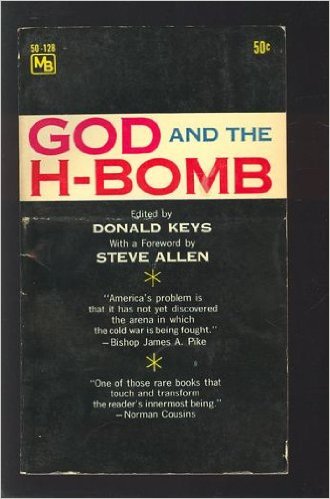
In 1961, a book called God and the H-Bomb was published. It’s not in print, but you might find a copy used or in a library, as I did a few years ago. The cover carries this question: “What counsel do our spiritual leaders offer in response to mankind’s greatest challenge?”

The roster of contributors is an impressive list of thinkers, some of whom are still recognized names, some less familiar. Paul Tillich, Martin Buber, Pope Pius XII, and so on.

We don’t see many—any—religious and spiritual leaders interviewed about the North Korean test, about the Iran deal, or about any Bomb related stories. Except for those religious and spiritual leaders with political strategy in mind or a political axe to grind.

That’s not what this 55-year-old book is about. It is about the moral and spiritual dimensions of the H-Bomb. That is reflected in the titles of the pieces. The power of self-destruction. War and Christian conscience. Fifteen years in hell is enough. Thy neighbor as thyself. The road of sanity.

The foreword is by Steve Allen, who is a little remembered as a significant television personality, but less as one of the most entertaining and brilliant public intellectuals of the middle twentieth century. Here’s what he writes:

That our nation is in the throes of moral collapse of serious dimensions is, apparently, no longer a debatable conclusion. Liberal and conservative spokesmen vie to see who shall express the conviction most vigorously. Churchmen and secularists, too, agree that we have fallen upon evil days. These various groups naturally differ as to the reasons for the situation, but that it exists no one seems to doubt….

Will our nation be guided in this dread hour by the moral code it professes to honor?

Will it?

Ken Griffey Jr. in the Baseball Hall of Fame

Ken Griffey Jr.

You probably don’t care that much about baseball. And I’ve been writing less and less about it, though it remains by far the greatest of our popular team sports, even if football has sort of taken over as America’s game. More’s the pity, as we seem to have chosen brute force in the service of skill and strategy over grace and talent actually forbidden to collide or be gratuitously aggressive.

Ken Griffey Jr. is going to the Baseball Hall of Fame. The official announcement will come late today. There will be plenty of stories to explain why and what it means, and you might enjoy reading a few of them.

He was known as Junior, in part to distinguish him from his baseball-player father, Ken Griffey Sr. If a son ever exceeded his father, exceeded even the highest expectations, and exceeded just about everybody else who played the game, Junior is it.

Read the stats. Watch the videos. And remember that just before baseball was mired in lies and controversies about stars succeeding by using performance enhancing drugs, there were a few actual supermen who did it themselves. Those who could do it all, including possessing the perfect swing. Junior was a cultural hero because he was both incredibly talented (literally, you couldn’t believe it) and so very cool. Actually, he was more like a cross between Superman and Batman.

It is uplifting to know that in this world there are such people.

Bankei New Year

Nightngale

What does it matter, the new year, the old year?
I stretch out my legs and all alone have a quiet sleep
Don’t tell me the monks aren’t getting their instruction
Here and there the nightingale is singing: the highest Zen!

-Zen Master Bankei (1622-1693)

You don’t have be Zenish to appreciate Bankei or his New Year message.

Bankei was mostly forgotten until the 1940s, when he was rescued “from the obscurity of two and a half centuries of near-total neglect.”

This is understandable. While he was trained and respected in traditional Zen disciplines, his iconoclastic conclusion was that the teaching could be reduced to a single concept that didn’t involve those practices. He preached this to thousands of ordinary people who weren’t involved in more rigorous and formal practice:

“Unlike the other masters everywhere, in my teaching I don’t set up any particular object, such as realizing enlightenment or studying koans. Nor do I rely on the words of the buddhas and patriarchs. I just point things out directly, so there’s nothing to hold onto, and that’s why no one will readily accept [what I teach]. To begin with, those who are wise and learned are obstructed by their own cleverness and calculation, so for them it’s impossible to accept. On the other hand, there are lots of ignorant women who can neither read nor write, who haven’t any special ability and can’t be pushed on to become Zen masters, but possess a truly heartfelt realization and don’t engage in intellectualizing.”

Is it any wonder that conventional teachers might be resistant and challenged enough to leave Bankei behind?

We will not leave Bankei behind. This year, he says, stretch your legs out, have a quiet sleep, listen to the nightingale singing. It is the only instruction you need.

Happy New Year.