Bob Schwartz

Hasidic Tales of the Holocaust

Hasidic Tales of the Holocaust

For International Holocaust Remembrance Day, this story from Hasidic Tales of the Holocaust by Yaffa Eliach.


Good Morning, Herr Müller

Near the city of Danzig lived a well-to-do Hasidic rabbi, scion of prominent Hasidic dynasties. Dressed in a tailored black suit, wearing a top hat, and carrying a silver walking cane, the rabbi would take his daily morning stroll, accompanied by his tall, handsome son-in-law. During his morning walk it was the rabbi’s custom to greet every man, woman, and child whom he met on his way with a warm smile and a cordial “Good morning.” Over the years the rabbi became acquainted with many of his fellow townspeople this way and would always greet them by their proper title and name.

Near the outskirts of town, in the fields, he would exchange greetings with Herr Müller, a Polish Volksdeutsche (ethnic German). “Good morning, Herr Müller!” the rabbi would hasten to greet the man who worked in the fields. “Good morning, Herr Rabbiner!” would come the response with a good-natured smile.

Then the war began. The rabbi’s strolls stopped abruptly. Herr Müller donned an S.S. uniform and disappeared from the fields. The fate of the rabbi was like that of much of the rest of Polish Jewry. He lost his family in the death camp of Treblinka and, after great suffering, was deported to Auschwitz.

One day, during a selection at Auschwitz, the rabbi stood on line with hundreds of other Jews awaiting the moment when their fates would be decided, for life or death. Dressed in a striped camp uniform, head and beard shaven and eyes feverish from starvation and disease, the rabbi looked like a walking skeleton. “Right! Left, left, left!” The voice in the distance drew nearer. Suddenly the rabbi had a great urge to see the face of the man with the snow-white gloves, small baton, and steely voice who played God and decided who should live and who should die. He lifted his eyes and heard his own voice speaking:

“Good morning, Herr Müller!”

“Good morning, Herr Rabbiner!” responded a human voice beneath the S.S. cap adorned with skull and bones. “What are you doing here?” A faint smile appeared on the rabbi’s lips. The baton moved to the right—to life. The following day, the rabbi was transferred to a safer camp.

The rabbi, now in his eighties, told me in his gentle voice, “This is the power of a good-morning greeting. A man must always greet his fellow man.”

Based on my conversation with an elderly Hasidic personality.


In the literature of the Holocaust, Hassidic Tales of the Holocaust stands alone. As the publisher describes it, “Derived by the author from interviews and oral histories, these eighty-nine original Hasidic tales about the Holocaust provide unprecedented witness, in a traditional idiom, to the victims’ inner experience of “unspeakable” suffering. This volume constitutes the first collection of original Hasidic tales to be published in a century.”

As the author writes in her Foreword:

The Hasidic tale of the Holocaust is rooted in the Auschwitz reality, yet it soars to heaven and higher. It can carry the faithful above pits filled with bodies. Despite Auschwitz, the tale still expresses belief that man is good and capable of improvement; it can restore order to a chaotic world and offer unlimited freedom to the creative mind attempting to come to terms with the Holocaust. Its rich Jewish heritage and European tradition make it a unique genre of modern literature. The tales in this collection completed a full cycle from documentation to art to documentation and back to art. For in the beginning there was a tale.

There are many other books that will tell you about the history of the Holocaust. There are few other books that so deeply and creatively offer its soul.

Making Your Mind

When you wake up
What is there to do
With your rumpled bed
Sheets twisted
Pillows tossed?
Do you make it immediately,
So orderly that it appears
Never to have been slept in?
Do you casually throw
The pieces in place?
Or do you leave it
As a recording
To be resumed and remixed
Yet again
The next night?

Bernie Sanders Is Barry Goldwater

Bernie Sanders for the Democrats is what Barry Goldwater was for the Republicans.

In the short run that might make the current generation of Democrats unhappy. In the long run, they should ask the Republicans how that turned out.

This is how it turned out. An unlikely, marginalized, and idealistic candidate tried to remind a party of its deepest philosophical roots. He won the party’s nomination for President, against all odds and against the wishes of many in the party, who believed he would lead them to total and inglorious defeat. Which he did.

Barry Goldwater also won. It is understandable that the Republican Party lionizes Ronald Reagan as its hero, model and godfather, since Reagan went on to serve two inspiring terms as President. But it was Goldwater, that embarrassment to some in 1964, who inspired Reagan himself and that first young generation of modern Republican conservatives (including Hillary Clinton, who began her political involvement as a Goldwater Girl).

We don’t know how the Bernie Sanders adventure turns out, either in the upcoming caucuses and primaries or at the convention. He is just as unlikely, marginalized and idealistic as Goldwater, and maybe less likely to win the nomination.

But in the long run, progressives who have been sidelined by the siren song of unwavering pragmatism—politics as the art of the possible—may be the winners. A new generation of genuine and fearless progressives may be born, even as the unlikely messenger is pushed aside.

In the words of Barry Goldwater, and as Bernie Sanders might also say:

“And let me remind you also that moderation in the pursuit of justice is no virtue!”

Trump: Psycho Killer q’est-ce que c’est?

Stop making sense

There are lots of things left to say about Donald Trump. But say it once, why say it again?

Which segues into the song I think fits Trump pretty well. Maybe not as well as one of those Trump suits (the kind Macy’s stopped selling, not the kind that Trump has filed or had to defend, and not the kind in bridge).

I admit I can’t quite explain how it fits. But when I listened this morning to Psycho Killer by Talking Heads, I spontaneously thought “Donald Trump!”

I hate people when they’re not polite.

Listen here.

And here are the lyrics:

I can’t seem to face up to the facts
I’m tense and nervous and I
Can’t relax
I can’t sleep ’cause my bed’s on fire
Don’t touch me I’m a real live wire

Psycho Killer
Qu’est-ce que c’est
fa fa fa fa fa fa fa fa fa far better
Run run run run run run run away

You start a conversation you can’t even finish it.
You’re talkin’ a lot, but you’re not sayin’ anything.
When I have nothing to say, my lips are sealed.
Say something once, why say it again?

Psycho Killer,
Qu’est-ce que c’est
fa fa fa fa fa fa fa fa fa far better
Run run run run run run run away

Ce que j’ai fais, ce soir la
Ce qu’elle a dit, ce soir la
Realisant mon espoir
Je me lance, vers la gloire … OK
We are vain and we are blind
I hate people when they’re not polite

Psycho Killer,
Qu’est-ce que c’est
Run run run run run run run away

Notes:

For those who don’t know Talking Heads, Rock Hall inductees since 2002, please investigate.

For those who don’t know French, “Q’est-ce que c’est?” means “What is this?” And the French lyrics mean:

What I did, that evening
What she said, that evening
Fulfilling my hope
Headlong I go towards the glory… OK

First Music of the Morning

Penguin Cafe Orchestra

I don’t listen to music very first thing in the morning. There’s quiet, until I start making breakfast.

And then, in the kitchen, it’s finding the right music, le musique juste. Here is a very small sample from the list. All are very short, all without words or voices.

Penguin Cafe Orchestra, Perpetuum Mobile

This is what joy sounds like. Who doesn’t need a little unconditional unmitigated joy? Top of the list.

Bill Evans, Peace Piece

This may seem a little too laid back for trying to get energized. It is low-key and lovely, until Evans throws in some equally low-key jazz dissonance. Just enough to remind us that if we are able, the day can have plenty of the peace we want, but there’s bound to be a few strident notes—all of which can be resolved.

Aaron Copland, Fanfare for the Common Man

If you believe you are about to conquer your day, or conquer the world, this is your anthem—whether you are a common or uncommon person. You can take on anything. Caustion: Do not mix with too much espresso.

Erik Satie, Trois Gymnopedies: Gymnopedie No. 1

Erik Satie called what he wrote “furniture music,” meaning it was just there, but not at all unuseful, unstyled, unformed or uncreative. Minimalist music and ambient music are its descendants (not to be confused with elevator music, which is unuseful, unstyled, unformed and uncreative). This is about two minutes of the finest furniture you can sit on to start your day.

Trump: Who’s the Wack Job Now?

Yesterday Donald Trump called U.S. Senator Bernie Sanders “a wack job.” He has also called U.S. Senator Ted Cruz “wacko” multiple times. Along with all his other free association invective, versions of “crazy” seem to be Trump favorites.

Back in November I wrote a post gently inquiring about Trump’s mental health. Now I discover that at the same time, actual psychiatrists and psychologists were considering the same thing.

Is Donald Trump Actually a Narcissist? Therapists Weigh In! appeared in Vanity Fair. Professionals raised genuine concerns that Trump’s history and his behavior during the campaign reflect a psychological shortfall, not an ideological or policy one. A shortfall big enough to put in question his fitness for the job he is seeking (and that he believes only he can succeed at).

As an observer, it isn’t hard to see some projection possibly going on here. Setting aside the lack of civility or respect in these accusations, neither Sanders nor Cruz nor any of the other “wack jobs” Trump finds are actually mentally unhealthy. Extreme, maybe, and not to Trump’s liking, but not crazy. Trump, on the other hand, may be revealing what he sees in the mirror. Besides a President.

Breaths

Breaths

The pain then and now
The troubles then and now
Are so many
That all the breaths
Past present and future
Won’t blow them away.
Yet in the death
Between breaths
Where are they now?

New York Daily News Wins Pulitzer Prize for Trump-Palin Front Page

I'm With Stupid!

There is no Pulitzer Prize for newspaper front pages. And if there was, the New York Daily News is not going to win it. Too bad.

“I’m with stupid!” Sarah Palin pointing at Donald Trump. Three words. One photo. It does what media outlets continue to spend hours and pages on, while avoiding the obvious in the name of fair-mindedness—or for ratings and circulation. Or to avoid insulting a future President.

Journalism schools will not use this as a model of anything. We do need high-minded and thoughtful analysis. But once in a while, you’ve just got to cut through the blah-blah-blah and get to the point.

Hermitage

Thomas Merton hermitage

Four Walls

Four walls
Three doors
One window
One ceiling
One floor.
How simple
How deep.
Walls layered
And filled.
Behind two doors
Filled too.
One door
Is different.
Goes out
Comes in.
Out there
The same.
In here
The same.
But not.

Hermitage has been in and on my mind. While not exactly a hermitage, the poem above describes the room in which I write.

When I first started reading Thomas Merton, I learned about his building a hermitage on the grounds of the Kentucky abbey where he lived. Merton was a sublime conundrum, who committed himself to relative silence and disciplined orthodoxy as a monk, yet whose spirit (the Spirit) would not allow him to be quiet and stop exploring. So he wrote and discovered. Thank goodness for us.

Sandokai is a famous poem by the Chinese Ch’an (Zen) Master Shitou Xiqian (700-790), who is known in Japanese as Sekito Kisen. I have long been reading and studying this, as have many Zen students. Of all the essential texts available, there are few more concisely powerful than Sandokai.

There is another poem by Sekito that is a little less known, but equally compelling. It is a description of his hermitage, a grass hut. There, he tells us, is nothing and everything.

Song of the Grass Roof Hermitage
by Shitou Xiqian

I’ve built a grass hut where there’s nothing of value.
After eating, I relax and enjoy a nap.
When it was completed, fresh weeds appeared.
Now it’s been lived in – covered by weeds.

The person in the hut lives here calmly,
Not stuck to inside, outside, or in between.
Places worldly people live, he doesn’t live.
Realms worldly people love, he doesn’t love.

Though the hut is small, it includes the entire world.
In ten square feet, an old man illumines forms and their nature.
A Great Vehicle bodhisattva trusts without doubt.
The middling or lowly can’t help wondering;
Will this hut perish or not?

Perishable or not, the original master is present,
not dwelling south or north, east or west.
Firmly based on steadiness, it can’t be surpassed.
A shining window below the green pines –
Jade palaces or vermilion towers can’t compare with it.

Just sitting with head covered, all things are at rest.
Thus, this mountain monk doesn’t understand at all.
Living here he no longer works to get free.
Who would proudly arrange seats, trying to entice guests?

Turn around the light to shine within, then just return.
The vast inconceivable source can’t be faced or turned away from.
Meet the ancestral teachers, be familiar with their instruction,
Bind grasses to build a hut, and don’t give up.

Let go of hundreds of years and relax completely.
Open your hands and walk, innocent.
Thousands of words, myriad interpretations,
Are only to free you from obstructions.
If you want to know the undying person in the hut,
Don’t separate from this skin bag here and now.

(from Taigen Daniel Leighton, Cultivating the Empty Field)

Donald Trump Wants to Make the Bible Great Again!

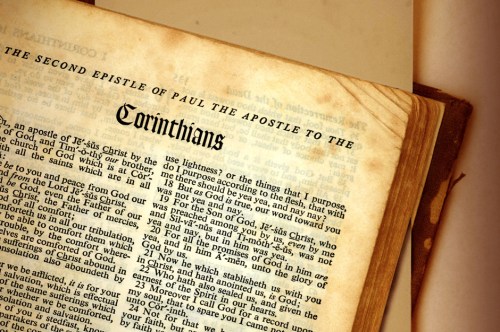
2 Corinthians

Donald Trump spoke to an assembly of students at Liberty University, one of the best-known evangelical colleges in the country. He quoted a Bible passage to show his depth of Christian faith and knowledge.

In doing that, he mispronounced the name of the New Testament book “2 Corinthians” as “Two Corinthians.” It is in fact universally called “Second Corinthians.” Anyone who has glancing familiarity with the Bible knows that, including five-year-olds in Sunday School. Every time there is a numbered series of books (such as 1 Kings and 2 Kings in the Old Testament, etc.), they are called by the ordinal number (First, Second).

Does this prove that Trump has little familiarity with the Bible? Yes. Does this prove that he is willing to cynically use faith as a tool to “close the deal” on the Republican nomination? Yes. Will this affect his support among evangelical Christians, Christians in general, or people of faith? Who knows?

Here’s the thing. It was no mistake.

Trump may not know much about the Bible or about the Presbyterian Church he identifies himself as belonging to. But he knows a “not great” situation when he sees it. Calling these books “First” or “Second” makes no sense. Plus, it’s a waste of time and breath. Everyone knows that Trump is all about making sense and not wasting breath.

And so, this is part of his strategy to make everything terrific. He wants to change the way people have been referring to the Bible for centuries.

He wants to make the Bible great again! Who can blame him? Thank you, Donald.