Bob Schwartz

Month: October, 2016

No Photos of Donald Trump Standing with or Hugging Republican Women Governors, Senators and House Members

Women for Trump

This was supposed to be a post containing photos of Donald Trump hugging, or just standing with, Republican women Governors, Senators and House Members. The point is that these women will have to hug, or just stand with, Donald Trump if he becomes President, because he will be the leader of their party.

I can’t, however, because I was unable to find almost any such photos. Why do you think that is?

Note: The photo above is from the Trump campaign website. The page for these Women for Trump shirts includes this:

Please refer to Fitting Guide when ordering; these are very form fitting shirts.

Trump and Triumph: The Insult Comics

Triumph

Donald Trump said Wednesday that derogatory statements he has made toward women were all for the sake of “entertainment” and did not reflect his true feelings. “A lot of that was done for the purpose of entertainment; there’s nobody that has more respect for women than I do,” the real estate mogul told Las Vegas’ KSNV-TV.

Or, as Triumph the Insult Comic Dog would say: “I keed. I keed.”

The first thought—the only rational thought—is that Trump considers himself a sort of insult comic. In his day, Don Rickles entertained millions by unmercifully insulting celebrities. In real life, it is reported that Rickles was actually a sweet guy.

Today, if you think of insult comics, the one that comes to mind is Triumph. Triumph is outrageously entertaining, because he is funny, he speaks with a Russian accent, he knows no limits, he is a dog, he is a puppet, and he smokes a cigar. And because his catchphrase is the perfect exclamation for any insult: “I poop on you.”

And now here’s the really weird thing about thinking of Trump as Triumph: they share the same letters in their name. Seriously. T-R-U-M-P is found in both Trump and Triumph.

Is it possible that somebody is trying to tell us something? I would like to think that this is absurd, but given the way things are going with the campaign, is anything really absurd?

Days of Random Awe – Day 4: Koheleth/Ecclesiastes 11

Utter futility!—said Koheleth—
Utter futility! All is futile!
Koheleth/Ecclesiastes 1:2 (New Jewish Publication Society translation)

The random chapter of Tanakh for this Day 4 of the Days of Awe is from the Book of Ecclesiastes, known in Hebrew by the name of the sage it is attributed to, Koheleth.

This book is unique in the Tanakh and uniquely troublesome for some rabbis and biblical interpreters. The conventional system of rewards and punishments seems, to a certain extent, to have been thrown out the window. Or at least put in perspective.

Here is Chapter 11:

Send your bread forth upon the waters; for after many days you will find it. Distribute portions to seven or even to eight, for you cannot know what misfortune may occur on earth.

If the clouds are filled, they will pour down rain on the earth; and *if a tree falls to the south or to the north, the tree will stay where it falls. If one watches the wind, he will never sow; and if one observes the clouds, he will never reap. Just as you do not know how the lifebreath passes into the limbs within the womb of the pregnant woman, so you cannot foresee the actions of God, who causes all things to happen. Sow your seed in the morning, and don’t hold back your hand in the evening, since you don’t know which is going to succeed, the one or the other, or if both are equally good.

How sweet is the light, what a delight for the eyes to behold the sun! Even if a man lives many years, let him enjoy himself in all of them, remembering how many the days of darkness are going to be. The only future is nothingness!

O youth, enjoy yourself while you are young! Let your heart lead you to enjoyment in the days of your youth. Follow the desires of your heart and the glances of your eyes—but know well that God will call you to account for all such things—1and banish care from your mind, and pluck sorrow out of your flesh! For youth and black hair are fleeting.

The Jewish Study Bible explains:

His [Koheleth’s] observations are bound together by certain fundamental themes. The first is expressed by the term “futility” (hevel). For Koheleth, this is foremost the inability of humans to make sense of the world around them—to see a coherent pattern, a plan to their lives and to nature, in the sense of a movement toward lasting goals, a line of development or progress….

But the human ability to discern what these all are is frustrated, he argues, again and again, as evident by the fact that the traditional doctrine of reward and punishment for the good and the wicked does not appear to work. In this regard, Koheleth is arguing against the sort of position evident in the book of Deuteronomy or the bulk of Proverbs, for which the covenant tradition and experience provide certainty about what God demands of humans and so about His reward and punishment justice.

The one thing that is clear for Koheleth is death. It is the final point in each one’s maʿaseh, the one immutable event in life that every human, animal, and other organism must succumb to, and that cuts across, therefore, all categories of morality, class and being. If there is any survival beyond death, either physically or in terms of memory and influence, humans cannot know this, and so cannot rely on it. What is left to humans, then, as Koheleth sees it—though he does raise an occasional doubt—is principally to enjoy their toil while they are alive….

The capacity to discern all of this—to understand what can be known and what cannot—is for Koheleth the task of wisdom. Wisdom, therefore, is most effective when it is used to clarify its own limits.

This does not suggest some sort of libertine, hedonistic nihilism. In this respect, Koheleth reflects a very modern perspective that, as with the Book of Job, offers something like divine existentialism. Just because you stop trying to make sense, there is still meaning. But that meaning may be inherently hidden in the phenomena, and very different from the external order and programs others try to impose on that meaning—and on us. Compassion and generosity may be required of us, and we may seemingly be rewarded for their doing and punished for their lack, but it is ultimately the facts of life and death, and of futility, that are their source.

Another Cool Way to Show Support for Our Veterans

IAVA Lifeline Flex

I’ve written a number of times before about veterans issues and about the Iraq & Afghanistan Veterans of America (IAVA), which last month sponsored a televised Commander-in-Chief Forum featuring the presidential candidates.

It is an old song, but worth repeating. Our treatment of those we have asked to fight is a national shame. If we don’t want to fight and defend, and don’t ask others to do the job for us, fine. Peace is wonderful. But once we ask, we have to provide virtually infinite support for those who answer. This should be at the top of any policy priority list, because it is a moral test, not a partisan talking point. For a grade, I’d consider giving us an E for Effort, but really, it’s more like an F.

If you want to show your support, IAVA has a very cool and inexpensive wearable. It’s the IAVA Lifeline Flex:

IAVA Lifeline Flex
$14.99

Iraq & Afghanistan Veterans of America (IAVA) Lifeline Flex in Night Vision Yellow and Black with engraved logo on a metal toggle clasp. Hand-wound from the same 550 lb tested parachute chord used in WWII to attach men to their chutes, these cuffs give you up to 15ft of usable paracord when unwound. Not just an all purpose survival tool, the 550 cord also looks killer on your wrist. Don’t leave home without one of these killer bracelets.

ITEM DETAILS:
Hand-wound from military grade 550 cord
One size fits all “Flex” interior with IAVA closure clasp

19 things Donald Trump knows better than anyone else, according to Donald Trump

Normally, I would quote a little bit of an article, and provide a link to the whole thing.

19 things Donald Trump knows better than anyone else, according to Donald Trump by Aaron Blake at the Washington Post today is simply too amazing for that. So the link is above, but here it is in its entirety:

I understand the tax laws better than almost anyone, which is why I’m the one who can truly fix them,” Donald Trump claimed Monday in Colorado.

It is one of many issues on which Trump is one of the world’s foremost experts, according to Trump. In fact, you might say he’s the best at being a self-proclaimed expert.

Below is a list of the many things about which Trump says he knows more than just about anybody. Even for a guy who’s fond of hyperbole, it’s a lot to take in.

1) Renewables

“I know more about renewables than any human being on Earth.” — April 2016

2) Social media

“I understand social media. I understand the power of Twitter. I understand the power of Facebook maybe better than almost anybody, based on my results, right?” — November 2015

3) Debt

“Nobody knows more about debt. I’m like the king. I love debt.” — May 2016

4) Taxes, again

“I think nobody knows more about taxes than I do, maybe in the history of the world. Nobody knows more about taxes.” — May 2016

Donald J. Trump ✔ @realDonaldTrump
I know our complex tax laws better than anyone who has ever run for president and am the only one who can fix them. #failing@nytimes
7:22 AM – 2 Oct 2016
15,459 15,459 Retweets   41,208 41,208 likes

“Nobody knows more about taxes than I do — and income than I do.” — May 2016

5) Banking

“Nobody knows banking better than I do” — February 2016

6) Wall Street bankers

MATT LAUER: You’re a guy who said you know the Wall Street bankers better than anyone.

TRUMP: Better than anyone.

— April 2016 on NBC’s “Today” show

7) Money

“I understand money better than anybody. I understand it far better than Hillary, and I’m way up on the economy when it comes to questions on the economy.” — June 2016

8) The U.S. system of government

“I think nobody knows the system better than I do.” — August 2016

“I am a person that used to be establishment when I’d give them hundreds of thousands of dollars. But when I decided to run, I became very anti-establishment, because I understand the system than anybody else.” — July 2016

“Nobody knows the system better than I do.” — April 2016

9) Campaign contributions

“I used to be, George, the fair-haired boy — you know, when I was a contributor. I know more about contributions than anybody.” — November 2015

10) Politicians

“Nobody knows politicians better than Donald Trump.” — February 2016 rally

11) Sen. Cory Booker

Donald J. Trump ✔ @realDonaldTrump
If Cory Booker is the future of the Democratic Party, they have no future! I know more about Cory than he knows about himself.
10:14 PM – 25 Jul 2016
10,079 10,079 Retweets   34,725 34,725 likes

(We’re putting this on the list assuming that nobody ELSE knows more about Booker than Booker, which would make Trump the world’s foremost non-Cory Booker expert on Cory Booker.)

12) Trade

“Nobody knows more about trade than me.” — March 2016

13) Jobs

Donald J. Trump ✔ @realDonaldTrump
I hope all workers demand that their @Teamsters reps endorse Donald J. Trump. Nobody knows jobs like I do! Don’t let them sell you out!
5:03 PM – 8 Jan 2016
2,170 2,170 Retweets   5,972 5,972 likes

14) Infrastructure

“Nobody in the history of this country has ever known so much about infrastructure as Donald Trump.” — July 2016

15) The military

“There’s nobody bigger or better at the military than I am.” — June 2015 Fox News interview

16) ISIS

“I know more about ISIS [the Islamic State militant group] than the generals do. Believe me.” — November 2015

17) Defense — and offense

“So a general gets on, sent obviously by Obama, and he said, ‘Mr. Trump doesn’t understand. He knows nothing about defense.’ I know more about offense and defense than they will ever understand, believe me. Believe me. Than they will ever understand. Than they will ever understand.” — July 2016

18) The ‘horror of nuclear’

“There is nobody who understands the horror of nuclear more than me.” — June 2016

19) The visa system

“Because nobody knows the system better than me. I know the H1B. I know the H2B. Nobody knows it better than me.” — March 2016

© 2016 The Washington Post

Poem, Joke, Etc.: Confused Birds

Confused Birds

These birds are confused
Not angry
Wondering where
The cold winds are.
Exulting in
Extended summer.
What’s time to a bird
Or me?

The line “What’s time to a bird” is borrowed from a favorite joke with a surprisingly philosophical punch line. It goes something like this:

A guy is driving along a country road. He sees a farmer under an oak tree, holding up a pig so the pig can eat acorns. The guy stops. “You know,” the guy says, “it would be a lot easier and take a lot less time if you just shook the tree and let the acorns fall to the ground.” “Maybe,” says the farmer, “but what’s time to a pig?”

More about birds:

In the sky a bird was heard to cry.
Misty morning whisperings and gentle stirring sounds
Belied a deathly silence that lay all around.
Hear the lark and harken to the barking of the dog fox gone to ground.
See the splashing of the kingfisher flashing to the water.
Grantchester Meadow, Pink Floyd

“Well, then, just what does it mean that everybody has the Buddha Mind?…in the course of listening to my talk, if a dog barks outside the temple, you recognize it as the voice of a dog; if a crow caws, you know it’s a crow…you didn’t come with any preconceived idea that if, while I was talking, there were sounds of dogs and birds, children or grown-ups somewhere outside, you were deliberately going to try to hear them. Yet here in the meeting you recognize the noises of dogs and crows outside and the sounds of people talking… the fact that you recognize these things you didn’t expect to see or hear shows you’re seeing and hearing with the Unborn Buddha Mind.”
From Bankei Zen: Translations from the Record of Bankei

Days of Awesome: Day 1 (Rosh Hashanah)


I brought them out of the land of Egypt and I led them into the wilderness. I gave them My laws and taught them My rules, by the pursuit of which a man shall live. Moreover, I gave them My sabbaths to serve as a sign between Me and them, that they might know that it is I the Lord who sanctify them.
Ezekiel 20:10-12 (New Jewish Publication Society translation)

Note from The Jewish Study Bible:

The Sabbath is the foundational sign of the covenant (Exod. 20.8–11; 31.12–17). Scholars have suggested that the Sabbath became particularly significant in the exile, as holy time replaced the vacuum of holy space (the Temple); this might explain why the Sabbath plays such a significant role here. As in Exod. 31.13, 17 (from the Priestly tradition), it is viewed as a sign, namely a symbol acknowledging God as Creator.

Here we are confronted with the phenomenon at the heart of this holiday. At the heart of every holiday. At the heart of religion and reality itself. We are concerned with space. We are concerned with being. We are concerned with time too. But we may not be properly concerned, in a balanced way that accounts for time, space and being.

We can rule space, or at least pretend to. If you visit New York or other great cities, you see how people have shaped space to their liking and purposes. But where in New York or elsewhere have even the richest and most powerful ultimately shaped time? We can mark time, but do we understand? To help us understand, time is set aside. It may be by God, it may be by our society or community, it may be by and for those close to us.

The Sabbath each week, and the Days of Awe each year, are set aside to be different than the other days of the week or of the year. Different in fact than any other days of eternity. In part to remind us of present eternity.

For more, see The Sabbath by Abraham Joshua Heschel and The Time-Being by Zen Master Dogen, which can be found in Enlightenment Unfolds.

This is the first post in a very small project/experiment in random wisdom I call The Days of Awesome. In addition to the standard and traditional forms of worship and contemplation associated with the Jewish High Holy Days (also known as Days of Awe), each day of the holiday I will be studying a randomly selected chapter of the Tanakh (also known as the Jewish Bible or the Old Testament), which has 39 books containing a total of 929 chapters.

Among other things, this is inspired by the I Ching and by social theorist and philosopher Gregory Bateson, who is quoted as saying “I am going to build a church someday. It will have a holy of holies and a holy of holy of holies, and in that ultimate box will be a random number table.”

Live Streaming: High Holy Days at Central Synagogue

Central Synagogue

Central Synagogue in New York is one of the great synagogues and congregations in America.

If you are not attending High Holy Days services in-person anywhere, for whatever reason (don’t usually attend, not convenient, not Jewish, etc.), here is your opportunity to join in the services at Central Synagogue. Without leaving the comfort of wherever you have your PC, tablet or phone. For as little or as long a visit as you like.

Central Synagogue live streams its services. Here is just a partial schedule. (You can see the complete schedule here.) All times Eastern Time.

Erev Rosh Hashanah
Sunday, October 2, 8:00pm

Rosh Hashanah
Monday, October 3
Morning Service 9:30am

Kol Nidrei
Tuesday, October 11
6:00pm or 8:00pm

Yom Kippur
Wednesday, October 12
Morning Service 10:45am
Afternoon Service 3:30pm

No prayer books? No problem. You can download those from Central Synagogue too.

Rosh Hashanah Prayer Book

Kol Nidrei and Yom Kippur Morning Prayer Book

Yom Kippur Afternoon Prayer Book

These are the highest of all Jewish services with the highest of all Jewish music and prayer on the highest of all Jewish holidays at one of the most extraordinary Jewish congregations with one of the most extraordinary rabbis. And all you need is a browser.

The Weird Randomness of Life

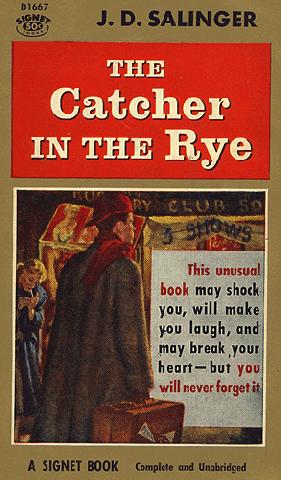
The Catcher in the Rye

I went to the gym this morning for my regular morning workout. The TV was on, but nobody was there. I saw that the remote control was gone. I climbed on a chair, pushed the power button and turned the TV off.

On further search for the remote, I discovered a handbag on the seat of stationery bike. I didn’t want to pry, but I peeked in to see if the remote had ended up there. Instead, I saw a copy of The Catcher in the Rye by J.D. Salinger.

Are people still reading The Catcher in the Rye? They should and apparently they are. It is a great and famous novel. Once upon a time controversial, when it was published in 1951, because Salinger included the word “fuck” multiple times.

After this novel, another novel, and a book of stories, Salinger disappeared, like the remote control. He is considered the most reclusive and mysterious of contemporary fiction writers. W.P. Kinsella included a character based on Salinger in his novel Shoeless Joe, which became a character in the movie version Field of Dreams. The character in the movie is played by James Earl Jones, a big black man with a booming voice. Salinger was a white Jewish man, as far as we can tell regular size and regular voice.

In high school, I wrote a book report on The Catcher in the Rye, one that was supposed to be read aloud. The English teacher was one of those young, hip women, so I thought it would be alright. I was a little concerned about some of the quotes, specifically the ones that included the word “fuck.” In that class was a girl who was a friend, not a girlfriend, who read it before class and urged me to read it just as it was. She was a popular and cool girl, but mostly I wanted to seem cool to her because she was pretty and had really big breasts.

So I read the report out loud. This is one of the passages I read. The confused and questioning adolescent Holden Caulfield says:

I went down by a different staircase, and I saw another “Fuck you” on the wall. I tried to rub it off with my hand again, but this one was scratched on, with a knife or something. It wouldn’t come off. It’s hopeless, anyway. If you had a million years to do it in, you couldn’t rub out even half the “Fuck you” signs in the world. It’s impossible.

I wasn’t particularly confused, but I was punished. Someone in the class took offense and told the principal. I was called down to his office, and despite his liking me a lot and despite my record as a star student, he believed some sort of sanction for my indiscretion was necessary. The sentence was that my entry into the National Honor Society was to be delayed one year.

If I had it to do all over again, I would know that none of this mattered. I read the book, still love it, and maybe my book report led someone else to read it. If I was somebody else, then or now, I might have said something to the principal that was clever and super-meta, such as “Go fuck yourself.” I didn’t and wouldn’t.

On the other hand, if I go down to the gym tomorrow, and still can’t find it, I might say to myself—only to myself and not out loud—“Where’s the fucking remote?”

Respected Political Journalist John Heilemann Calls Trump a Lunatic

Eclipse

You lock the door
And throw away the key
There’s someone in my head but it’s not me

John Heilemann is one of the most respected, talented and fair-minded political journalists in America.

He and his partner Mark Halperin  have written two of the most insightful and entertaining presidential campaign books of all time: Game Change: Obama and the Clintons, McCain and Palin, and the Race of a Lifetime  and Double Down: Game Change 2012. They are the Managing Editors of Bloomberg Politics. They have a weekly show about the campaign on Showtime called The Circus: Inside the Greatest Political Show on Earth. They have a daily show for Bloomberg Politics that airs on MSNBC called With All Due Respect.

It was on that show that something extraordinary happened yesterday. It was a tiny moment, one that could go unnoticed and unremarked. Talking about Donald Trump and the week he has had, Heilemann called Trump a lunatic.

One possibility is that despite the overwhelming evidence of a career marked by even-handed reporting, Heilemann has all along been a substandard journalist with a secret partisan agenda. The other possibility is that Heilemann is a great professional journalist who just finally had enough and could not avoid speaking the obvious.

In the event, hearing the word brought to mind the song I think about any time the word lunatic pops up, Pink Floyd’s Brain Damage from Dark Side of the Moon. It is the penultimate track on the album, leading into the closing Eclipse. The song is inspired in part by the tragic story of original Pink Floyd member Syd Barrett, whose genius was paired with and compromised by mental illness.

This may have absolutely nothing to do with the presidential campaign and election. Then again…

The lunatic is on the grass
Remembering games and daisy chains and laughs
Got to keep the loonies on the path

The lunatic is in the hall
The lunatics are in my hall
The paper holds their folded faces to the floor
And every day the paper boy brings more

And if the dam breaks open many years too soon
And if there is no room upon the hill
And if your head explodes with dark forebodings too
I’ll see you on the dark side of the moon

The lunatic is in my head
You raise the blade, you make the change
You re-arrange me ’til I’m sane
You lock the door
And throw away the key
There’s someone in my head but it’s not me

And if the cloud bursts, thunder in your ear
You shout and no one seems to hear
And if the band you’re in starts playing different tunes
I’ll see you on the dark side of the moon