Bob Schwartz

The Mad Dancers

The Mad Dancers
The Baal Shem Tov is the eighteenth-century founder of the Hasidic movement in Judaism. Jews and non-Jews who know the modern versions of the movement often don’t know much about its beginnings. Some of those contemporary manifestations may seem distant from the original spirit.

We have no writings by the Baal Shem Tov, so we rely on the records of his disciples, and on legends and stories that have come down the years—and that still have a remarkable power to inspire. Their authenticity is not in their being a verbatim record of what was said and what happened. Instead, they are an unmistakable reflection of a unique spiritual figure from any age or faith.

The Baal Shem Tov believed in and lived the direct experience of God everywhere in everything. Study and conventional piety took second place, which made him unpopular with the establishment, and would still today. He thought we should be outdoors in the trees, not indoors at the desks. Living in a divine state of optimism, joy and wonder was the ideal. People who live that way, of course, are remarkably hard to control.

This story is taken from The Golden Mountain (1932) by Meyer Levin.

The Mad Dancers

Already the voices of opponents were raised against the Baal Shem’s teaching, for many
rabbis could not understand his ways. Some said of him that he dishonored the Sabbath with singing and freedom, some said that his ways and the ways of those who followed him and called themselves Chassidim were truly the ways of madmen.

One of the scholars asked of the Baal Shem, “What of the learned rabbis who call this teaching false?”

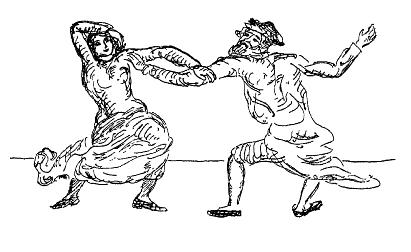
The Baal Shem Tov replied, “Once, in a house, there was a wedding festival. The musicians sat in a corner and played upon their instruments, the guests danced to the music, and were merry, and the house was filled with joy. But a deaf man passed outside the house; he looked in through the window and saw the people whirling about the room, leaping, and throwing about their arms. ‘See how they fling themselves about! ‘ he cried, ‘it is a house filled with madmen! ‘ For he could not hear the music to which they danced.”

Yom Kippur: Beyond the Self

Shofar - Chagall
No sin is so light that it may be overlooked; no sin is so heavy that it may not be repented.
Moses ibn Ezra

A person cannot find redemption until he sees the flaws in his soul, and tries to efface them. Nor can a people be redeemed until it sees the flaws in its soul and tries to efface them. But whether it be a person or a people, whoever shuts out the realization of his flaws is shutting out redemption. We can be redeemed only to the extent which we see ourselves.
Martin Buber

Should we despair of our being unable to retain perfect purity? We should, if perfection were our goal. However, we are not obliged to be perfect once and for all, but only to rise again and again beyond the level of the self.
Abraham Joshua Heschel

Bear in mind that life is short, and that with every passing day you are nearer to the end of your life. Therefore, how can you waste your time on petty quarrels and discords? Restrain your anger, hold your temper in check, and enjoy peace with everyone.
Rabbi Nachman of Breslov

Al Cheit (For Our Sins) is a central prayer of Yom Kippur. It is traditionally recited while beating our hearts for each item on the list.

It is a long list. Few will have committed all of them. Few have escaped committing any. It is just a list of examples. Your experience may vary, and there may be others you might add.

The tradition says that the Book of Life is open during the Ten Days of Awe. When the holy days end with Yom Kippur, the Day of Atonement, when the shofar sounds, the book closes and our lives will have been written for the next year. But the book is always open. This isn’t an inventory of recriminations. It is an opportunity to reflect and, if needed, to make amends. That is how, as Heschel says, “to rise again and again beyond the level of the self.” That is how we write the book.

Al Cheit
For Our Sins

For the sins we have committed through arrogance and selfishness:
For being obsessed with our own concerns,
For choosing rudeness over common courtesy,
For loving our egos.

For the sins we have committed by defrauding others:
For using people in pursuit of our ambitions,
For manipulating the love of others,
For gossiping.

For the sins we have committed through denial and deceit:
For creating theories to rationalize our behavior,
For faking emotions for our own benefit,
For using the sins of others to excuse our own,
For claiming that ends justify the means.

For the sins we have committed through greed and overindulgence:
For using force to maintain our power,
For poisoning our planet,
For remembering the price of things but forgetting their value.

For the sins we have committed through hardening our hearts:
For accepting poverty as inevitable,
For staying silent when we should speak out,
For resenting the young and ignoring the elderly,
For abandoning proper outrage.

For the sins we have committed through hypocrisy:
For condemning in our children the faults we tolerate in ourselves,
For condemning in our parents the faults we tolerate in ourselves,
For neglecting our promises.

For the sins we have committed by narrow-mindedness:
For passing judgment without knowledge,
For denying our baseless hatreds.

For the sins we have committed against You through sex and love:
For confusing love with lust,
For pursuing fleeting pleasure while disregarding lasting hurt,
For withholding affection to control the ones we love.

For all these sins, forgive us, pardon us, grant us atonement.