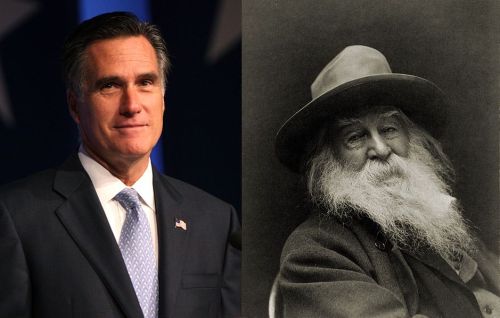
Those who love America and poetry should love Walt Whitman. So should Mitt Romney.
Just as the Civil War was a dividing line in our history, Whitman was the line in poetry and culture. His lyrical innovation and his exuberant celebration of all things human and exciting—including sex and beautiful bodies—limited appreciation by nineteenth century readers. If Whitman seemed out of place then, he is right at home now:
Of Life immense in passion, pulse, and power,
Cheerful—for freest action form’d, under the laws divine,
The Modern Man I sing.
Why should Mitt Romney care about Walt Whitman?
Whitman was more than just an expert on being himself and singing about himself. He recognized that constancy and consistency is not a part of the artist’s makeup. And so he wrote the mantra for all those who stand so accused:
Do I contradict myself? Very well, then I contradict myself, I am large, I contain multitudes.
Romney should also care as a student of the Presidency. The most memorable poems about an American President (and there are surprisingly few) were written by Whitman. On the death of Abraham Lincoln, he wrote not one but two famous elegies that are still read and recited today.
From O Captain My Captain:
O CAPTAIN! my Captain! our fearful trip is done;
The ship has weather’d every rack, the prize we sought is won;
The port is near, the bells I hear, the people all exulting,
While follow eyes the steady keel, the vessel grim and daring:
But O heart! heart! heart!
O the bleeding drops of red,
Where on the deck my Captain lies,
Fallen cold and dead.
From When Lilacs Last in the Door-yard Bloom’d:
WHEN lilacs last in the door-yard bloom’d,
And the great star early droop’d in the western sky in the night,
I mourn’d—and yet shall mourn with ever-returning spring.
O ever-returning spring! trinity sure to me you bring;
Lilac blooming perennial, and drooping star in the west, 5
And thought of him I love.
Finally, while Mitt Romney may have never read the poem I Sing the Body Electric, there is an extraordinary scene in the third verse. It is a pastoral picture of a tall older man—fifteen years older than Romney—standing with his five grown sons. He is deeply beloved for who he is and what he has done. It is not just the way that Mitt Romney wants to be seen; it may be the way he is seen by those who do know and love him:
I know a man, a common farmer—the father of five sons;
And in them were the fathers of sons—and in them were the fathers of sons.
This man was of wonderful vigor, calmness, beauty of person;
The shape of his head, the pale yellow and white of his hair and beard, and the immeasurable meaning of his black eyes—the richness and breadth of his manners,
These I used to go and visit him to see—he was wise also;
He was six feet tall, he was over eighty years old—his sons were massive, clean, bearded, tan-faced, handsome;
They and his daughters loved him—all who saw him loved him;
They did not love him by allowance—they loved him with personal love;
He drank water only—the blood show’d like scarlet through the clear-brown skin of his face;
He was a frequent gunner and fisher—he sail’d his boat himself—he had a fine one presented to him by a ship-joiner—he had fowling-pieces, presented to him by men that loved him;
When he went with his five sons and many grand-sons to hunt or fish, you would pick him out as the most beautiful and vigorous of the gang.
You would wish long and long to be with him—you would wish to sit by him in the boat, that you and he might touch each other.

 Bob Schwartz